

Yes, AiSensy does offer white label — your brand, your domain, your logo, your pricing. But the price is not published anywhere.
No setup fee, no per-number rate, no minimum. Just a “Request Callback” button. This article takes the pricing AiSensy does publish, does the arithmetic for a 50-seat agency, and gives you the ten questions to ask on that call. Checked 10 September 2026.
All prices in this article were checked on the vendors’ own live pages on 10 September 2026.
The AiSensy white label cost is the one number their partner page does not give you. AiSensy genuinely offers a white-label product — your brand, your domain, your pricing — but the AiSensy white label cost sits behind a callback form, with no setup fee, no per-seat rate and no minimum published anywhere. This guide works out what you are negotiating against, using only the prices AiSensy does publish.
- AiSensy does have white label — but not a public price
- What AiSensy actually charges on its published plans
- AiSensy’s five partner models, and which one is genuinely white label
- What the white-label option includes, and what they do not tell you
- What 50 client seats cost on AiSensy’s published pricing
- The Meta conversation cost nobody models properly
- Two things on AiSensy’s own partner page that do not agree
- WhatsApp CRMs that do publish white-label pricing
- Lion CRM white label: what it costs, and when it is the wrong choice
- Questions to ask AiSensy on the callback
- Frequently asked questions
AiSensy white label cost: real, but not published
This needs saying clearly, because a lot of comparison articles get it wrong. AiSensy, run by AiSensy Communications Private Limited, lists a White-Labelled Solution as one of five partner models. In their own words on the partner page: “Get AiSensy platform under your brand name – custom domain, logo, pricing, everything. We manage the backend, while you own the customer experience.”
So the product exists. What does not exist is a published AiSensy white label cost. Every other AiSensy plan has a rupee figure on the pricing page. The white-label tier has a “Request Callback” button and nothing else. No setup fee, no per-seat rate, no minimum client count, no contract length, no revenue-share percentage.
That is the honest position, and it is the reason this article exists. Nobody outside AiSensy can tell you what their white label costs. What we can do is take their published retail pricing, do the arithmetic properly for a 50-seat agency, and give you the floor and the ceiling of what you are negotiating against — plus the exact questions to ask when they call you back.
What AiSensy actually charges on its published plans
Everything below is from aisensy.com/pricing, in INR, on monthly billing.
| Plan | Price per month | What it includes |
|---|---|---|
| Free Forever | ₹0 | Free WhatsApp Business API on your number with no setup fee, free Blue Tick application, ability to run Meta ads, ₹50 free conversation credits |
| Basic | ₹1,500 | Broadcasting, retargeting, shared team inbox. Account owner plus five agent logins |
| Pro | ₹3,200 | Marked “Most Popular” and “Growth Marketer”. Adds scheduling, click tracking, budget analytics |
| Extra agent login | ₹750 each | Charged per additional agent beyond the included five |
| Chatbot Flows | ₹2,500 | Charged separately on top of any plan. Keyword and rule-based flows, drag-and-drop builder, cart management, catalog sharing |
| AI Chat Agent | ₹1,350 | Charged separately on top of any plan. Covers 1,000 AI messages; extra AI messages cost more |
Two things about this table matter more than the headline numbers.
First, Chatbot Flows and the AI Chat Agent are not inside any plan. They are separate line items added on top. An agency quoting “AiSensy from ₹1,500” to a client who wants an automated chatbot is quoting less than half the real figure.
Second, the agent seat is the unit that scales. The plan fee is nearly fixed; the ₹750 per extra agent is what grows with your client base. On any reseller model, that ₹750 line is the one that decides whether you have a business.
AiSensy also publishes term discounts: quarterly billing saves 5% and yearly billing saves 10%.
AiSensy’s five partner models, and which one is genuinely white label

The partner page lists five distinct arrangements. Only one of them puts your brand on the product.
- Affiliate Commission Model — 20% recurring commission on every purchase, for as long as the client stays. Your brand does not appear. The client signs up with AiSensy and knows it.
- Prime Plus Partner — a higher recurring commission than the standard affiliate rate, and it pays on Ad Credits and WhatsApp Conversation Credits as well as plan revenue. The exact percentage is not published. Still not white label; still AiSensy’s brand in front of the client.
- White-Labelled Solution — the platform under your brand name, custom domain, your logo, your pricing. AiSensy runs the backend; you own the customer experience. This is the only true white-label model of the five. Access is by callback request.
- Direct APIs Partnership — you build your own platform on AiSensy’s APIs. Their own page says this suits teams who can dedicate months of engineering. This is a product decision, not a reseller decision.
- Integration Partnership — you embed AiSensy inside a product you already sell.
For context on scale, AiSensy claims 6,000+ partners, ₹200Cr+ in revenue generated by partners, presence in 20+ countries, 30+ tech partners, and 210,000+ businesses across 68+ countries.
The practical distinction for an agency owner is simple. Options 1 and 2 pay you a slice of someone else’s revenue. Option 3 makes it your revenue, your price, your client. That difference is worth paying for — which is exactly why you need to know what it costs before you commit.
What the white-label option includes, and what they do not tell you
From the partner page, the white-label offer includes a custom domain, your logo and branding, your own pricing set by you, a backend managed by AiSensy, and the customer experience owned by you.
That is the complete published description. Everything below is not stated anywhere on the page, and you should treat each one as an open question:
- The setup or onboarding fee, if any
- The per-account or per-seat rate you pay AiSensy
- Whether pricing is a flat platform licence, a per-seat wholesale rate, or a revenue share
- Minimum client commitment or minimum monthly spend
- Contract length and notice period
- Whether Chatbot Flows and the AI Chat Agent are included in the white-label rate or still billed separately
- Whether Meta conversation charges pass through at cost or with a markup
- Who legally owns the client account and the message data
- What happens to your clients if you exit the programme
- Whether AiSensy’s name appears anywhere in the Meta embedded signup or template approval flow that the client sees
None of these are unreasonable things for a vendor to keep off a public page. Enterprise pricing is often negotiated. But it does mean that until you have had the call, you cannot build a P and L.
What 50 client seats cost on AiSensy’s published pricing

Since the AiSensy white label cost is unknown, the only useful reference point is retail. If you simply bought 50 agent seats at AiSensy’s published prices, this is what you would pay. Your white-label rate would be some undisclosed discount on these figures.
The formula for the seat cost is straightforward. The Basic plan covers the account owner plus five agent logins, so 50 agents means 45 extra seats: 45 × ₹750 = ₹33,750, plus the plan fee.
AiSensy publishes the ₹750 extra-agent rate and states the five included agents against the Basic plan. The Pro column below applies the same seat structure, which is an assumption on our part, not a published fact — confirm it on the call.
| Line item | Working | Basic (₹1,500) | Pro (₹3,200) |
|---|---|---|---|
| Plan fee | As published | ₹1,500 | ₹3,200 |
| 45 extra agent seats | 45 × ₹750 | ₹33,750 | ₹33,750 |
| Platform subtotal | Plan + seats | ₹35,250 | ₹36,950 |
| Chatbot Flows | Add-on, flat | ₹2,500 | ₹2,500 |
| Subtotal with chatbot | Subtotal + ₹2,500 | ₹37,750 | ₹39,450 |
| AI Chat Agent (1,000 messages) | Add-on, flat | ₹1,350 | ₹1,350 |
| Full stack, per month | All of the above | ₹39,100 | ₹40,800 |
| Effective cost per seat | Full stack ÷ 50 | ₹782 | ₹816 |
| Full stack, per year | Monthly × 12 | ₹4,69,200 | ₹4,89,600 |
| Per year with 10% annual discount | Annual × 0.90 | ₹4,22,280 | ₹4,40,640 |
A few observations from the working.
The seats are the cost, not the plan. On the Basic column, ₹33,750 of a ₹35,250 platform subtotal is extra agent seats. That is 96% of the platform bill. Moving from Basic to Pro adds ₹1,700 a month across 50 seats — about ₹34 per seat. Whatever you negotiate, negotiate on the seat rate.
Add-ons are flat, so they get cheaper per seat as you scale. Chatbot Flows at ₹2,500 is ₹50 per seat across 50 seats. That is one of the few things working in a reseller’s favour.
The annual discount is real money. 10% off ₹4,69,200 is ₹46,920 saved on the Basic stack. Note that the published discount applies to AiSensy’s plan pricing; whether it extends to add-ons is not specified, and Meta’s conversation charges are pass-through and would not be discounted in any case.
Now the important part. The white-label rate is a discount on these numbers, and you do not know what it is. It could be 20% off. It could be 60% off with a minimum commitment. It could be a flat platform licence with no per-seat charge at all. All three are plausible and none is published. You cannot model a business on a number nobody has told you.
The Meta conversation cost nobody models properly
Every article about WhatsApp CRM reseller margins stops at the software fee. That is the smaller number.
AiSensy passes Meta’s per-conversation charges through at these published rates: Marketing ₹1.09, Utility ₹0.145, Authentication ₹0.145, and Service conversations free.
Here is what that looks like at agency volumes.
| Conversations per month (all clients) | If all Marketing (× ₹1.09) | If all Utility or Authentication (× ₹0.145) |
|---|---|---|
| 1,000 | ₹1,090 | ₹145 |
| 5,000 | ₹5,450 | ₹725 |
| 10,000 | ₹10,900 | ₹1,450 |
| 50,000 | ₹54,500 | ₹7,250 |
| 100,000 | ₹1,09,000 | ₹14,500 |
Put that against the platform table. Fifty clients each sending 1,000 marketing conversations a month is 50,000 conversations, which is ₹54,500 a month in Meta charges alone. That is more than the entire ₹39,100 full-stack platform bill for 50 seats. The software is the minority of your cost of goods.
The ratio between marketing and utility rates is 7.5 to 1. A client whose use case is order updates, delivery notifications and OTPs costs you a fraction of a client running promotional broadcasts. If you are going to price your white-label product as a flat monthly fee per client, you are taking on that variance yourself. Most agencies that get burned on WhatsApp reselling get burned here, not on the licence fee.
One more figure for scale. The Free Forever plan’s ₹50 of free conversation credits works out to roughly 45 marketing conversations, or about 344 utility conversations. It is enough to test the plumbing, not enough to run a pilot.
Two things on AiSensy’s own partner page that do not agree
Reported neutrally, because they affect how you read the rest of the page.
The affiliate minimum payout appears as two different figures. One place on the partner page gives the minimum payout threshold as ₹999. Another gives it as ₹1999. Both were live on 10 September 2026.
The payout frequency is described two ways. One section of the page says “Monthly Payouts”. The affiliate section says payments roll out quarterly.
Neither of these is evidence of bad faith — pages get updated in pieces and stale copy survives. But if you are joining the affiliate or Prime Plus model, the payout threshold and frequency are the two commercial terms that most affect your cash flow, and they are the two that currently contradict each other. Get both confirmed in writing before you promote anything.
Alternatives that publish what AiSensy white label cost does not
Three platforms were checked on 10 September 2026. This table reflects only what those vendors publish publicly.
| Platform | White label offered | Setup fee | Per-user rate | Price published? |
|---|---|---|---|---|
| AiSensy | Yes — White-Labelled Solution, custom domain, logo, own pricing | Not publicly disclosed | Not publicly disclosed | No — callback request only |
| Wati | No white-label programme. Value-added Reseller (commission and discount) only | No joining fee for the VAR programme | Not applicable | Discount percentage not published |
| Lion CRM | Yes — partner branding, own admin panel, own selling price | $150 / $200 / $250 one-time | $3.25 / $2.60 / $1.30 per user per month | Yes — listed on the pricing page |
The point of the table is not that published pricing is automatically better pricing. AiSensy’s negotiated white-label rate could easily beat a published rate. The point is that one of these you can model this afternoon and two of them you cannot.
Lion CRM white label: what it costs, and when it is the wrong choice
Full disclosure: this is our product, and we publish the numbers because we think an agency owner should be able to build a spreadsheet without booking a call.
| Tier | One-time setup | Per user per month | Cost at 50 users per month |
|---|---|---|---|
| Starter | $150 | $3.25 | $125 |
| Growth (most popular) | $200 | $2.60 | $100 |
| Enterprise | $250 | $1.30 | $50 |
Every tier includes your own branding — name, logo and colour — your own admin panel hosted by Lion CRM, licences for your clients under your own brand, your own selling price, and support for sub-resellers. Lion CRM is built by Lotsofcode Private Limited, a Meta verified Tech Provider.
Now the part that matters more than the price.
Lion CRM is a Chrome extension for WhatsApp Web. It is not the official WhatsApp Business API. That has three consequences you must tell your clients:
- The browser has to be open for it to work. It is a tool that sits on top of a human’s WhatsApp session, not a server-side sending platform.
- There is no green tick. Official Business verification and the Blue Tick application route go through the API, not through an extension.
- It is not built for high-volume official template sending. If your client needs approved templates going out at scale, with Meta’s delivery guarantees and conversation-based billing, an extension is the wrong architecture.
For those clients, AiSensy is the better choice, and you should sell them AiSensy. A regulated lender sending authentication messages, an e-commerce brand pushing 50,000 marketing conversations a month, anyone who needs the green tick for credibility — that is API territory, and AiSensy’s published stack handles it properly.
Lion CRM fits the other half of the market: small teams, local businesses, sales desks and support desks where a few people work out of WhatsApp Web all day and need labelling, quick replies, a lead board and controlled outreach from their own number. For that buyer, an extension at $2 a user is proportionate and the API is overkill. Many agencies end up carrying both, and there is nothing wrong with that.
Questions to ask AiSensy on the callback
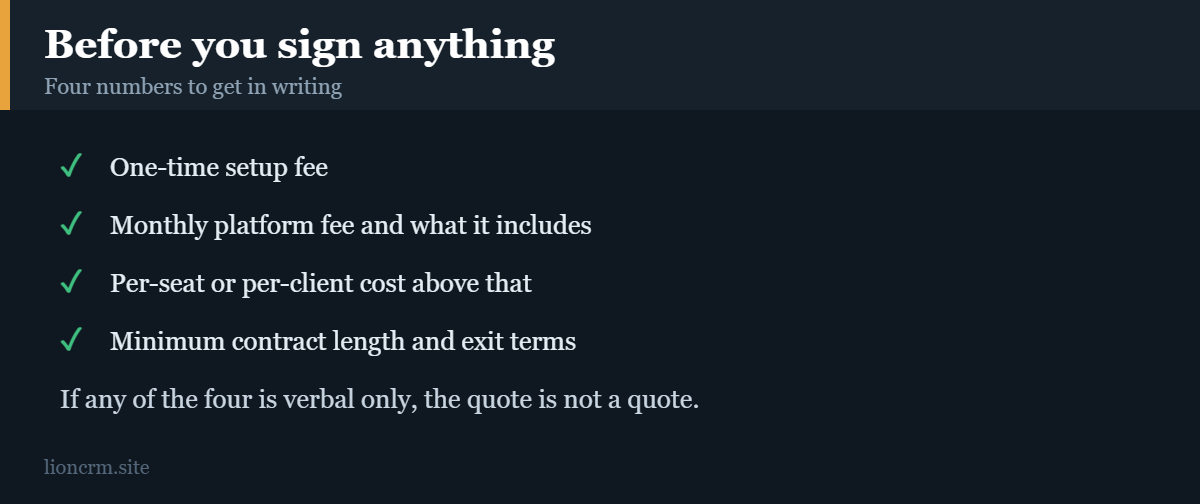
Since the AiSensy white label cost is not published, the call is the only way to get it. Go in with a list. These are the ten that decide whether the deal works.
- Is there a one-time setup or onboarding fee, and how much? Get it separated from the recurring cost.
- What exactly is the recurring charge? A flat platform licence, a per-agent-seat wholesale rate, a revenue share, or a combination. Ask them to state the model, not just a number.
- What is my wholesale per-seat rate against the published ₹750? This single figure drives your entire margin. Ask for it in writing.
- Is there a minimum commitment? Minimum number of client accounts, minimum monthly spend, or minimum contract term.
- Are Chatbot Flows (₹2,500) and the AI Chat Agent (₹1,350) included, or still billed on top? If billed on top, at what wholesale rate.
- Do Meta conversation charges pass through at cost? Confirm the ₹1.09 marketing and ₹0.145 utility rates apply unmarked-up, and ask who is invoiced for them.
- Who owns the client account and the message data? Legally, in the contract — not conversationally on the call.
- Does my client ever see the AiSensy name? Specifically during Meta embedded signup, template submission, WhatsApp Manager access, and in any system email or notification.
- What happens to my clients if I leave the programme? Can accounts be migrated to another provider, do the phone numbers and Business Manager assets stay with the client, and what is the notice period.
- Do the term discounts apply? Whether the 5% quarterly and 10% yearly savings carry into the white-label rate, and whether the price is locked for the term.
If a vendor cannot answer questions 3, 4 and 9 clearly on a first call, that is useful information in itself.
AiSensy’s white label is real and their platform is proven — 210,000+ businesses, official API, green tick, template sending at scale. For enterprise clients, that is the right answer.
The problem is that you cannot price a business around a number nobody has told you. Go into the callback with the ten questions above, get the per-seat rate in writing, and only then decide.
Sources and further reading
Every figure here was read on 10 September 2026 from AiSensy pricing and the AiSensy partner page. The Wati comparison figures come from Wati pricing.
Related reading on this site: whether a Wati white label plan exists, the Lion CRM whitelabel programme, published reseller pricing, and AiSensy alternatives compared.
Frequently asked questions
Does AiSensy offer a white-label WhatsApp CRM?
Yes. AiSensy lists a White-Labelled Solution as one of five partner models, described on their partner page as the platform under your brand name with a custom domain, your logo and your own pricing, with AiSensy managing the backend. Access is through a callback request rather than a self-serve signup.
How much does AiSensy white label cost?
The price is not published. As of 10 September 2026 there is no setup fee, per-number rate, minimum commitment or contract term listed anywhere on the AiSensy partner page, only a “Request Callback” form. The only public reference point is their retail pricing: ₹1,500 for Basic, ₹3,200 for Pro, ₹750 per extra agent, ₹2,500 for Chatbot Flows and ₹1,350 for the AI Chat Agent, each per month.
What is the difference between being an affiliate and being a white-label partner?
An affiliate refers clients to the platform and earns a commission on their spend — AiSensy publishes 20% recurring for its standard affiliate model. The client signs up with the platform directly and sees its brand. A white-label partner sells the platform as their own product under their own brand and sets their own price, which means they own the client relationship and the billing, but also carry the support load and the platform cost.
Why do most WhatsApp API providers hide their white-label pricing?
White-label deals are usually negotiated rather than listed, because the rate depends on committed volume, seat count and contract length. That is a normal commercial practice. The practical consequence for an agency is that you cannot compare providers or build a margin model until you have completed a sales call with each one.
Who pays Meta’s per-conversation charges in a white-label arrangement?
This has to be confirmed with the provider, because it is rarely spelt out publicly. AiSensy publishes Meta’s rates as pass-through at ₹1.09 for marketing, ₹0.145 for utility, ₹0.145 for authentication and free for service conversations. In a white-label setup, ask specifically whether those pass through at cost to you, whether you or the end client is invoiced, and whether any markup is applied.
What is the biggest cost an agency underestimates when reselling a WhatsApp CRM?
Conversation charges. At published rates, 50,000 marketing conversations a month costs ₹54,500 — more than the ₹39,100 monthly platform cost of a full 50-seat stack at retail. Agencies that quote a flat monthly fee per client without capping or metering conversation volume absorb that variance themselves.
Is a browser extension a valid alternative to the official WhatsApp Business API?
For some clients, yes; for many, no. An extension works on top of WhatsApp Web, so it needs a browser session open, it does not carry the official green tick, and it is not designed for high-volume approved template sending. It suits small teams working manually out of WhatsApp all day. Clients who need verified business status, server-side sending or template-based notifications at volume need the official API.
What should be in a white-label contract before you sign?
At minimum: the wholesale rate and how it is calculated, any setup fee, the minimum commitment and contract term, whether add-on modules are included, how Meta charges are billed, who legally owns the client accounts and message data, whether the provider’s brand is visible anywhere in the client-facing flow, and the exit terms — specifically whether your clients and their phone numbers can be migrated elsewhere if you leave.