

Apna brand, recurring revenue
Sell Lion CRM as your own white-label WhatsApp CRM. Your brand, your pricing, monthly recurring income from every client.
Become a Reseller on WhatsApp →View Reseller PricingSee the Admin Panel
A coaching-centre owner in Kota told me something I keep thinking about. He said his whole admissions team was already running on WhatsApp — every enquiry, every fee reminder, every batch update — but it lived inside one staff member’s personal phone. When she quit, half his follow-ups walked out the door with her. He didn’t need a fancy ERP. He needed the WhatsApp work his team was already doing to sit inside a system the institute owned. That gap is the opening, and this post is about how to fill it — both for an institute that wants the tool, and for an agency that wants to sell it as their own product.
I’m Rakshit Soni, co-founder of Lion CRM, a WhatsApp CRM Chrome extension built by LotsOfCode Private Limited for end-users and for whitelabel agency resellers. This guide has two readers in mind. If you run a coaching institute or a tuition centre, you’ll see exactly which jobs a WhatsApp CRM does for admissions, fees, and parent communication. If you sell software to local businesses, you’ll see why coaching is one of the cleanest verticals in India to resell a branded WhatsApp CRM into, and the margin math behind it. (If you’d rather watch than read, the LotsOfCode YouTube channel covers a lot of this in short videos.)
Let me start with why this vertical is such a good fit in the first place.
Why coaching institutes are a perfect WhatsApp CRM vertical
India runs one of the largest private coaching markets on earth. Think of the layers: JEE and NEET factories in Kota and Hyderabad, UPSC and banking-exam centres in every state capital, CA and CS classes, spoken-English and IELTS shops on high streets, school-tuition franchises, dance and music academies, and the neighbourhood tutor with two batches a day. The sector is worth several lakh crore rupees (tens of billions of dollars) and it keeps growing because Indian families spend on education before almost anything else.
Here’s why that matters for a WhatsApp CRM. A coaching institute is a high-touch, follow-up-heavy business. A single admission can be worth ₹40,000 to ₹2,00,000 (about $480 to $2,400) for a full course, so chasing every enquiry pays for itself many times over. The buying decision is slow and emotional — parents compare three or four centres, attend demo classes, and decide over weeks. And almost every one of those conversations already happens on WhatsApp, because that is where Indian parents and students actually reply.
So you have a high-value sale, a long follow-up cycle, and a customer base that lives inside one app. That is the exact shape of business a CRM was invented for. The only missing piece is a tool that wraps structure around the WhatsApp conversations the institute is already having. Get that right and enquiries stop leaking, fees come in on time, and the owner finally sees what their team is doing. That is the prize, for the institute and for anyone selling the institute software.
What a coaching institute actually does on WhatsApp all day
Before talking features, it helps to picture a normal day at a mid-sized centre with, say, 300 active students across a dozen batches. The front desk is messaging constantly, and almost none of it is captured anywhere useful.
A parent fills a form on the website at 11am asking about the new NEET batch. Someone needs to reply within minutes, share the fee structure, and book a demo class — but the lead sits in an inbox until evening. A student in the morning batch messages that they will miss class; the teacher sees it three hours late. The accounts person sends fee-due reminders one by one, copy-pasting the same line forty times, and still misses a dozen. After results day, the centre wants to message last year’s students about the next-level course, but the contact list is scattered across two phones and a notebook. And the owner, sitting in the back office, has no idea how many enquiries came in this week or how many turned into admissions.
Every one of those moments is a WhatsApp message that should have been a tracked action. The work is already happening. What is missing is the layer that turns scattered chats into a pipeline: a lead that gets assigned, a reminder that fires on its own, a fee notice that goes to the whole batch in one click, and a dashboard the owner can actually read. That layer is the product, whether the institute buys it directly or an agency sells it to them under its own brand.
The six jobs a coaching WhatsApp CRM has to do
If you strip the vertical down to its real needs, a WhatsApp CRM for a coaching institute has to do six concrete jobs. Anything beyond these is nice to have; anything short of these and the institute keeps leaking money.
Capture and assign every admission enquiry. When a parent messages or fills a form, the lead should land in the CRM, get tagged by course and batch, and be assigned to a counsellor — so no enquiry dies in a personal inbox.
Follow up on its own. Most admissions are won on the third or fourth touch, not the first. The CRM should send timed follow-ups after an enquiry — share the brochure on day zero, nudge about the demo class on day two, and check in after the demo — without anyone remembering to do it.
Send fee reminders to a whole batch at once. Fee collection is the single biggest admin pain in coaching. The CRM should let accounts broadcast a polite, personalised reminder to every student with a due date in one action, then track who paid.
Run class and batch updates. Timetable changes, holidays, test schedules, doubt-session links — these go to a defined batch group fast, with the institute’s name on them, not a teacher’s personal number.
Re-enroll past students. After a result or a course ends, the best leads are the students you already taught. The CRM should hold that history and let you reach the right segment when the next batch opens.
Show the owner the numbers. Enquiries this week, conversion rate, fees pending, follow-ups overdue — a simple dashboard so the owner runs the centre on data, not on a gut feeling.
Hold those six jobs in your head, because they are also the buying checklist. When an agency pitches a coaching institute, this is the list that closes the deal — and the Lion CRM dashboard maps onto all six.
Why WhatsApp beats calls, SMS and email for coaching
Coaching centres have tried other channels, and they keep coming back to WhatsApp for a simple reason: it is the only one parents and students actually read.
Phone calls feel intrusive and most go unanswered, especially during school and office hours. SMS gets ignored, lands in spam folders, and costs add up across thousands of fee reminders. Email is almost dead for this audience — a parent might check it once a week, by which time the demo-class slot is gone. WhatsApp is different. Messages are typically read within minutes, replies come back in the same thread, and you can send a fee receipt, a brochure PDF, a location pin, and a class-recording link in the channel the family already trusts.
There is a money angle too. A reminder call ties up a staff member for two minutes; a WhatsApp broadcast reaches the whole batch in seconds. A counsellor juggling fifty live enquiries on a personal phone will drop some; the same counsellor working a tagged, sorted CRM pipeline drops far fewer. The channel is not just friendlier — it is cheaper to run and easier to measure. That is why, when a coaching institute finally puts structure around WhatsApp, the admissions team usually wonders how they ever worked without it.
Try Lion CRM free for 7 days
If you run a coaching institute and you simply want the tool for your own front desk, you can start today without talking to anyone. Lion CRM is a Chrome extension that runs on top of WhatsApp Web using your existing centre number, so there is nothing to migrate and no new app for staff to learn.
Install it from the Chrome Web Store and a 7-day free trial starts automatically — no card needed. After that, the end-user plans are simple: a First Month Special at ₹99, then ₹299 per month (about $3.6), or ₹2,360 a year (about ₹197 a month) if you pay yearly. For a centre that closes even one extra admission a month because a follow-up didn’t slip, it pays for itself many times over. You can see plans and start at crm.lotsofcode.in.
If instead you are an agency and you want to sell this to coaching institutes under your own brand, keep reading — the rest of this guide is the reseller playbook, and it is where the real money in this vertical sits.
The whitelabel wedge: sell a branded CRM to coaching institutes
Now the part most people miss. Coaching is not just a great place to use a WhatsApp CRM — it is one of the best places in India to resell one as your own branded product.
Think about who already serves coaching institutes: local digital-marketing agencies running their Google and Meta ads, website developers who built their site, ed-tech consultants, and the people who sell them biometric attendance or billing software. All of them have trust and a foot in the door, and none of them currently sell the one tool the institute touches all day. If you are one of those agencies, a whitelabel WhatsApp CRM lets you add a high-margin, recurring software product to a relationship you already own.
The vertical is ideal for a reseller for three reasons. First, the institutes cluster — win one good centre in a city and its competitors hear about it, because coaching owners talk to each other. Second, the use-case is identical from one institute to the next, so your pitch, your demo, and your onboarding barely change between clients. Third, the recurring need is real: fee reminders and admissions happen every single month, so churn is low once a centre embeds the tool into its routine. A focused reseller can build a tidy book of coaching clients faster than in almost any other niche. The catch is that you can only do this if the underlying CRM is genuinely whitelabel — which most are not. So let me define that precisely.
Three coaching sub-niches worth selling into first
Coaching is not one market — it is several, and some are far easier to land as your first clients than others. If you are building a reseller book, start where the pain is sharpest and the budgets are real.
The first is competitive exam prep — JEE, NEET, UPSC, banking, and CA or CS classes. These centres run the highest-value admissions, often ₹50,000 to ₹2,00,000 (about $600 to $2,400) per course, so a single saved enquiry pays for the software for a year. They also chase leads aggressively across a long season, which is exactly the work a follow-up pipeline automates. Walk in here with the admission-enquiry and demo-booking story and the owner does the math instantly.
The second is skill and language training — spoken English, IELTS and PTE, coding bootcamps, and design or digital-marketing academies. These run rolling batches that start every few weeks, so admissions never stop and the follow-up engine runs all year. Their buyers are younger and almost entirely on WhatsApp, which makes the channel an even easier sell. The recurring batch cadence is what keeps your churn low.
The third is school tuition and franchise centres — after-school tuition chains, hobby academies, and neighbourhood centres with a few hundred students. The individual deal is smaller, but they cluster tightly in residential areas and talk to each other, so one happy centre becomes a referral engine for the whole locality. Fee reminders and parent updates are their daily pain, and that is the cleanest entry pitch of all. Start with whichever of these three you already have a relationship in, prove the six jobs on one centre, and let the cluster effect carry you to the next.
What whitelabel really means here
The word whitelabel gets thrown around loosely, so it pays to be exact, because a vague version will cost you margin and brand equity later.
A genuine whitelabel WhatsApp CRM lets you do four things. You rebrand the product end to end — name, logo, colours, support details, and your own web address — so the coaching institute sees your agency’s brand on every screen, never the vendor’s. You set your own prices and bill the institute directly, keeping the full spread. You own the customer relationship and the data attached to it. And you lean on the vendor only for the infrastructure underneath, so you run no servers, no DNS, and no SSL, and you build no app.
Many tools offer a watered-down version of this. A Cloud API CRM might give you a partner discount or a referral cut, but the institute still logs into a screen that says the vendor’s name, so you are selling someone else’s brand. A reseller dashboard might let you add seats, yet the product a teacher touches is still branded by the maker. Those are useful, but they are not whitelabel, and they do not build the brand equity that makes your agency worth more every year.
The test is simple. Can the coaching institute tell who actually makes the software? If yes, it isn’t whitelabel. If every screen the front desk touches says your brand, and you didn’t write a line of code, then you own something that compounds across your whole client book. That is the difference between earning a referral fee once and owning a software brand in your city.
The per-message meter that eats your margin in this vertical
This deserves its own section, because coaching is exactly the kind of high-volume-messaging business where a per-message cost quietly destroys a reseller’s margin.
Most WhatsApp CRMs built on Meta’s Cloud API charge per business-initiated conversation. That sounds fine until you remember what a coaching institute does: it broadcasts fee reminders to hundreds of students every month, sends class updates to every batch, and runs admission campaigns at the start of each session. Each of those is a metered conversation. India’s marketing-message rates actually went up on 1 January 2026, so that meter is rising, not falling. If you sell the institute a flat monthly price and your own cost moves with their broadcast volume, one busy admissions month can turn a profitable account into a loss.
A flat-cost model avoids the trap entirely. Lion CRM runs as a Chrome extension on WhatsApp Web using the institute’s own number, so the cost per client is flat — there is no per-conversation meter ticking every time accounts reminds a batch about fees. For a reseller, that is the whole game: you can promise a coaching institute a simple, fixed monthly price and know your own cost will not spike when they go heavy on broadcasts in admission season. Predictable cost in, predictable price out, protected margin in the middle. In a vertical that messages this much, the cost model is not a detail — it is the difference between a business and a treadmill. For the deeper version of this argument, see my guide on Cloud API vs on-prem WhatsApp CRM for resellers.
The feature checklist for a coaching WhatsApp CRM
When you evaluate a CRM to resell into coaching — or to use yourself — match it against the six jobs from earlier. Here is the practical checklist that maps to them.
- Lead capture from forms and chats, with tagging by course, batch, and source, so no admission enquiry is lost.
- A visual pipeline — ideally a WhatsApp Kanban board — so a counsellor can see every enquiry by stage, from new lead to demo booked to admitted.
- Automated, timed follow-ups after each enquiry, so the third and fourth touches happen on their own.
- Bulk broadcast with personalisation to a saved batch or segment, for fee reminders and class updates, with a number validator and human-like sending delays to keep the centre’s number safe.
- Saved replies and templates for the questions every parent asks — fees, timings, syllabus, demo booking — so the front desk answers in one tap.
- Segmentation and history, so you can reach last year’s students when the next batch opens.
- A simple owner dashboard with enquiries, conversion, and pending follow-ups.
- And, for a reseller, full whitelabel — your brand on every screen, your pricing, your client relationship.
A centre that wants the tool directly cares about the first seven. An agency that wants to resell cares about all eight, because the last one is what makes it your product instead of someone else’s. Lion CRM was built around this exact list, which is why it fits the vertical without a pile of custom work.
Start your whitelabel WhatsApp CRM
If you want to sell a branded WhatsApp CRM to coaching institutes, the whole thing runs through the reseller admin panel — and it is faster to set up than most people expect.
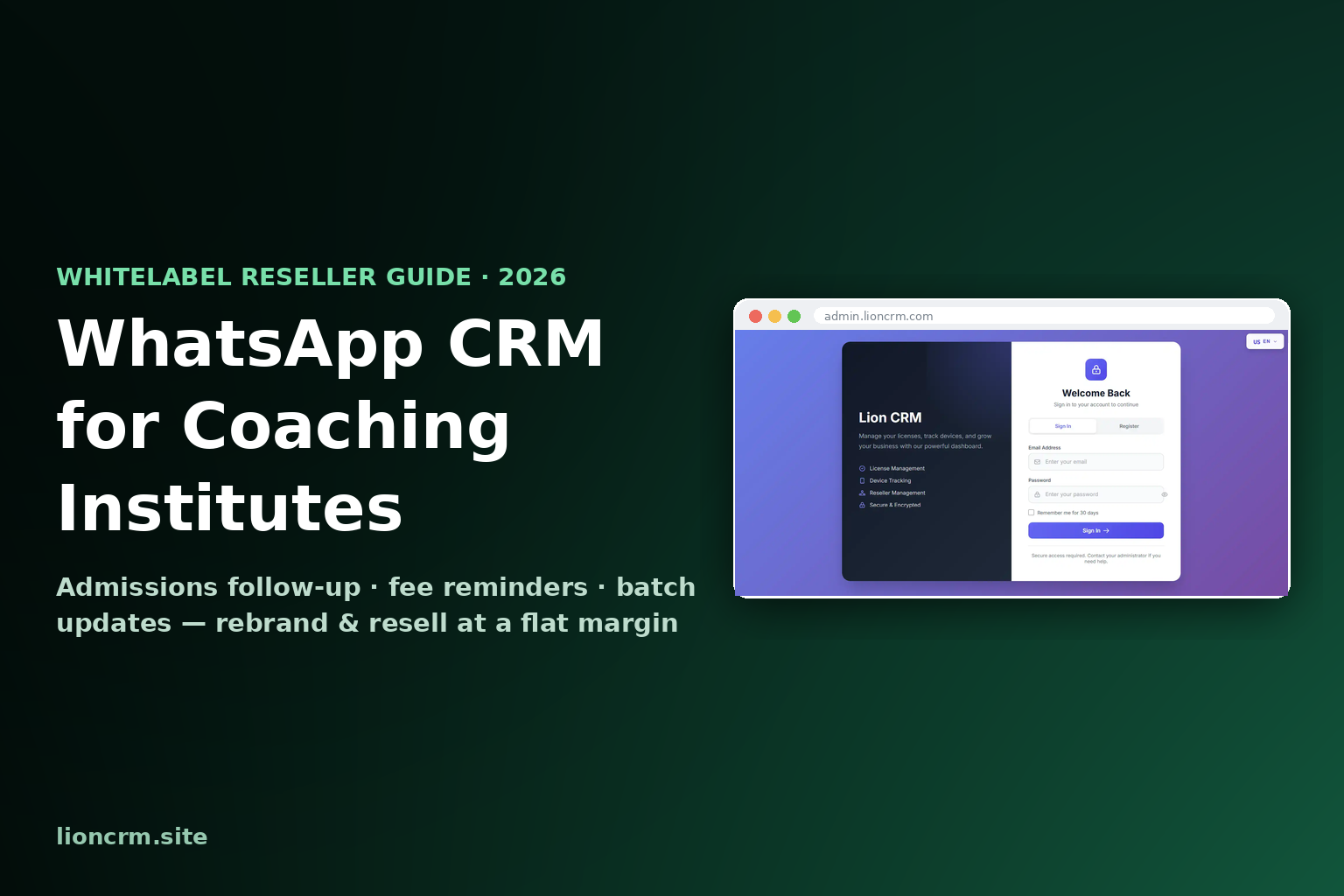
- Go to the admin panel → admin.lioncrm.com and set up your brand: name, logo, colours, and support details.
- Create your client-facing pricing — what you will charge each coaching institute per month or per year.
- Provision a trial licence so you can demo to a centre without paying upfront.
- Onboard the institute: connect their number, import contacts, and set up their batches and fee-reminder templates.
- Bill the client directly and keep the spread; international agencies can settle through PayPal.
The fastest way to size a plan and get your rebrand questions answered is a short call with my co-founder Kuldeep, who runs the reseller programme day to day — WhatsApp him at +91 74260 38448. You can also see the public plans on the pricing page first. If you want the macro picture before you start, my guide on how to start a whitelabel WhatsApp CRM business is the full start-to-finish resource.
The reseller margin math: a 20-institute book in ₹ and USD
Let me make the money concrete, because that is what decides whether this vertical is worth your time. The numbers below are an illustration, not a quote — your real spread depends on your pricing and the vendor plan you choose.
Picture a focused agency that has signed 20 coaching institutes over a year. A typical mid-sized centre runs two or three front-desk and counsellor seats, so call it an average of three seats per institute — 60 seats across the book. Suppose your flat per-seat cost on a whitelabel plan works out to roughly ₹700 (about $8.4) per seat per month at that volume. Your total cost is around ₹42,000 (about $504) a month.
Now your pricing. Coaching institutes happily pay for tools that protect admissions revenue, and ₹2,500 (about $30) per seat per month is an easy number when one saved admission covers a year of it. At 60 seats that is ₹1,50,000 (about $1,800) in monthly revenue. Subtract your ₹42,000 cost and you keep about ₹1,08,000 (about $1,300) a month in gross margin — a little over ₹13,00,000 (about $15,600) a year — from one tidy vertical book, with no servers to run and no app to build.
The reason the spread holds is the flat cost model. Because your per-seat cost does not move with how many fee reminders a centre broadcasts, a heavy admission season grows the institute’s value without growing your bill. Add the low churn of a vertical that needs the tool every month, and you have the kind of recurring software income that makes an agency genuinely more valuable. For a like-for-like breakdown against a metered competitor, see Wati’s whitelabel program cost vs Lion CRM.
How to rebrand Lion CRM and sell it to coaching institutes
The rebrand itself is the part agencies worry about most and it turns out to be the easy part, because Lion CRM hands you a finished product to dress, not a codebase to build.
Inside the admin panel you set your brand identity once — name, logo, colour scheme, and your support contact — and that is what every coaching institute sees from the login screen onward. You define your own plans and prices, so the centre is buying your product at your rate, never the vendor’s. You issue trial and paid licences yourself, which means you can walk into a centre, switch on a 7-day trial in front of the owner, and let the front desk feel the difference during a live admissions week. Nothing about the experience tells the institute that someone else makes the software.
Your job, then, is the work an agency is already good at: branding, packaging the offer for coaching, demoing against the six jobs, onboarding the centre’s batches and templates, and handling first-line support. Anything that touches the underlying product — an outage, a platform question — escalates to the vendor, so you never run engineering. That division of labour is the whole appeal: you own the brand and the customer, the vendor owns the servers. To go deeper on finding and closing these clients, my guide on how to find whitelabel WhatsApp CRM customers lays out the outreach.
A simple 30-day rollout for one institute
Resellers who do well in this vertical have a repeatable onboarding. Here is a clean 30-day plan you can run for every coaching client, so the centre feels value fast and stays.
In week one, connect the institute’s WhatsApp number and import its contacts, then set up the batches as segments and load the three or four reply templates they use most — fees, timings, syllabus, and demo booking. In week two, switch on the admission-enquiry pipeline and the timed follow-up sequence, and train the front desk on the one screen they will live in. The point is to make the counsellor’s day easier in the first fortnight, not to roll out every feature at once.
In week three, turn on fee reminders for one batch as a pilot and let accounts feel a collection cycle run on autopilot, then expand it to all batches once they trust it. In week four, sit with the owner over the dashboard — enquiries, conversion, fees pending — and show them the numbers they have never had before. That dashboard meeting is what renews the contract, because it moves the tool from a staff convenience to something the owner reads every week. Land that, and the institute is embedded for the long run.
Mistakes that kill a coaching-vertical reseller
A few avoidable errors sink agencies in this niche, and they are worth naming so you can dodge them.
The first is selling on a metered cost base. If your own bill rises every time a centre broadcasts fee reminders, your margin is hostage to your client’s busiest months — exactly when you should be happiest. Pick a flat-cost model so heavy usage grows the account’s value, not your cost.
The second is promising that a WhatsApp tool is ban-proof. Bans come mainly from mass-messaging cold, unknown numbers. Coaching is the opposite — you are messaging your own students and parents, who already know the centre — so the risk is low if you sell responsible use, lean on opt-in lists, and keep a number validator and sending delays on. Never promise immunity; sell good practice.
The third is shipping the institute a bare tool and walking away. The centres that stay are the ones whose batches, templates, and fee reminders were set up properly in the first month and whose owner saw a dashboard. Onboarding is the product in this vertical. The fourth, quieter mistake is reselling a CRM that is not truly whitelabel, so your client sees the vendor’s brand and you spend years building someone else’s equity. Get the cost model, the onboarding, and the branding right, and coaching becomes one of the steadiest reseller books you can build.
The honest verdict
Coaching institutes are a near-perfect fit for a WhatsApp CRM: high-value admissions, long follow-up cycles, constant fee and batch messaging, and a customer base that already lives on WhatsApp. If you run a centre, putting structure around those conversations stops enquiries leaking and gets fees in on time — and you can start a 7-day trial on the Chrome extension today at crm.lotsofcode.in without talking to anyone.
If you sell software to local businesses, coaching is one of the cleanest verticals in India to resell a branded WhatsApp CRM into, because the institutes cluster, the use-case repeats, and the need recurs every month. The two things that decide whether it is profitable are a flat cost model that protects your margin in a heavy-broadcast niche, and a genuinely whitelabel product that builds your brand instead of the vendor’s. Lion CRM was built for both. If that is the business you want, start in the admin panel, or message Kuldeep at +91 74260 38448 to size your first batch of coaching clients.
Frequently asked questions
What is the best WhatsApp CRM for a coaching institute?
The best fit is a tool that captures admission enquiries, follows up on its own, broadcasts fee reminders to a whole batch, and shows the owner a simple dashboard. A flat-cost Chrome-extension CRM like Lion CRM does all of that on the institute’s own number, with no per-message meter, so cost stays predictable even in heavy admission months.
Can I use a WhatsApp CRM just for fee reminders and admissions?
Yes — those are the two highest-value jobs in coaching. You can broadcast a personalised fee reminder to an entire batch in one action and track who paid, and you can run an automated follow-up sequence on every admission enquiry so the third and fourth touches happen without anyone remembering. Most centres start with exactly these two and expand from there.
Is a Chrome-extension WhatsApp CRM safe for a coaching institute’s number?
Yes, when used normally. Bans come mainly from mass-messaging cold, unknown contacts. A coaching centre messages its own students and parents, who already know it, which is far safer. A bulk number validator and human-like sending delays reduce the risk further. Sell and use responsible practice, and never promise total immunity.
How is whitelabel different from a partner or referral program?
A partner program gives you a discount or a referral cut, but the institute still sees the vendor’s brand. A genuine whitelabel CRM lets you put your own name, logo, and web address on every screen, set your own prices, and own the client relationship — so you build your agency’s brand, not the vendor’s, on every coaching client you sign.
How much can an agency earn reselling a WhatsApp CRM to coaching institutes?
As an illustration, a book of 20 institutes at an average of three seats each — 60 seats — priced near ₹2,500 (about $30) per seat per month can bring in around ₹1,50,000 (about $1,800) a month, leaving roughly ₹1,08,000 (about $1,300) in monthly gross margin after a flat per-seat vendor cost. The spread scales with seats because the per-seat cost is flat.
Do I need to be technical to resell a WhatsApp CRM to coaching institutes?
No. The vendor hosts and maintains the software. Your job is branding, packaging the offer for coaching, demoing, onboarding the institute’s batches and templates, and first-line support — services skills, not engineering. Anything touching the underlying product escalates to the vendor, so you never run servers or write code.
Will a WhatsApp CRM work for small tuition centres, not just big institutes?
Yes. A neighbourhood tutor with two batches benefits from the same jobs — capturing enquiries, automating follow-ups, and reminding students about fees and timings — just at a smaller scale. The Chrome-extension model keeps the entry cost low, so a small centre can start on the trial and grow into paid use as its batches grow.
Related guides
If this guide was useful, these companion pieces go deeper into the parts that matter most:
- How to Start a Whitelabel WhatsApp CRM Business in 2026 (7 Steps) — the full start-to-finish business guide behind this vertical playbook.
- How to Find Whitelabel WhatsApp CRM Customers (2026) — the outreach playbook for landing your first coaching clients.
- Cloud API vs On-Prem WhatsApp CRM for Resellers: 2026 Decision Tree — the architecture decision behind the flat-cost argument here.
- Wati Whitelabel Program Cost vs Lion CRM (2026) — a like-for-like look at a metered competitor’s reseller economics.
- WhatsApp Kanban Board for Sales Teams (2026) — the visual pipeline a coaching counsellor uses to track every admission enquiry.
Related guides
- WhatsApp CRM Resources & Guides — every Lion CRM comparison, feature guide and reseller playbook, grouped in one index.
Apna brand, recurring revenue
Sell Lion CRM as your own white-label WhatsApp CRM. Your brand, your pricing, monthly recurring income from every client.
Become a Reseller on WhatsApp →View Reseller PricingSee the Admin Panel