

Apna brand, recurring revenue
Sell Lion CRM as your own white-label WhatsApp CRM. Your brand, your pricing, monthly recurring income from every client.
Become a Reseller on WhatsApp →View Reseller PricingSee the Admin Panel
A founder pinged me last Tuesday with a Twilio invoice in PDF and one question above it: why did this bill double in three months? He runs an 8-person digital agency in Pune. He’d plugged Twilio’s WhatsApp Business API into a homemade dashboard for six SMB clients on the promise of developer-grade rails at predictable per-message pricing. The first month bill was modest. The second month, two of his clients ran a Diwali broadcast. The third month, one of them added a recurring drip flow. By month three, Twilio’s per-message meter, the Twilio platform markup on Meta’s WhatsApp conversation fee, plus the engineering hours his lead developer spent firefighting his own dashboard, had pushed the project firmly into the red. He was searching for Twilio WhatsApp alternatives before his next month’s invoice landed.
You’re probably reading this for a version of the same reason.
I’m Rakshit Soni, co-founder of Lion CRM, a WhatsApp CRM Chrome extension built by LotsOfCode Private Limited for end-users and whitelabel agency resellers. Twilio is one of the two or three vendor names that show up in almost every reseller-migration conversation I have — usually framed as we’re paying Twilio per message and we still don’t have a product to resell. This guide is the conversation I have with each agency on that call. (If video reads easier than long-form, our LotsOfCode YouTube channel walks the same ground in 12 minutes.)
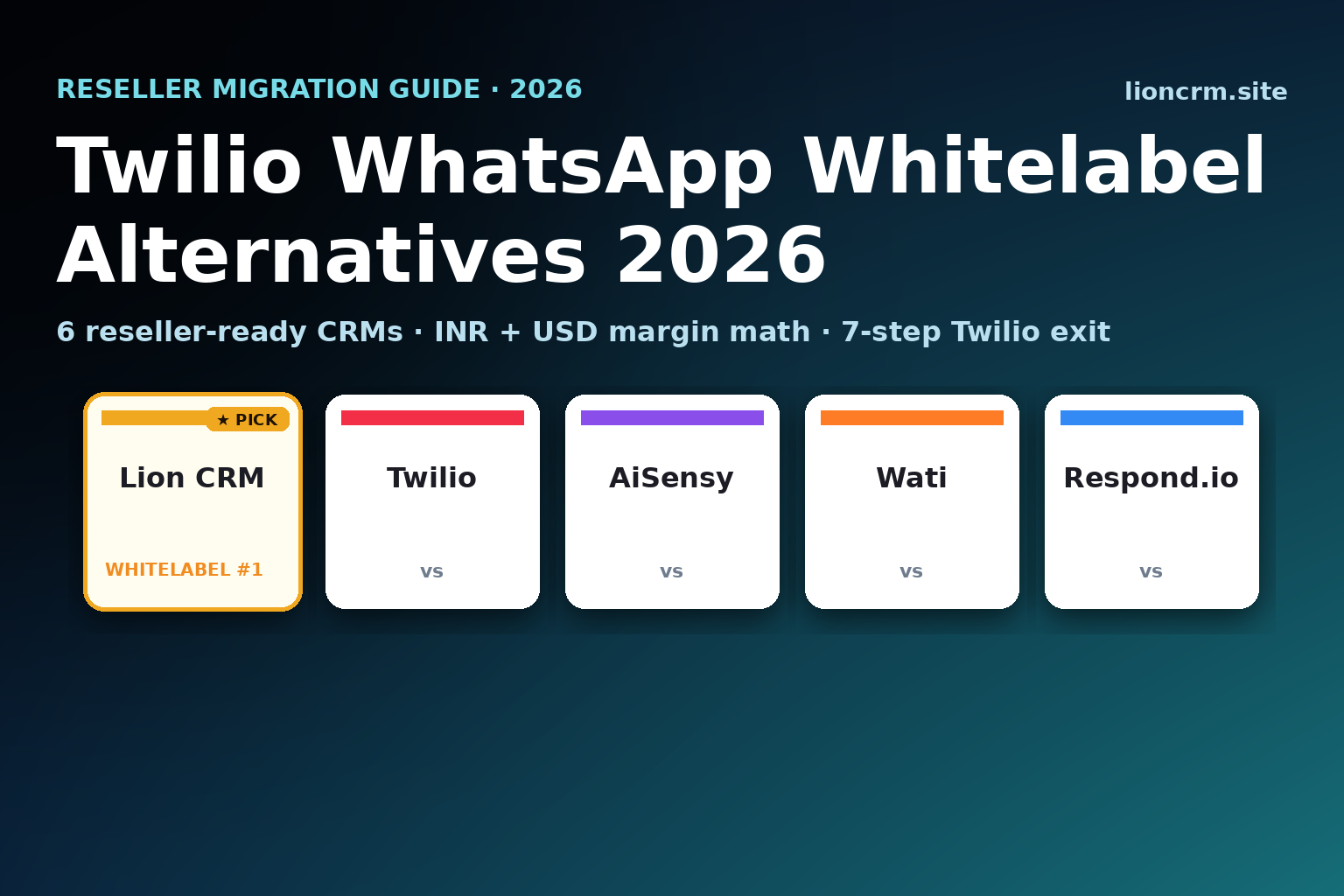
We’ll cover what Twilio genuinely does well, why it stops making sense for reseller economics the moment your client base actually uses WhatsApp at any volume, then walk through six realistic alternatives in 2026 — from Chrome-extension whitelabel-first picks (Lion CRM) to BSP peers at SMB price points (AiSensy, Wati, Gallabox, Interakt) to multi-channel customer-support platforms (Respond.io). I’ll run a 25-customer agency scenario in rupees and US dollars, lay out a side-by-side comparison table, give an honest verdict on which alternative fits which reseller profile, and finish with a 7-step migration playbook for agencies who decide to switch.
Why resellers want off Twilio in 2026
I keep a folder of cold messages from agency owners and regional SaaS founders who came to Lion CRM after a Twilio WhatsApp experiment that did not pencil out. Four reasons show up in almost every message:
- Twilio sells rails, not a reseller product. Twilio is a Communications Platform as a Service. It gives you APIs for WhatsApp, SMS, voice, email, and video. It does not give you a multi-agent inbox, a sales kanban, a broadcast scheduler, a chatbot builder with a visual editor, or a whitelabel reseller admin panel out of the box. If you want any of that, you build it — or you stitch Twilio together with another vendor’s CRM. For a Vikram-style 5-30 person agency that wants a finished SaaS product to upsell, Twilio is the wrong layer of the stack.
- Per-message pricing in USD compounds fast. Twilio’s WhatsApp pricing stacks the Meta conversation fee (set by category — marketing, utility, authentication, service) on top of Twilio’s own per-message markup. Every line of the invoice is in US dollars. Convert at ~₹83/USD and even small per-message numbers add up the moment your SMB clients run a real broadcast. An agency owner I spoke to last month booked ~$680 (~₹56,000) in Twilio fees on a single Diwali campaign for one mid-sized client. The campaign itself converted well — the agency margin on top did not survive the per-message stack.
- No published self-serve whitelabel programme. Twilio runs an ISV partner programme and a BSP partner channel, both of which take engineering effort, business validation, and time to clear. None of it is the sign up in an afternoon, rebrand the dashboard, set your own retail price shape that an Indian or LATAM agency reseller actually wants. You can resell capacity through Twilio. You cannot easily ship a rebranded WhatsApp CRM under your own brand without building the front-end yourself.
- Engineering load is the hidden bill. Every agency I’ve spoken to who’s run Twilio for more than a quarter discovered the same hidden cost: the developer hours. Webhooks need monitoring. Templates need re-approval each time Meta changes a category rule. The custom dashboard you built needs upkeep every time WhatsApp ships a new feature. For an agency that does not have a full-time backend engineer, this work either falls on the founder at the worst possible moments or gets outsourced at ~₹2,000/hour to a contractor. Either way, the engineering bill is the line item that nobody quotes in the original Twilio sales pitch.
If any of those four lines describe your last quarter on Twilio, the rest of this guide is for you. Let’s look at what Twilio is genuinely good at first, then walk through the realistic alternatives.
What Twilio actually is: a CPaaS, not a whitelabel CRM
I’m not here to bash Twilio. It is a legitimately excellent product for the customer it is built for — and being honest about that matters when you’re picking the alternative.
Twilio is the largest publicly listed Communications Platform as a Service in the world. The WhatsApp Business API access through Twilio is mature, the documentation is some of the best in the industry, the developer surface is clean, and the platform reliability genuinely matters when you are sending mission-critical messages at scale. If you are an in-house engineering team at a 500-person consumer brand, or a regional SaaS startup with two backend engineers and a six-month roadmap, Twilio’s rails will hold up. The Studio flow builder, the Programmable Messaging API, the Conversations API for multi-party threads — these are all serious tools.
The catch, the entire catch, is that Twilio sells you the rails. It does not sell you the WhatsApp CRM product your agency clients actually want to use. The Twilio team’s own positioning is consistent on this: they are infrastructure. The expectation is that you bring or build the customer-facing software on top.
So if you are an in-house engineering team or a tech-mature regional SaaS founder with two or three backend engineers, a UI designer, and a six-month build window, Twilio is a reasonable pick. The alternatives below are for the other case — the case where you’re an agency, a regional reseller, or a digital marketing shop trying to ship a finished whitelabel WhatsApp CRM to SMB clients at ₹1,500-5,000 per client per month, this quarter, without first hiring a backend team.
Twilio WhatsApp pricing decoded: the USD meter most agencies misread
Let’s run the actual numbers on Twilio first, so the alternatives have something to be compared against. Twilio’s WhatsApp pricing has three layers stacked on top of each other, and most first-time agency buyers underestimate the third one.
Layer one: Meta’s WhatsApp conversation fee. Meta charges per conversation window (24-hour rolling), with the rate set by conversation category and the recipient’s country code. In India, marketing conversations sit at roughly ₹0.78 each (USD pass-through equivalent ~$0.0094), utility conversations at roughly ₹0.34 (~$0.0041), and authentication conversations at roughly ₹0.13 (~$0.0016). Service conversations (initiated by the customer’s incoming message) are now free in most markets. Those numbers come from Meta, not Twilio, and every BSP including Twilio passes them through.
Layer two: Twilio’s per-message markup. On top of Meta’s conversation fee, Twilio charges its own per-message fee, currently in the range of $0.005 per message in the cheapest direction. That’s the Twilio fee line you’ll see in the invoice. Convert at ~₹83/USD and you’re paying an extra ~₹0.42 per message to Twilio on top of whatever Meta already charged you for the conversation window.
Layer three: the engineering you bring. Twilio does not sell you a sender UI, a contact manager, a broadcast scheduler, or a chatbot builder. You build that yourself, or you stitch Twilio into a CRM that has those components. Either way, the engineering hours and the third-party CRM seat fees are the third line of the bill, and they’re the one that catches agencies off-guard.
Run a 25-client agency scenario at 100 outbound conversations per day per client. That’s 75,000 conversations per month across the book. At ~₹0.5-0.85 per conversation (mix of marketing and utility, India rates) plus Twilio’s ~₹0.42 per message markup, the platform-plus-passthrough bill alone lands around ~₹85,000-95,000 per month. Add the in-house or contractor engineering load — let’s call it 20 hours per month at ₹2,000/hour — and you’re at another ~₹40,000 per month. Total cost: ~₹1,25,000-1,35,000 per month for the platform and engineering, before you’ve added a single rupee of agency margin. Run the same maths in dollars and you’re at roughly $1,500-1,650 per month per 25-client agency.
If your retail price per SMB client is ₹2,000-3,500 per month, your gross client revenue at 25 clients is ₹50,000-87,500 per month. The math does not close. That’s the gap that drives the search for Twilio WhatsApp alternatives. Let’s get into the six that actually solve it.
The 6 best Twilio WhatsApp alternatives for whitelabel resellers
I’ve ordered these by fit for the whitelabel-reseller use case, not by raw enterprise feature count. If you’re an agency owner reading this and you only care about which one will let you rebrand the tool, set your own price, and ship it to your existing SMB book of business in two weeks, start at #1 and stop wherever the answer fits.
1. Lion CRM — Whitelabel-first WhatsApp CRM Chrome extension
Lion CRM is what I’d hand a Vikram-style agency owner the day they tell me Twilio priced them out. The product is a Chrome extension on WhatsApp Web with a full CRM layer — contact tagging, sales kanban, scheduled messages, bulk broadcasts with anti-ban randomisation, multi-agent shared inbox, auto-reply, and an AI chatbot. The reseller motion is the entire point: you sign up for the whitelabel programme via admin.lioncrm.com, and you get your own rebrandable Chrome Web Store listing, your own admin panel, your own pricing tiers, and your own customer accounts billed under your brand. Per-message costs disappear because the extension rides on WhatsApp Web (your customer’s own WhatsApp number), not on the Cloud API conversation meter. Reseller plans start at the Starter tier with a flat monthly fee plus a per-end-user fee, so a 25-customer agency can model unit economics on a single line of a spreadsheet. Talk to my co-founder Kuldeep on WhatsApp at +91 74260 38448 or visit the whitelabel WhatsApp CRM pricing page to get started.
2. AiSensy — Cloud API at SMB price points
AiSensy is the closest like-for-like alternative if you genuinely need the Cloud API rails (regulated industry, banking templates, very high-volume broadcasts) and you want SMB-priced packaging. Indian SaaS, built for the Indian and Southeast Asian market, with broadcast campaigns, chatbot flows, and a WhatsApp-first inbox. Their whitelabel programme has been live for a couple of years and is the route most ex-Twilio agencies take when they want to keep the Cloud API but stop paying USD per-message markup. The trade-off: AiSensy’s whitelabel rebrand depth is partial — your customers will not always see a 100% rebranded experience, and the admin surface still ships some AiSensy-branded settings screens. Worth a free trial if Cloud API is non-negotiable.
3. Wati — Cloud API with a polished helpdesk-style inbox
Wati was the early-mover Indian Cloud API CRM and still has one of the most polished inbox UIs in the SMB segment. Strong on customer-support workflows, decent on outbound broadcasts, with a whitelabel programme on the higher tiers. Pricing is per-seat plus per-conversation, same shape as Twilio but at INR-friendly rates and without the developer-build requirement. The catch is the same one Twilio has at scale — the per-conversation meter still runs on the Cloud API, so your unit economics depend on your customer’s traffic pattern. Better than Twilio for SMB resellers because the product is finished; still worse than a Chrome-extension whitelabel for predictable margin.
4. Respond.io — The multi-channel omnichannel competitor
Respond.io is the strongest positioning match if your reseller business sells omnichannel customer support rather than WhatsApp-only sales tool. Multi-channel inbox, WhatsApp + Messenger + Instagram + email + SMS, automation flows, contact management, and an Asia-Pacific base that makes its INR and SGD pricing more competitive than US-headquartered CPaaS sticker. The whitelabel programme is partner-led rather than self-serve, which is the same shape as Twilio’s BSP partner channel just at a lower price point and with a finished product UI included. Worth a demo if multi-channel is non-negotiable.
5. Gallabox — Indian SMB-first BSP
Gallabox is an Indian Cloud-API CRM that has been quietly building one of the cleanest SMB experiences in the segment. Strong onboarding, sensible default chatbot templates, and pricing structured for 5-100 user customer counts that match the agency-reseller pattern. Whitelabel is available on higher plans, the rebrand depth is partial (similar to AiSensy), and the support team is responsive at agency scale. Worth a free trial if you want a Cloud-API alternative to Twilio with a more SMB-shaped UI than Wati’s enterprise-helpdesk surface.
6. Interakt — Haptik-pedigree BSP for retail and SMB
Interakt is the WhatsApp CRM product from Haptik (now Jio Haptik), positioned at the retail and SMB end of the market. Solid Cloud-API base, a Shopify integration that resellers selling into ecommerce SMBs care about, and pricing in INR. The whitelabel and reseller-channel programme is partner-led, with rebrand depth gated on plan tier. Best suited to agencies whose SMB book is retail-heavy or has a strong Shopify-integrated requirement, where the Interakt ecommerce extras compound on top of the WhatsApp CRM layer.
Twilio alternatives compared: pricing, whitelabel, rails
The numbers below are agency-friendly entry-tier prices, not enterprise quotes. USD figures are converted to INR at ~₹83/USD for a Tier-1 Indian or LATAM agency reseller scenario, and per-conversation Cloud API fees use Meta’s India rates as a representative reference.
| # | Tool | Starting price (entry tier) | WhatsApp rails | Whitelabel programme | Best for |
|---|---|---|---|---|---|
| 1 | Lion CRM | Reseller tier from a flat monthly fee + per-end-user-month (talk to Kuldeep for a current quote) | WhatsApp Web (Chrome extension) | Self-serve, full rebrand: own Chrome Web Store listing, own admin panel, own pricing | Agencies wanting predictable SMB-priced WhatsApp CRM to retail |
| 2 | AiSensy | ~₹2,400/mo platform + Cloud API conversations | WhatsApp Cloud API | Partial whitelabel; some AiSensy-branded surfaces remain | Agencies that need Cloud API at SMB cost |
| 3 | Wati | ~₹2,500/mo platform + Cloud API conversations | WhatsApp Cloud API | Whitelabel add-on on higher tiers | Customer-support-led SMB resellers |
| 4 | Respond.io | ~₹6,000/mo platform + per-conversation | WhatsApp + Messenger + IG + SMS + email | Partner-led, talk-to-sales | Omnichannel-first agencies |
| 5 | Gallabox | ~₹2,200/mo + per-conversation | WhatsApp Cloud API | Partial whitelabel on higher plans | SMB-shaped Indian agency book |
| 6 | Interakt | ~₹2,800/mo + per-conversation | WhatsApp Cloud API + Shopify | Whitelabel via partner channel | Retail / Shopify-heavy SMB resellers |
| — | Twilio (reference) | ~$0.005/message Twilio markup + Meta conversation fee + your engineering build | Cloud API + SMS + voice + email | BSP / ISV partner programme; you build the front-end | In-house engineering teams building their own product |
Two things jump out of that table. First, Lion CRM is the only row with a self-serve full-rebrand programme — every other vendor is either partner-led or has partial rebrand depth. Second, the Chrome-extension rails (Lion CRM) sidestep the per-conversation Cloud API meter that drives most of the agency-margin damage on Twilio, AiSensy, Wati, Respond.io, Gallabox, and Interakt at higher client-traffic profiles.
INR pricing math: 25-customer agency on each option
Let’s stop theorising and run the same scenario through each option: a Bangalore or Mumbai agency with 25 SMB clients, each client doing roughly 100 outbound conversations per day, billed at ₹2,000 per client per month at retail (so the agency books ~₹50,000/mo in client revenue from this product line alone).
- Twilio (reference): ~75,000 conversations/month across the book. Meta passthrough at a marketing/utility mix ~₹0.50-0.85 per conversation = ~₹50,000/mo. Twilio per-message markup at ~₹0.42 × an average 1.2 messages per conversation = ~₹38,000/mo. Engineering load at 20 hours × ₹2,000 = ~₹40,000/mo. Total: ~₹1,28,000/mo. Client revenue: ₹50,000/mo. Margin: negative ~₹78,000/mo. That’s the gap that drives the search.
- AiSensy: ~₹2,400/mo platform × 25 = ~₹60,000/mo + ~₹50,000/mo Meta passthrough = ~₹1,10,000/mo. Margin: negative ~₹60,000/mo. Still under water at this client traffic profile, though half the engineering load goes away because the product UI is included.
- Wati: ~₹2,500/mo platform × 25 = ~₹62,500/mo + ~₹50,000/mo Meta passthrough = ~₹1,12,500/mo. Margin: negative ~₹62,500/mo. Same shape as AiSensy.
- Respond.io: ~₹6,000/mo × 25 = ~₹1,50,000/mo + ~₹50,000/mo passthrough = ~₹2,00,000/mo. Margin: negative ~₹1,50,000/mo. The omnichannel value is real, but the entry-tier per-seat fee makes the SMB-reseller motion difficult at this retail price.
- Gallabox: ~₹2,200/mo × 25 = ~₹55,000/mo + ~₹50,000/mo passthrough = ~₹1,05,000/mo. Margin: negative ~₹55,000/mo. Closest of the Cloud-API alternatives to breakeven.
- Interakt: ~₹2,800/mo × 25 = ~₹70,000/mo + ~₹50,000/mo passthrough = ~₹1,20,000/mo. Margin: negative ~₹70,000/mo. Extra cost is offset partly by the Shopify integration value for retail-heavy books.
- Lion CRM: Reseller flat monthly + per-end-user-month at SMB-friendly rates. For a 25-end-user reseller plan, the cost stays under ₹40,000/mo in most configurations (talk to Kuldeep for the current quote). No Meta passthrough — runs on WhatsApp Web. Margin: ~₹10,000-15,000/mo positive at ₹2,000 retail, climbing to ~₹40,000+ at ₹3,500-5,000 retail per client.
The pattern is clear. Any Cloud-API based vendor — Twilio, AiSensy, Wati, Respond.io, Gallabox, Interakt — has the same Meta-passthrough problem the moment your client base is doing real WhatsApp traffic. Only the Chrome-extension rails (Lion CRM) survive at SMB retail prices, and Lion CRM is the one option in that rails class with a deep self-serve whitelabel programme.
Whitelabel depth: the 5 questions Twilio can’t answer yes to
Whitelabel is a word every SaaS vendor uses and most don’t deliver on. Five questions I ask every vendor before recommending them to an agency client. Twilio cannot say yes to a single one without you doing the engineering yourself first:
- Can I ship my own Chrome Web Store listing? Lion CRM: yes. Twilio: not applicable — Twilio is an API, you build whatever Web Store presence yourself. Cloud-API vendors (AiSensy, Wati, Gallabox, Interakt): partially, via subdomain and brand assets.
- Will my customer ever see the vendor’s brand? Lion CRM: no, if you ship under your own listing. Twilio: you control the front-end completely, but only because you built it from scratch. Cloud-API vendors: occasionally in settings, support flows, or transactional emails.
- Can I set my own pricing tiers without telling the vendor? Lion CRM: yes. Twilio: yes — you set the retail price on the product you built. Cloud-API vendors: typically no, your retail price has to make sense relative to the underlying per-conversation cost they pass through.
- Do I own the billing relationship? Lion CRM: yes, you bill the end customer directly. Twilio: yes, but only because you wrote the billing logic into your own product. Cloud-API vendors: mixed — often the vendor handles billing and you take a commission or revenue-share.
- Can my customer cancel and stay with me on a different plan? Lion CRM: yes — the customer relationship is yours. Twilio: yes, on the product you built. Cloud-API vendors: usually the customer can churn directly to the vendor’s lower-tier plan, cutting you out.
Twilio answers yes to questions 3, 4, and 5 only because you built the entire product layer yourself. That’s not a whitelabel programme — that’s you ran a six-month engineering project. Lion CRM is the only row on this list that answers yes to all five without first asking you to write a single line of backend code. That’s the architectural difference between an API and a whitelabel programme.
Try Lion CRM free for 7 days
Before you commit to a reseller plan, the end-user version of Lion CRM is free to try for 7 days — no card required. Install the Chrome extension, run the broadcast and kanban flows on your own WhatsApp number for a week, and you’ll have a much clearer picture of what your future reseller customers will experience. Install the Lion CRM Chrome extension from the Chrome Web Store and run it on your own laptop. The 7-day trial begins the moment you complete onboarding — you don’t have to find a hidden trial button. If you’d rather see the product walked through first, the LotsOfCode YouTube channel has a 12-minute walkthrough.
7-step migration playbook from Twilio to Lion CRM
If the math above lands and you’ve decided to move off Twilio, here’s the practical sequence that works for the agencies I’ve helped through this switch. Plan for three weeks of elapsed time end-to-end, with most of the work front-loaded into the first week.
- Export everything from Twilio and your custom dashboard while the integration is still live. Pull message logs from the Twilio Console (CSV export), contact lists from your custom database, and any chatbot Studio flows you’ve built. Anything custom (webhook handlers, template approvals, status callback logic) document by hand so the engineering work is not silently retired.
- Run a 30-day per-client cost calculation in INR. For each of your active SMB clients, calculate the last 30 days of Twilio platform fees, Meta passthrough, and the engineering hours your team spent on dashboard maintenance specific to that client. This is the number you’ll re-quote against Lion CRM’s reseller-plan cost so you can show the savings to your finance lead.
- Talk to Kuldeep on WhatsApp at +91 74260 38448 to size the reseller plan for your current and projected end-user count. Lion CRM’s reseller tiers price differently for 10-, 25-, 50-, and 100-user bands — getting the tier right at sign-up saves a billing adjustment later. Pay via PayPal or Razorpay at onboarding.
- Sign up at admin.lioncrm.com and complete the whitelabel onboarding. This includes uploading your logo, naming your rebranded extension, configuring your subdomain, and connecting your billing account for billing your end-customers.
- Ship your own Chrome Web Store listing. The Lion CRM team will provide the rebranded extension package; you publish it under your agency’s Chrome Web Store developer account. Allow 1-3 business days for Google’s review queue.
- Migrate 2-3 friendly customers first. Pick the clients who will forgive a hiccup, run them on the new tool for a week, collect feedback, then move the rest in batches of 5-10 per week. Decommission the custom Twilio dashboard once the last client is migrated.
- Cancel Twilio in the same billing cycle as your last migrated client. Don’t run both in parallel for a full month — you’ll bleed the USD-denominated per-message meter unnecessarily. Mark the cancel date in your calendar the moment you start the migration, and update your status callback to a no-op endpoint two days before so any straggler messages do not generate a final invoice surprise.
The whole switch is roughly 70% the same operational work you’d do for any vendor migration — export, import, ship, validate, cancel. The other 30% is the whitelabel-specific work — the Chrome Web Store listing, the rebrand setup, and decommissioning the engineering you built on top of Twilio. Both are handled by the Lion CRM team in onboarding.
Start your whitelabel WhatsApp CRM SaaS
If reading the migration playbook surfaced more questions than answers, the fastest way to resolve them is a 20-minute call with Kuldeep, my co-founder. He runs the whitelabel reseller programme day-to-day and can size a plan, walk through the rebrand depth, and answer the tier-pricing question on the spot. WhatsApp him at +91 74260 38448. The whitelabel WhatsApp CRM software guide covers the same material in writing if you’d rather read first, and the admin.lioncrm.com reseller portal is where the actual reseller onboarding lives. Billing flows through PayPal for international agencies and Razorpay for Indian agencies — pick whichever your customers prefer.
The honest verdict: which Twilio alternative fits which reseller profile
If I’m being completely honest about the trade-offs — and not just plugging my own product — here’s how I’d actually advise an agency owner across the six options:
- 5-30 person Indian, LATAM, or Southeast-Asian agency selling to SMB clients at ₹1,500-5,000/mo retail per client: Lion CRM. The only option in this guide with self-serve full rebrand and no per-conversation passthrough. The reseller economics actually close.
- Cloud-API is non-negotiable (regulatory reasons, banking/insurance vertical, broadcast-template heavy): AiSensy or Wati. Either works; AiSensy is slightly more agency-friendly on entry-tier pricing, Wati has the better support-inbox UI. Both leave whitelabel rebrand depth on the table.
- Multi-channel customer-support reselling (WhatsApp + IG + Messenger as a bundle): Respond.io. Strong APAC coverage and a clean omnichannel inbox; partner-led on whitelabel.
- Retail or Shopify-heavy SMB book: Interakt. The Shopify integration plus the Indian-market positioning compound nicely for retail-focused agencies.
- Indian SMB book with sensible chatbot needs and a preference for a clean UI: Gallabox. Closest Cloud-API alternative to breakeven at SMB retail prices, with a finished product UI.
- In-house engineering team building a regional SaaS product, with a six-month build window and two-plus backend engineers: Twilio stays the right call. Your buyer is not the same as the buyer in this guide.
The thing nobody tells you about reseller business models is that the vendor is also your business partner. You are not just buying software; you are effectively in a joint venture on every end-customer relationship. Pick the vendor whose programme actually matches the joint venture you want to run.
Bonus: 5 questions to ask any whitelabel vendor before you sign
These are the questions I wish someone had handed me four years ago when I started LotsOfCode. Ask each vendor — Lion CRM included — and weigh the answers literally, not in marketing language.
- Show me a screenshot of the rebranded customer-facing surface. Not a slide deck. An actual screenshot from a real reseller’s deployment, with the reseller’s logo and brand visible end-to-end. If the vendor cannot produce that, the rebrand depth is shallower than the brochure suggests.
- What’s the upgrade path when I outgrow the starter tier? Reseller plans usually have user-count bands; ask what triggers a tier change, how much notice you get, and whether the migration is automatic or requires a redeploy of your Chrome extension or subdomain.
- Who owns the end-customer billing relationship and the support relationship? Two separate questions. On the billing side: do you invoice the customer or does the vendor? On the support side: when the end customer raises a ticket, does it route to you or to the vendor?
- What happens to my Chrome Web Store listing or subdomain if I cancel the reseller plan? The wrong answer is we take it down and your customers lose access. The right answer is some flavour of we give you 30-60 days to migrate your customers off, with the listing or subdomain remaining live during that window.
- Can I see another agency reseller’s reference numbers? Vendors with real reseller traction will happily connect you with an existing agency partner doing similar volume. Vendors who say we don’t share customer data on a question like this often just don’t have the reference customers.
If you take nothing else from this guide, take that list to every vendor demo you do. The answers will sort the genuine whitelabel programmes from the partner programmes pretending to be whitelabel.
Frequently asked questions
Is Twilio a WhatsApp Business Solution Provider (BSP)?
Yes. Twilio is a tech-provider partner to Meta and can provision WhatsApp Business API access for your numbers. The difference between Twilio and a reseller-friendly BSP like AiSensy or Wati is the product layer on top — Twilio sells you API access plus a thin layer of tooling. AiSensy and Wati sell you a finished CRM product built on top of the same Cloud API rails.
What does Twilio charge per WhatsApp message in 2026?
Twilio’s per-message markup sits around $0.005 per message (~₹0.42 at ₹83/USD) on top of Meta’s per-conversation fee. The per-conversation fee itself is set by Meta and varies by category (marketing, utility, authentication, service) and recipient country. India marketing conversations sit at around ₹0.78 each at the time of writing. Always confirm current rates on Twilio’s pricing page before you build a model.
Does Twilio have a whitelabel reseller programme for agencies?
Not the kind a 10-person agency can sign up for in an afternoon. Twilio runs an ISV partner programme and a BSP partner channel, both of which involve business validation, engineering effort, and longer onboarding. There is no self-serve rebrand the dashboard and resell programme. For that shape of programme, Lion CRM is the closest fit in the WhatsApp CRM segment.
Is Lion CRM cheaper than Twilio for a 25-customer agency?
By a wide margin in most realistic SMB scenarios, yes — primarily because Lion CRM runs on WhatsApp Web (no per-message Cloud API markup) and prices reseller tiers in INR with no engineering load on top. A 25-customer reseller scenario that costs ~₹1,25,000-1,35,000/mo on Twilio (including the engineering line item) typically lands under ~₹40,000/mo on Lion CRM at comparable end-user count. Run your own numbers with Kuldeep at +91 74260 38448.
Can I migrate from Twilio to Lion CRM without disrupting my customers?
Yes, if you stage it. Export message logs and contacts from Twilio first, sign up at admin.lioncrm.com, ship your rebranded Chrome Web Store listing, then migrate 2-3 friendly customers, validate for a week, and roll the rest in batches. Plan three weeks of elapsed time and decommission the Twilio integration only after the last client is moved.
Does Lion CRM support the WhatsApp Cloud API too, or only WhatsApp Web?
The whitelabel reseller motion runs on the Chrome-extension and WhatsApp-Web rails — that’s how the unit economics stay agency-friendly. If a specific reseller use case needs Cloud API (banking templates, very high broadcast volumes, regulated industries), talk to Kuldeep at +91 74260 38448 about hybrid options.
What if I want to keep Twilio for one regulated client and Lion CRM for the SMB book?
That works. Several agencies in the LotsOfCode book run exactly this split — Twilio (or another Cloud-API vendor) for one or two regulated accounts that require it, Lion CRM whitelabel for the rest of the SMB client base. The Lion CRM reseller plan does not require exclusivity.
Related guides
If you found this Twilio-alternatives breakdown useful, these companion pieces go deeper into the trade-offs:
- MessageBird Alternatives 2026: 7 Whitelabel WhatsApp CRMs for Resellers — the EU-CPaaS sibling of this post, for agencies migrating off Bird’s per-seat platform fee.
- Zendesk WhatsApp Alternatives: 7 Whitelabel WhatsApp CRMs — for agencies running the WhatsApp integration on top of Zendesk’s helpdesk pricing.
- AiSensy Whitelabel Program vs Lion CRM (2026) — head-to-head if AiSensy is your top Cloud-API alternative pick from this guide.
- Whitelabel WhatsApp CRM Pricing Models for Agencies — three pricing models that actually work for a 25-customer agency book.
- Whitelabel WhatsApp CRM Software: Founder’s 2026 Guide — the pillar guide on the whole whitelabel WhatsApp CRM category, if you want the macro picture before zooming back into Twilio-specific economics.
Related guides
- WhatsApp CRM Resources & Guides — every Lion CRM comparison, feature guide and reseller playbook, grouped in one index.
Apna brand, recurring revenue
Sell Lion CRM as your own white-label WhatsApp CRM. Your brand, your pricing, monthly recurring income from every client.
Become a Reseller on WhatsApp →View Reseller PricingSee the Admin Panel