

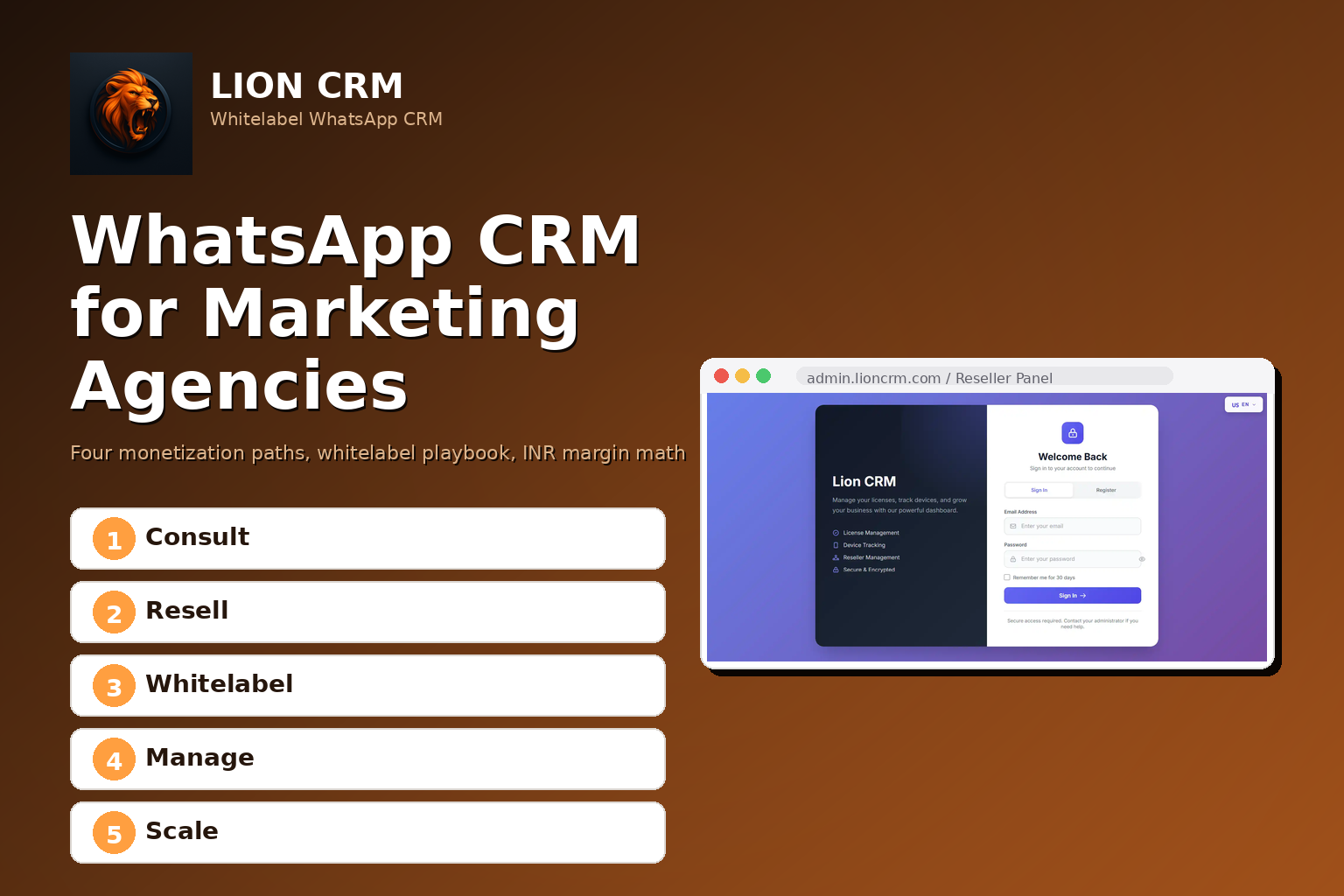
Why marketing agencies are the natural fit for WhatsApp CRM in 2026
Marketing agencies already sit at the perfect spot to sell WhatsApp CRM. You run the client’s ads. You build their landing pages. You write their email flows. The single channel that beats every one of those for reply rate is WhatsApp, and your customer keeps asking you about it.
What changed in the last twelve months is that WhatsApp Business API access stopped being the bottleneck. Meta opened up the Cloud API, dozens of BSPs (business solution providers) and Chrome-extension CRMs entered the market, and the unit economics of reselling WhatsApp tooling finally cleared the floor. An agency in Bangalore, Sao Paulo, Madrid, or Pune can now plug a WhatsApp CRM into its retainer stack the same way it plugs in Google Analytics or HubSpot.
The catch is that plug it in hides four very different business models. You can refer the client to a BSP and earn a one-time consulting fee. You can become a partner and earn a recurring commission. You can rebrand the platform fully and sell it as your own SaaS. You can wrap the platform in services and charge a fat monthly retainer. The math, risk, and ceiling for each one is different.
This guide walks through all four monetization paths, the seven-step rollout playbook for the whitelabel route (the one most established agencies end up choosing by year two), and a worked scenario for a 25-customer agency book. By the end you should know which path matches your agency’s stage and how to start without burning your team’s bandwidth.
The four ways a marketing agency can monetize WhatsApp CRM
Before you pick a vendor, you have to pick a business model. The four paths look similar on a pitch deck and are very different on a profit and loss statement.
The first path is pure consulting. You charge the client a one-time fee to research a BSP, set up the WhatsApp number, configure templates, and train the team. The client pays the BSP directly. You walk away after handover.
The second path is reseller commission. You enrol in a partner program — WATI Solution Partner, AiSensy Partner, DoubleTick Reseller, Watidy Affiliate — and refer the client. The BSP pays you a recurring percentage as long as the client stays subscribed. You never see the dashboard branding.
The third path is whitelabel SaaS. You buy a reseller license from a whitelabel vendor (Lion CRM Whitelabel is the cleanest in this category for Indian and Latin American markets in 2026). The platform runs on your subdomain, with your logo, your terms of service, your billing. You set retail pricing per customer.
The fourth path is WhatsApp-as-a-service, which is really a managed-services wrapper on top of any of the first three. You charge a fat monthly retainer (₹15,000 to ₹75,000 per client) that covers the underlying license plus your team’s hours on templates, broadcast campaigns, chatbot updates, and Meta policy babysitting.
Most agencies start with consulting because it needs zero infrastructure. By year two, they shift to whitelabel or to a managed retainer because the unit economics of one-off project revenue stop scaling once headcount enters double digits.
| Path | Recurring revenue? | Brand exposure | Margin per ₹100 client bill | Setup effort |
|---|---|---|---|---|
| 1. Consulting | No — one-off | Low | ₹0 (you bill separately) | Hours |
| 2. Reseller commission | Yes, modest | Zero | ₹10 to ₹20 | Hours |
| 3. Whitelabel SaaS | Yes, strong | Full — your brand | ₹70 to ₹90 | 1 to 2 weeks |
| 4. Managed retainer | Yes, strong | Medium to high | ₹40 to ₹70 (after staff cost) | Hours |
We will unpack each in the next four sections, then come back to the comparative margin math.
Option 1: pure consulting — set it up, the client owns the bill
This is where almost every agency begins. A retainer client says we want to start using WhatsApp for marketing, and you say cool, I’ll find you a tool and set it up. You quote ₹50,000 to ₹2,00,000 for the project depending on scale, the client signs, you research three to five BSPs, pick one, configure the WhatsApp Business API number, build templates, integrate the CRM, train the team, and hand over login credentials.
The strengths are real. There is no recurring obligation, no infrastructure to maintain, no second-line support to staff. You bill, you deliver, you move on. If the BSP is later acquired, raises prices, or has an outage, it is the client’s problem, not yours.
The weaknesses are also real. You earn the fee once. The client now has a recurring expense (the BSP subscription) that doesn’t flow through you. If the client asks for help six months later — a new template, a chatbot tweak, a Meta policy renewal — you either eat the time as goodwill or quote a fresh small project. Both are painful.
Pure consulting fits agencies that bill on hourly or scope-based projects and don’t want to be in the platform business. It also fits agencies that want to test demand for WhatsApp work before they commit to a vendor relationship. If three out of your last ten clients have asked about WhatsApp, that signal is enough to consider option 2 or 3.
The hidden cost most agencies underestimate is research depth. A serious BSP evaluation for one client takes 8 to 15 hours — competitive matrix, pricing model, Meta limits, integration check, security review. Doing that for every client every time is a tax that compounds across your team. Picking a vendor once and reusing the setup across clients is what option 3 unlocks.
Option 2: reseller commission — solution partner with a BSP
The reseller-commission route looks reseller-shaped on a pitch deck and is built more like an affiliate program in practice. WATI, AiSensy, Watidy, DoubleTick, and many regional BSPs publish a partner program. You refer clients, the BSP signs them, the BSP pays you a percentage of the subscription each month.
Commission rates fall in a narrow band. WATI Solution Partner runs at around 15 percent (varies by tier). AiSensy Partner pays roughly 20 percent in year one and 10 percent in renewal years. Watidy Affiliate sits near 20 to 30 percent on first-year revenue. Regional BSPs in Brazil and Spain (WaSender Pro, Watidy, Cooby variants) advertise 10 to 25 percent.
The math is simple. If your client pays a BSP ₹6,000 per month (a typical Pro plan in 2026), a 15 percent commission is ₹900 per month, or ₹10,800 per year, per client. For an agency with 25 active client referrals on that plan, the commission stream lands around ₹2.7 lakh per year. That is real revenue with zero infrastructure cost, but it is also capped — you can never charge more than the BSP charges, you cannot upsell white-label features, and the brand the customer remembers is the BSP, not you.
The structural problem with the commission route shows up around month 18. Your best retainer clients start asking why the dashboard they log into has a different logo from your agency’s. Why the renewal email comes from billing@wati.io and not from your inbox. Why a Meta policy issue gets routed to a support queue you don’t control. Every one of those friction points trains the client to attribute the win to the BSP, not to you. When the BSP launches a direct-sales push in your market — which most do once they hit a revenue threshold — your renewal commission curves down.
If your agency runs on referral revenue and you don’t intend to build a software product, reseller commission is a fine bolt-on. If you are trying to build a brand customers associate with WhatsApp marketing in your geography, it is structurally the wrong choice.
Option 3: whitelabel SaaS — your brand, your pricing, recurring MRR
Whitelabel SaaS is the path that most successful WhatsApp CRM agencies converge to by year two. The deal is straightforward. You pay a one-time reseller license to a whitelabel vendor (Lion CRM Whitelabel charges ₹49,999, roughly USD 599, for the lifetime reseller license in 2026). The vendor gives you the platform under your subdomain (crm.youragency.com), with your logo on the login screen, your terms of service, and your billing integration. You charge customers whatever you want per seat.
The unit economics flip. Your gross margin on a ₹3,000-per-month customer is no longer ₹450 commission. It is ₹2,400 to ₹2,800 after the underlying Meta conversation cost and a small hosting allocation. On a 25-customer book, you are now keeping 80 to 95 percent of revenue instead of 10 to 20 percent.
The brand effect compounds. Every login screen, every email notification, every support ticket reinforces your agency’s name as the place customers go for WhatsApp marketing. Two years in, your agency has accidentally become a regional WhatsApp CRM brand in addition to a marketing agency, and the SaaS arm becomes a sellable asset on its own.
There are real costs to this path. You take on more support obligation — your team handles first-line questions before escalating to the vendor. You absorb churn risk — if a customer leaves, the BSP doesn’t, your agency does. You commit to a single platform — switching whitelabel vendors is harder than switching BSPs you only referred to.
For agencies past the 10 to 15 person mark with at least 5 paying WhatsApp customers under retainer, whitelabel is almost always the next move. The reseller license costs less than a single month of senior developer salary, breaks even at three customers in most pricing models, and uncaps your revenue ceiling permanently. We go deep on the rollout in the playbook section below.
Option 4: WhatsApp-as-a-service — a managed monthly retainer
The fourth path is a wrapper, not a standalone model. You package the underlying WhatsApp CRM (whether via consulting, reseller, or whitelabel) with managed services and charge a monthly retainer. A typical retainer in the Indian market is ₹15,000 to ₹75,000 per client per month depending on volume, and a typical Latin American or Spanish retainer is USD 300 to USD 1,500.
The retainer scope usually covers two to four hours per week of senior team time on broadcast campaign setup, template approvals, chatbot tuning, lead-routing rules, weekly performance review, and Meta policy babysitting. The customer pays a single line item to your agency. They don’t see the underlying BSP or whitelabel license separately.
Stacked on top of option 3 (whitelabel), the retainer model is the most profitable configuration available to a marketing agency in 2026. You earn the seat-based MRR from whitelabel software and you earn services revenue on top. For a 10-customer book at ₹30,000 average retainer, that is ₹36 lakh per year in retainer revenue, on top of whatever the whitelabel seat revenue contributes (typically another ₹6 to ₹15 lakh on the same book).
Stacked on top of option 1 (consulting) it becomes pure services revenue with no software margin, which works but caps your scale at your team’s bandwidth. Stacked on top of option 2 (reseller commission) it works decently but you are still leaving the platform margin on the BSP’s table.
The retainer model is also how you move clients off whatever DIY tool they were using when they came in. Most customers don’t want to manage WhatsApp broadcast templates themselves. They want their agency to handle it. The retainer is what your customer actually wants to buy.
Why most agencies pick whitelabel by year 2 — the margin math
Run the math on a 25-customer book under each model and the gap is brutal. Same customer, same end-of-month bill, very different agency take.
Assume an average customer paying ₹6,000 per month for their WhatsApp seat (a Pro-tier scope on most BSPs).
| Model | Customer pays you / BSP | Agency keeps per month | 25-customer monthly | 25-customer annual |
|---|---|---|---|---|
| Consulting (one-off ₹1,00,000 setup) | ₹0 (BSP gets ₹6,000) | ₹0 recurring | ₹0 recurring | ~₹25 lakh one-time, then ₹0 |
| Reseller commission (15%) | ₹6,000 to BSP | ₹900 commission | ₹22,500 | ₹2.7 lakh |
| Whitelabel SaaS (₹6,000 retail, ~₹600 in pass-through) | ₹6,000 to your agency | ₹5,400 gross margin | ₹1,35,000 | ₹16.2 lakh |
| Whitelabel + retainer (₹6,000 seat + ₹25,000 retainer; ~₹10,000 service cost) | ₹31,000 to your agency | ₹20,400 net | ₹5,10,000 | ₹61.2 lakh |
The whitelabel-plus-retainer line is what every mature WhatsApp CRM agency in India is chasing in 2026. The ₹49,999 one-time Lion CRM Whitelabel license becomes a 0.8 percent cost of annual revenue at that scale. The commission model becomes laughable in comparison.
The flip-point is small — you need roughly three to five paying customers for whitelabel revenue to exceed what you would have earned on commissions across the same book. After that, every new customer is pure margin upside.
Start your whitelabel WhatsApp CRM SaaS today
The 7-step whitelabel rollout playbook for a 10-person agency
If the math above convinced you, the next question is how to roll out whitelabel without breaking the rest of your agency. The honest answer is that for a 10-person agency, a phased rollout takes 4 to 6 weeks of part-time effort, mostly from a senior account manager and a junior developer or technical lead.
Here is the seven-step playbook we have seen work cleanly in Indian and Latin American markets across roughly 40 agencies that adopted Lion CRM Whitelabel in the last 18 months.
Step 1: pick your BSP or whitelabel vendor
You have two architecture choices. You either pick a BSP and become its partner (no rebrand) or you pick a whitelabel vendor and rebrand (full ownership).
For a marketing agency, the whitelabel route is almost always the better fit because you already have a brand customers trust. Look for four traits in your whitelabel vendor.
First, full rebrand control — subdomain (crm.youragency.com), your logo on every screen, your terms of service. Anything less than this is partner-program in disguise.
Second, predictable license economics. A one-time license like Lion CRM Whitelabel at ₹49,999 is cleaner than a per-seat license that scales with your customer count. The latter caps your margin as you grow.
Third, integration sanity. Your whitelabel vendor’s API should connect to the WhatsApp tools your customers already use — broadcast, chatbot, kanban, follow-ups. A whitelabel platform with a thin feature set forces you to add upsells your competitors offer out of the box.
Fourth, support depth. You will field first-line support yourself. The vendor’s second-line response time matters. Ask for a 24-hour SLA in writing.
If you want a head-to-head matrix of the whitelabel vendors in India and Latin America, our whitelabel WhatsApp CRM comparison guide walks through ten vendors against these four traits.
Step 2: brand the dashboard, set up your subdomain
The technical lift is small but the brand impact is enormous. Two pieces of infrastructure to wire up in week one.
Subdomain — point crm.youragency.com (or whatever subdomain you want customers to use) at the whitelabel vendor’s host. This is a 10-minute DNS CNAME change. Tell the vendor your domain and they configure the rest on their end.
Brand assets — upload your logo (PNG, transparent background, 240 by 64 pixels works for most platforms), your primary brand color in hex, and your customer-facing terms of service. Most whitelabel platforms also let you replace the login background and customer-onboarding screens.
While you are in there, write a one-page customer-onboarding doc on your agency letterhead that explains how to log in, where to ask for support, and what is included in their package. That single document does more for customer retention than any feature.
Step 3: build three ICP packages priced for retainer clients
Most agencies make the mistake of pricing the whitelabel platform the same way they would price a single feature inside their retainer. That leaves money on the table.
Instead, package the platform into three tiers your customer can buy outright or include in their retainer. A common Indian-market structure looks like this.
Starter — ₹2,499 per month, includes one WhatsApp Business number, two team seats, basic broadcast and chatbot. Margin to you: roughly ₹2,000 after BSP and platform pass-through costs.
Growth — ₹5,999 per month, three numbers or more, five team seats, advanced automations, integration with your retainer reporting. Margin to you: roughly ₹4,800.
Agency-managed — ₹19,999 per month, includes everything in Growth plus four hours per week of your team managing campaigns, templates, and chatbot updates. Margin to you: roughly ₹12,000 after staff cost.
Price the tiers in line with the regional retainer ceiling, not in line with what a BSP charges direct. Your customer is buying your agency, not a CRM, so the perceived value is higher.
Step 4: migrate your first three customers as low-risk pilots
Don’t move your whole book on day one. Pick three customers with the lowest risk profile — small WhatsApp volume, friendly relationship, recently renewed retainer — and migrate them across four weeks.
Week one, sit in their office (or run a Zoom) and walk them through the new dashboard on your subdomain. Show them the broadcast tool, the chatbot builder, the kanban view. The single biggest objection you’ll hear is why do I need to log in to something new, so prepare a 30-second answer about the value of the upgraded interface and the deeper integration with your team’s work.
Week two, mirror their existing broadcasts and templates onto your whitelabel platform. Don’t shut off their current tool yet. Run in parallel.
Week three, do a coordinated cutover. Switch their WhatsApp Business number to your whitelabel platform, deactivate the old tool, validate that day-of broadcasts are working end-to-end.
Week four, do a debrief. Capture three case-study points and two complaints. The case-study points become your sales material; the complaints become your roadmap.
Three pilots done well give you the confidence (and the proof) to move the rest of the book in months two and three.
Step 5: add managed-services upsells — templates, broadcast, chatbot
The whitelabel platform on its own gets you to ₹2,400 in monthly margin per customer. The managed-services wrap doubles or triples that.
Three high-value services to package, in order of ROI for the customer.
Template management — Meta requires every transactional template to be pre-approved, and the approval cycle has nuance most customers can’t handle. Charging ₹5,000 per month to manage templates is reasonable because the cost of a botched template is a 24-hour Meta block on the customer’s number.
Weekly broadcast campaigns — pick one weekly broadcast slot, design the message, schedule it, monitor delivery, report results. Worth ₹8,000 to ₹15,000 per month.
Chatbot tuning — most customers set up a chatbot once and never touch it. A monthly chatbot review (new branches for new product launches, cleanup of dead conversation paths) is worth ₹6,000 to ₹10,000 per month.
Stack any two of these on top of the platform license and you double the customer’s monthly bill while only adding 2 to 3 hours of team time per week per customer.
Step 6: hire or train your account-management layer
Once you cross 5 to 7 whitelabel customers, you will need at least one dedicated WhatsApp account manager. This is true even if your founder has been handling it personally. Three reasons.
First, response-time SLAs matter. Customers expect template approvals turned around in 12 hours and broadcast results reported within 24 hours. A founder juggling sales calls cannot consistently hit these.
Second, internal product knowledge has to be repeatable. The account manager is the single source of truth on which broadcasts ran when, which templates are approved, which numbers are at risk.
Third, the AM becomes your second-line support layer to the whitelabel vendor. They learn the platform, talk to the vendor’s support team directly, and escalate to your CEO only when commercial decisions are needed.
In Indian salary bands in 2026, a junior WhatsApp account manager costs ₹35,000 to ₹50,000 per month. They become break-even at roughly four whitelabel customers and profitable from customer five onward.
Step 7: track per-customer margin every month
Whitelabel revenue is easy to overestimate because the gross looks beautiful. Discipline yourself to track net margin per customer, every month, on a single spreadsheet.
Five lines per customer.
Top line — monthly invoice to the customer (₹3,000 for Starter, ₹6,000 for Growth, and so on).
Pass-through cost — Meta conversation charges, vendor pass-throughs, hosting. Usually ₹400 to ₹1,200 per active customer.
Staff cost — hours your team spent that month, costed at internal rates. Typically ₹2,000 to ₹6,000 per customer per month depending on tier.
License amortization — your one-time reseller license divided across the customer book. At ₹49,999 across 25 customers over 36 months, this is roughly ₹56 per customer per month. Trivial.
Net margin — top line minus the three costs. This is the only number that matters.
When a customer’s net margin drops below ₹1,500 per month, that is your signal to either upsell, renegotiate, or churn them. Most agencies discover that 20 percent of customers absorb 60 percent of staff time, which is fixable once you can see it.
Claim your reseller license on admin.lioncrm.com
25-customer agency margin scenario (INR + USD)
Let us put real numbers on a real book. Assume a Bangalore- or Delhi-based marketing agency with 25 active retainer clients, an average customer paying ₹6,000 per month for their WhatsApp seat, and 14 of those 25 also paying a ₹25,000 monthly retainer for managed services.
| Line | Per month | Per year |
|---|---|---|
| Whitelabel seat revenue (25 × ₹6,000) | ₹1,50,000 | ₹18,00,000 |
| Meta + pass-through cost (25 × ₹600) | (₹15,000) | (₹1,80,000) |
| Managed-services revenue (14 × ₹25,000) | ₹3,50,000 | ₹42,00,000 |
| Account-manager cost (2 AMs at ₹45,000 each) | (₹90,000) | (₹10,80,000) |
| License amortization (₹49,999 ÷ 24 months) | (₹2,083) | (₹25,000) |
| Net to agency | ₹3,92,917 | ₹47,15,000 |
Roughly ₹47 lakh per year in net margin (about USD 56,500) from a single product line, on top of the agency’s main retainer revenue.
The same book on a 15 percent reseller-commission model would generate ₹2.7 lakh in commission revenue and zero retainer pull-through. The same book on a pure consulting model would generate a one-time ₹15 to ₹25 lakh in setup fees over 12 to 18 months and then taper to zero.
The case for whitelabel does not need any creative accounting. The numbers tell the story on their own.
Three real agency archetypes and which monetization fits each
Not every agency should go whitelabel on day one. Here are three archetypes we see most often and the recommended starting path.
Archetype 1 — the boutique creative agency, 5 to 10 people, project-billed. Your revenue is lumpy, you don’t have an account-management layer yet, and your customer base is too small to amortize a software product. Start with reseller commission (option 2) for six to twelve months. Use that period to validate that at least 30 percent of your client base wants ongoing WhatsApp work. Then evaluate whitelabel.
Archetype 2 — the retainer-driven performance agency, 10 to 30 people, mostly digital ads. Your existing retainers already include reporting, optimization, and account management. Your customers expect you to own the tooling stack. Skip option 2 entirely. Go straight to option 3 (whitelabel) bundled with option 4 (retainer). Pilot with three customers, then move the rest of the book within 90 days.
Archetype 3 — the regional digital agency, 30 to 100 people, mature retainer book in a tier-2 or tier-3 city. Your customers are not buying tools, they are buying your agency. Whitelabel is non-negotiable. The retainer wrap is where most of your margin lives. Look at the agency-managed tier as your default package and steer 70 percent of customers into it.
If your agency does not match any of these, it is worth a 30-minute conversation rather than a guess. WhatsApp Kuldeep can usually pattern-match your situation in one call.
Talk to Kuldeep on WhatsApp before you pick a path
Common mistakes marketing agencies make selling WhatsApp CRM
Five patterns we see repeat across agencies that struggle with WhatsApp CRM monetization in their first 12 months.
Mistake one — pricing the seat, not the outcome. Agencies copy the BSP’s retail price (₹2,499 for Growth, ₹5,999 for Pro) and forget that customers are buying an outcome — more replies, more bookings, more revenue. Price the package against the outcome. ₹15,000 per month for a chatbot that books appointments is reasonable; ₹2,499 for a WhatsApp seat is a commodity quote.
Mistake two — selling the platform to non-technical buyers without a managed wrap. Most agency customers cannot operate a WhatsApp Business API tool unattended. They book a demo, they buy the seat, they never use it, they churn at 90 days. Wrap every seat sale in at least 2 hours per week of managed time and your churn drops to single digits.
Mistake three — picking the cheapest BSP. Cheap BSPs save you ₹500 per customer per month and cost you 4 hours per week in support tickets. The hidden cost is your senior team’s calendar. Spend the extra ₹500 and pick a platform with a real support response time.
Mistake four — not branding the platform. If your customer logs into a WATI dashboard, the customer remembers WATI, not your agency. Whitelabel is what allows the brand equity to build on your side. Putting it off for a year usually means you re-platform in year two and lose 2 to 5 percent of customers during the migration.
Mistake five — measuring revenue instead of net margin per customer. Top-line whitelabel revenue is intoxicating. Net margin is where the business lives. If you cannot see net margin per customer per month on one screen, you cannot manage the book.
FAQ
Is WhatsApp Business API actually different from regular WhatsApp Business app for an agency client?
Yes, very different. The free WhatsApp Business app is one phone, one user, no automation, no broadcast to non-saved contacts. The WhatsApp Business API is what unlocks broadcast, multi-user inbox, chatbots, CRM integration, and programmatic message sending. Every CRM platform you would resell to a client sits on top of the API, not the app. If a client says they already have WhatsApp Business, ask whether they mean the app (no, you cannot integrate) or the API (yes, you can take over).
How much does a WhatsApp CRM agency typically charge a small business in India in 2026?
The realistic monthly spend a small Indian business will sign for, all-in, is ₹5,000 to ₹15,000 per month — that includes the platform seat plus a light managed-services layer. Mid-market customers (50+ employees) sign at ₹20,000 to ₹60,000 per month for a fuller managed wrap. Enterprise customers run higher but require a different sales motion.
Can I run WhatsApp CRM for a client without becoming a WhatsApp BSP myself?
Yes. You don’t need to be a BSP. You either resell a BSP’s plan (option 2) or rebrand a whitelabel CRM that sits on top of a BSP under the hood (option 3). Becoming a Meta-approved BSP is a six-figure commitment and a regulated process, and is not required for any of the four monetization paths in this guide.
What is the minimum agency size that should consider whitelabel WhatsApp CRM?
A team of 5 to 8 people with at least 3 active WhatsApp-curious retainer customers. Below that, the operational overhead of managing a platform yourself outweighs the unit-economics upside. Above it, the math compounds quickly.
Can my agency offer WhatsApp CRM whitelabel in multiple countries?
Yes. Lion CRM Whitelabel works across India, Brazil, Spain, the UAE, and Indonesia in 2026, and the platform handles multi-currency billing and multi-language UI. The constraint is Meta’s WhatsApp Business API approval per number, which is country-specific and takes 2 to 5 business days per region. The agency-side rollout is the same.
How do I prove the whitelabel platform won’t get cut off by Meta during a policy change?
The risk is real but manageable. Pick a whitelabel vendor that sits on top of the official Cloud API, has a track record of staying ahead of Meta policy updates, and offers a documented incident-response SLA. Ask for the vendor’s last 18-month uptime and policy-incident log before you sign. A vendor that won’t share it is a red flag.
The honest verdict: when whitelabel beats pure reseller for agencies
The short answer is almost always, but not on day one.
If your agency is fewer than 5 people, has no WhatsApp clients yet, and has no account-management layer, start with reseller commission. The risk is low, the cash flow is positive from month one, and you learn whether WhatsApp work is a fit for your client mix without committing infrastructure.
If your agency is 8 or more people, has 3 or more active WhatsApp-curious customers, and runs on retainer revenue rather than project revenue, whitelabel SaaS plus a managed wrap is the right structural answer. The ₹49,999 license is small compared to the margin upside, and the brand effect compounds quietly until your agency is the WhatsApp CRM brand in your geography.
Most agencies who delay whitelabel by a year do not regret the delay itself. They regret that they spent that year building referral volume into the BSP’s brand instead of their own. By month 18 they migrate anyway, and they lose a few percent of customers during the platform switch.
If you want to skip the year of regret, do the small experiment now. Pick three customers, pilot whitelabel for 90 days, measure net margin, and decide with data. The downside is bounded; the upside is the next decade of your agency’s revenue model.
If you want help running that 90-day pilot, or just a clear-eyed read on whether your agency is ready, the easiest next step is to apply at admin.lioncrm.com, review the pricing for retail benchmarks, and WhatsApp Kuldeep on +91 74260 38448 for the agency walkthrough.
Related guides
- Whitelabel WhatsApp CRM Pricing Models: Agency Playbook 2026 — the five pricing models agencies actually use, with margin math per model.
- Whitelabel WhatsApp CRM Comparison India 2026 — head-to-head of ten whitelabel vendors against rebrand control, support depth, and integration sanity.
- WATI Whitelabel Program Cost in 2026: The Reseller Math — why WATI’s partner program is not real whitelabel, and what it actually costs.
- Whitelabel WhatsApp CRM Onboarding Checklist for Resellers — the 18-item rollout checklist for your first three whitelabel customers.
- Whitelabel WhatsApp CRM SLA Tiers: A Reseller’s 2026 Guide — what to promise customers on response times, uptime, and Meta policy babysitting.
- WhatsApp CRM Resources & Guides — every Lion CRM comparison, feature guide and reseller playbook, grouped in one index.