

Apna brand, recurring revenue
Sell Lion CRM as your own white-label WhatsApp CRM. Your brand, your pricing, monthly recurring income from every client.
Become a Reseller on WhatsApp →View Reseller PricingSee the Admin Panel
The owner of a small digital agency in Jaipur told me his real problem in one sentence. He said his team did great work, his clients liked him, and yet every month started at zero — he had to win the same retainers again, chase the same invoices, and hope nobody churned. He had trust with forty local businesses and almost nothing recurring to sell them beyond ads and websites. That is the gap this post is about: agencies sit on a book of trusting clients and a thin, project-based income, while the one tool those clients touch all day — WhatsApp — has no product wrapped around it. A whitelabel WhatsApp CRM is how an agency turns that gap into a recurring software line under its own brand.
I’m Rakshit Soni, co-founder of Lion CRM, a WhatsApp CRM Chrome extension built by LotsOfCode Private Limited for end-users and for whitelabel agency resellers. This guide is written for agency owners — digital-marketing shops, web-development studios, branding and social-media agencies, and the consultants who serve local businesses. You’ll see why a branded WhatsApp CRM is one of the cleanest recurring products an agency can add, what truly whitelabel means, the cost model that protects your margin, and the real money math behind a client book. (If you’d rather watch than read, the LotsOfCode YouTube channel covers a lot of this in short videos.)
Let me start with why agencies, specifically, are the right business to do this.
Why agencies are the natural home for a whitelabel WhatsApp CRM
Reselling software works best when you already have three things: trust with a set of businesses, a way to reach them, and a reason they listen to you about tools. An agency has all three by definition. You already run a client’s ads, built their website, or manage their social media, so you are the person they call when they want to do something better online. That position is worth more than most agencies realise, because it is exactly the position from which you can introduce a new product without a cold pitch.
Now look at what your clients actually do all day. A real-estate office, a clinic, a boutique, a coaching centre, a travel agent — almost every local business you serve runs its enquiries and customer chat on WhatsApp. They are doing it badly, on personal phones, with no follow-up and no record. You already know this because you see it every time you hand them a lead from a campaign and watch it vanish into someone’s inbox. The tool that fixes that is a WhatsApp CRM, and you are the natural person to sell it to them, because you are already the one improving how they get and keep customers.
The third reason is the shape of the income. Ads and websites are project work — valuable, but lumpy and easy to cancel. Software is recurring, sticky, and it compounds. Adding a whitelabel WhatsApp CRM lets an agency convert one-off relationships into monthly software revenue, under its own brand, without becoming a software company. That combination — your existing trust, your clients’ obvious need, and recurring income on top of project work — is why agencies are the natural home for this product, and why a focused agency can build a software line faster than a startup can find its first customers.
The revenue problem every service agency eventually hits
Every service agency runs into the same wall, usually around the point where it has ten or fifteen clients. The work is good and the clients are happy, but the income is fragile, and it is worth being honest about why.
Service revenue is capped by hours. To earn more you either raise rates, which clients resist, or hire more people, which adds cost and management. Project work is also lumpy — a big website lands this month and nothing lands next month — so cash flow swings and you spend half your energy on the next sale instead of the current work. Worst of all, retainers churn the moment a client tightens its budget, because ads and design feel optional when money is tight. An agency built only on services is always one bad quarter from a scramble.
A software product changes the maths because it breaks the link between income and hours. Once a client is on a monthly tool, that revenue arrives whether or not you shipped a new campaign this month, and it costs you almost nothing to keep running. It is also far harder to cancel than a retainer, because the client’s daily work now lives inside the tool. This is the standard playbook of the agencies that grow past the ceiling: they stop selling only their time and start selling a product that earns while they sleep. A whitelabel WhatsApp CRM is one of the easiest such products to add, because it solves a problem your clients already feel and it rides on a channel they already use. The rest of this guide is about doing it well.
What a whitelabel WhatsApp CRM actually adds to your stack
Before the business case, it helps to be concrete about what the product does, because you will be demoing it and your clients will ask. A WhatsApp CRM wraps structure around the messaging a business already does, and it does a handful of jobs that every local business understands instantly.
It captures every enquiry. When a lead messages or fills a form, it lands in the CRM, gets tagged, and is assigned to a person — so no enquiry dies in a personal inbox. It follows up on its own, sending timed nudges after an enquiry so the second and third touches happen without anyone remembering. It broadcasts to a saved segment, so a business can send an offer, a reminder, or an update to a whole list in one action, with a number validator and human-like delays to keep the number safe. It holds saved replies and templates for the questions every customer asks, so the front desk answers in one tap. It segments and keeps history, so a business can reach last month’s customers when it has something new. And it shows the owner a simple dashboard — enquiries, conversions, follow-ups due — so they run on data instead of memory.
For your client, that is the difference between leaking leads and closing them. For you, the agency, the important part is what sits on top: a visual WhatsApp Kanban pipeline and a clean dashboard make for a demo that sells itself, because the owner sees their own chaos turned into order in two minutes. You are not selling an abstract idea — you are showing a business its own WhatsApp work, finally organised, with your agency’s name on it. That is a product you can confidently put in front of every client you have.
Which of your clients already need this
You do not have to guess who to sell this to — your existing client list already tells you. Some verticals feel the pain harder than others, and starting where it is sharpest gets you proof and referrals fast.
Real-estate and property businesses are at the top, because every site visit and price enquiry runs on WhatsApp and the deal sizes are large enough that one saved lead pays for the tool for a year. Clinics, salons, and dental or wellness centres live on appointment booking and reminders, which a WhatsApp CRM automates directly, and the no-show reduction alone sells it. Coaching institutes and tuition centres run admissions and fee reminders entirely on WhatsApp — a vertical clean enough that it deserves its own playbook. Then there are boutiques and D2C sellers chasing repeat orders, travel and tour operators sending itineraries, gyms managing memberships, and event and service businesses handling bookings.
The common thread is simple: any client whose customers reach them on WhatsApp, who has more enquiries than they can follow up by hand, and who loses business to slow or forgotten replies. That is most of the local businesses an agency serves. Start with the two or three verticals where you already have happy clients, prove the tool on one account in each, and let the result become the case study that sells the next. You are not entering a cold market — you are upselling a relationship you already own.
Try Lion CRM free for 7 days
Before you sell it, use it — the fastest way to understand the product is to run it on your own agency’s WhatsApp for a week. Lion CRM is a Chrome extension that runs on top of WhatsApp Web using your existing number, so there is nothing to migrate and nothing for your team to learn from scratch.
Install it from the Chrome Web Store and a 7-day free trial starts automatically — no card needed. After the trial, the end-user plans are simple: a First Month Special at ₹99, then ₹299 per month (about $3.6), or ₹2,360 a year (about ₹197 a month) if you pay yearly. Running it on your own leads — the businesses you are pitching for retainers — does two things at once: it organises your own pipeline, and it gives you a real, lived demo you can narrate to clients from experience. You can see plans and start at crm.lotsofcode.in.
That is the end-user path. But if you want to sell this to your clients under your own brand and keep the recurring revenue, the trial is just research — the real opportunity is the reseller programme, and that is what the rest of this guide covers.
What whitelabel really means for an agency
The word whitelabel gets used loosely, and the difference matters a great deal to an agency, because a weak version means you spend years building someone else’s brand instead of your own.
A genuine whitelabel WhatsApp CRM lets you do four things. You rebrand the product end to end — name, logo, colours, support details, and your own web address — so every client sees your agency’s brand on every screen, never the vendor’s. You set your own prices and bill the client directly, keeping the full spread. You own the customer relationship and the data attached to it. And you lean on the vendor only for the infrastructure underneath, so you run no servers, no DNS, and no SSL, and you write no code. In effect you get a finished software product to sell as your own, while someone else keeps the lights on.
Many tools offer a thinner version. A Cloud API platform might give you a partner discount or a referral cut, but your client still logs into a screen that says the vendor’s name — so you are selling someone else’s brand and earning a finder’s fee. A reseller dashboard might let you add client seats, yet the product the business actually touches is still branded by the maker. Those are fine for a quick referral, but they do not build the asset that makes an agency worth more every year. The test is one question: can your client tell who really makes the software? If yes, it is not whitelabel. If every screen says your agency and you wrote no code, you own a software brand that compounds across your whole client book — which is the entire point of doing this.
The per-message meter that quietly eats agency margin
This deserves its own section, because it is the single thing most likely to turn a promising agency software line into a loss-maker, and it is easy to miss when you are choosing a platform.
Most WhatsApp CRMs built on Meta’s Cloud API charge per business-initiated conversation. As a cost that you, the agency, carry, this is dangerous, because your clients are exactly the businesses that message a lot — broadcasts, reminders, offers, follow-ups. Each of those is a metered conversation, and India’s marketing-message rates actually went up on 1 January 2026, so the meter is rising, not falling. If you sell a client a flat monthly price and your own cost moves with their messaging volume, your busiest, happiest clients become your least profitable ones. That is the opposite of what a product business should do.
A flat-cost model removes the trap. Lion CRM runs as a Chrome extension on WhatsApp Web using each client’s own number, so your cost per client is flat — there is no per-conversation meter ticking every time a business broadcasts an offer. For an agency, that is the whole game: you can promise every client a simple, fixed monthly price and know your own cost will not spike when they go heavy on messaging. Predictable cost in, predictable price out, protected margin in the middle — across a whole book of clients with very different usage. In a product you intend to sell at scale, the cost model is not a detail, it decides whether the line is a business or a treadmill. For the deeper version of this argument, see my guide on Cloud API vs on-prem WhatsApp CRM for resellers.
The feature checklist before you pick a platform to resell
When you evaluate a CRM to resell, you are choosing a product you will attach your brand to for years, so it pays to match it against a clear checklist rather than a feature-count. Here is the practical list.
- Lead capture from forms and chats, with tagging by source and segment, so no client enquiry is lost.
- A visual pipeline — ideally a WhatsApp Kanban board — so a business can see every enquiry by stage, which is also your strongest demo.
- Automated, timed follow-ups after each enquiry, so the second and third touches happen on their own.
- Bulk broadcast with personalisation to a saved segment, with a number validator and human-like sending delays to keep clients’ numbers safe.
- Saved replies and templates for the questions every business gets asked, so the front desk answers in one tap.
- Segmentation and history, so a client can re-engage past customers.
- A simple owner dashboard with enquiries, conversion, and follow-ups due — the screen that renews contracts.
- A flat, predictable cost per client, so your margin survives heavy-messaging accounts.
- And, above all, full whitelabel — your brand on every screen, your pricing, your client relationship.
A business that just wants the tool cares about the first seven. An agency building a product line cares about all nine, because the last two are what make it your profitable product instead of someone else’s expensive referral. Lion CRM was built around this exact list, which is why agencies can resell it without a pile of custom work.
Start your whitelabel WhatsApp CRM
If you want to sell a branded WhatsApp CRM to your clients, the whole thing runs through the reseller admin panel — and it is faster to set up than most agency owners expect.
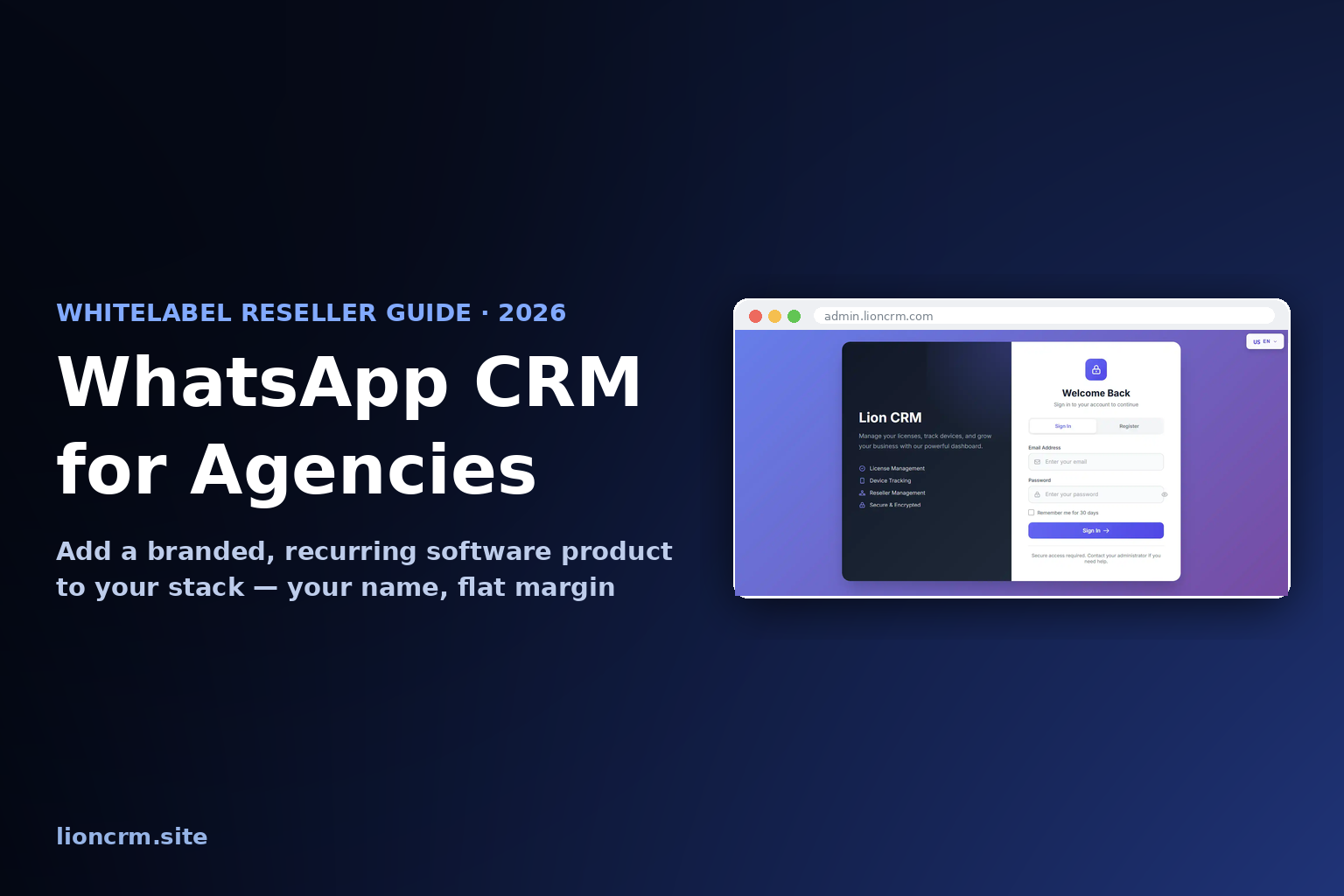
- Go to the admin panel → admin.lioncrm.com and set up your brand: name, logo, colours, and support details.
- Create your client-facing pricing — what you will charge each client per month or per year.
- Provision a trial licence so you can demo to a client without paying upfront.
- Onboard the client: connect their number, import contacts, and set up their segments and templates.
- Bill the client directly and keep the spread; international agencies can settle through PayPal.
The fastest way to size a plan and get your rebrand questions answered is a short call with my co-founder Kuldeep, who runs the reseller programme day to day — WhatsApp him at +91 74260 38448. You can also see the public plans on the pricing page first. If you want the macro picture before you start, my guide on how to start a whitelabel WhatsApp CRM business is the full start-to-finish resource, and agency-friendly pricing models walks through how to package and price the product for clients.
The agency margin math: a 30-client book in ₹ and USD
Let me make the money concrete, because that is what decides whether this line is worth your time. The numbers below are an illustration, not a quote — your real spread depends on your pricing and the vendor plan you choose.
Picture an agency that has converted 30 of its existing clients onto a branded WhatsApp CRM over a year. Many local businesses run two front-desk or sales seats, so call it an average of two seats per client — 60 seats across the book. Suppose your flat per-seat cost on a whitelabel plan works out to roughly ₹700 (about $8.4) per seat per month at that volume. Your total cost is around ₹42,000 (about $504) a month.
Now your pricing. A local business happily pays for a tool that wins and keeps customers, and ₹2,500 (about $30) per seat per month is an easy number when one saved deal covers months of it. At 60 seats that is ₹1,50,000 (about $1,800) in monthly revenue. Subtract your ₹42,000 cost and you keep about ₹1,08,000 (about $1,300) a month in gross margin — a little over ₹13,00,000 (about $15,600) a year — from clients you already had, with no servers to run and no app to build. Note what this is: recurring income layered on top of your existing ads and web revenue, not instead of it.
The reason the spread holds is the flat cost model. Because your per-seat cost does not move with how many messages a client broadcasts, a heavy-usage client grows your account value without growing your bill. Add the low churn of a tool a business uses every day, and you have the kind of recurring software income that makes an agency genuinely more valuable — the difference between selling your hours and owning an asset. For a like-for-like breakdown against a metered competitor, see Wati’s whitelabel program cost vs Lion CRM.
How to rebrand Lion CRM and sell it under your agency name
The rebrand is the part agencies worry about most, and it turns out to be the easy part, because Lion CRM hands you a finished product to dress, not a codebase to build.
Inside the admin panel you set your brand identity once — name, logo, colour scheme, and your support contact — and that is what every client sees from the login screen onward. You define your own plans and prices, so the business is buying your product at your rate, never the vendor’s. You issue trial and paid licences yourself, which means you can walk into a client meeting, switch on a 7-day trial in front of the owner, and let them feel the difference during a live week. Nothing about the experience tells the client that someone else makes the software, so every account you sign builds your agency’s brand, not a vendor’s.
Your job, then, is the work an agency is already good at: branding, packaging the offer for each vertical, demoing against the jobs that matter, onboarding the client’s contacts and templates, and handling first-line support. Anything that touches the underlying product — an outage, a platform question — escalates to the vendor, so you never run engineering. That division of labour is the whole appeal: you own the brand and the customer, the vendor owns the servers. To go deeper on finding and closing these accounts, my guide on how to find whitelabel WhatsApp CRM customers lays out the outreach, and the best whitelabel WhatsApp CRM platforms of 2026 compares the options if you are still choosing.
A 90-day plan to launch the product line
Agencies that succeed at this treat it as a product launch, not a side experiment. Here is a clean 90-day plan that moves you from idea to a paying book without betting the business on it.
In the first month, get your own house in order. Run Lion CRM on your agency’s own WhatsApp so you know the product cold, set up your brand and pricing in the admin panel, and write a one-page offer for the two verticals where you have the happiest clients. Pick three friendly clients and onboard them at a soft launch or founder price, in exchange for honest feedback and a case study. The goal of month one is not revenue — it is proof and confidence.
In the second month, turn those three accounts into a repeatable pitch. Record a two-minute demo using a real client’s tidy pipeline, document a simple onboarding checklist, and start offering the product in every client conversation you already have about ads or websites. Aim for ten paying clients by the end of month two, all from your existing book. In the third month, formalise it: add the CRM to your service menu and proposals, train one team member to onboard and support it so it does not depend on you, and set a monthly review where you watch churn and usage. By day 90 you should have a small but real recurring line, a proven pitch, and a process that runs without your constant attention. From there it is repetition, not invention.
Mistakes that kill an agency software line
A few avoidable errors sink agencies that try this, and naming them lets you dodge them.
The first is selling on a metered cost base. If your own bill rises every time a client broadcasts, your margin is hostage to your best clients’ busiest months. Pick a flat-cost model so heavy usage grows the account’s value, not your cost. The second is treating the CRM as a one-off sale. The clients who stay are the ones whose contacts, templates, and first pipeline were set up properly in onboarding and whose owner saw a dashboard — onboarding is the product, not an afterthought. Ship a bare tool and walk away and you will churn it back out within a quarter.
The third is reselling a CRM that is not truly whitelabel, so your client sees the vendor’s brand and you spend years building someone else’s equity instead of your own. The fourth is promising a WhatsApp tool is ban-proof. Bans come mainly from mass-messaging cold, unknown numbers; your clients are messaging their own customers, who already know them, so the risk is low if you sell responsible use, opt-in lists, a number validator, and sending delays — but never promise immunity, sell good practice. The fifth, quieter mistake is launching to strangers. The whole advantage of being an agency is your existing book; start there, win proof, and only then think about cold outreach. Get the cost model, the onboarding, the branding, and the launch sequence right, and a WhatsApp CRM becomes one of the steadiest recurring lines an agency can own.
The honest verdict
Agencies are the natural home for a whitelabel WhatsApp CRM. You already have trust with a book of local businesses, those businesses already run on WhatsApp and run it badly, and you already sell them improvements to how they win customers. Adding a branded CRM converts that trust into recurring software income on top of your project work, under your own name, without becoming a software company. If you simply want to use the tool first, you can start a 7-day trial on the Chrome extension today at crm.lotsofcode.in without talking to anyone.
The two things that decide whether the line is profitable are a flat cost model that protects your margin across heavy-messaging clients, and a genuinely whitelabel product that builds your brand instead of the vendor’s. Lion CRM was built for both. If that is the business you want — recurring revenue, your brand, no servers — start in the admin panel, see the pricing, or message Kuldeep at +91 74260 38448 to size your first batch of clients.
Frequently asked questions
What is a whitelabel WhatsApp CRM for an agency?
It is a WhatsApp CRM you can rebrand and sell as your own product. You put your agency’s name, logo, and web address on every screen, set your own prices, and bill clients directly, while the vendor runs the hosting and infrastructure underneath. A flat-cost option like Lion CRM runs as a Chrome extension on each client’s own number, so your cost per client stays predictable.
Why should a digital agency resell a WhatsApp CRM instead of just doing ads?
Ads and websites are project work — valuable but lumpy and easy to cancel. A WhatsApp CRM is a recurring product that earns every month, costs almost nothing to keep running, and is hard for a client to drop once their daily work lives inside it. It layers on top of your existing services and your existing client trust, so it adds stable income without replacing what you already do.
Do I need to be technical to resell a WhatsApp CRM?
No. The vendor hosts and maintains the software. Your job is branding, packaging the offer, demoing, onboarding the client’s contacts and templates, and first-line support — services skills, not engineering. Anything touching the underlying product escalates to the vendor, so you never run servers or write code.
How much can an agency earn reselling a WhatsApp CRM?
As an illustration, a book of 30 clients at an average of two seats each — 60 seats — priced near ₹2,500 (about $30) per seat per month can bring in around ₹1,50,000 (about $1,800) a month, leaving roughly ₹1,08,000 (about $1,300) in monthly gross margin after a flat per-seat vendor cost. The spread scales with seats because the per-seat cost stays flat.
How is whitelabel different from a partner or referral program?
A partner program gives you a discount or a referral cut, but the client still sees the vendor’s brand. A genuine whitelabel CRM lets you put your own name, logo, and web address on every screen, set your own prices, and own the client relationship — so you build your agency’s brand, not the vendor’s, on every account you sign.
Why does the cost model matter so much for an agency?
Because your clients message a lot, and many WhatsApp CRMs charge per conversation. If your cost rises with their messaging, your busiest clients become your least profitable. A flat-cost Chrome-extension model keeps your cost per client fixed, so heavy usage grows the account’s value without growing your bill — which is what protects your margin across a whole book.
Which clients should an agency sell a WhatsApp CRM to first?
Start with the verticals where you already have happy clients and where customers reach the business on WhatsApp — real estate, clinics and salons, coaching institutes, boutiques, travel, and gyms are all strong. Prove the tool on one account in a vertical, turn it into a case study, and let the result sell the next. You are upselling existing relationships, not entering a cold market.
Related guides
If this guide was useful, these companion pieces go deeper into the parts that matter most:
- How to Start a Whitelabel WhatsApp CRM Business in 2026 (7 Steps) — the full start-to-finish business guide behind this agency playbook.
- How to Find Whitelabel WhatsApp CRM Customers (2026) — the outreach playbook for landing your first reseller clients.
- Whitelabel WhatsApp CRM Pricing Models for Agencies (2026) — how to package and price the product for your clients.
- Cloud API vs On-Prem WhatsApp CRM for Resellers: 2026 Decision Tree — the architecture decision behind the flat-cost argument here.
- WhatsApp CRM for Coaching Institutes: Whitelabel Reseller Guide (2026) — a worked example of selling this into one specific vertical.
Related guides
- WhatsApp CRM Resources & Guides — every Lion CRM comparison, feature guide and reseller playbook, grouped in one index.
Apna brand, recurring revenue
Sell Lion CRM as your own white-label WhatsApp CRM. Your brand, your pricing, monthly recurring income from every client.
Become a Reseller on WhatsApp →View Reseller PricingSee the Admin Panel