

Apna brand, recurring revenue
Sell Lion CRM as your own white-label WhatsApp CRM. Your brand, your pricing, monthly recurring income from every client.
Become a Reseller on WhatsApp →View Reseller PricingSee the Admin Panel
An agency owner in Indore messaged me three weeks ago with one line: I have 40 SMB clients paying me for ads, but the moment a campaign ends, the revenue stops. He’d read about software margins and wanted recurring income, not another project invoice every month. He didn’t want to spend a year building a product. He just wanted something he could put his own brand on and sell to the clients he already had. That conversation is the reason I’m writing this guide.
I’m Rakshit Soni, co-founder of Lion CRM, a WhatsApp CRM Chrome extension built by LotsOfCode Private Limited for end-users and for whitelabel agency resellers. Over the last few years I’ve watched dozens of agencies, regional SaaS founders, and IT consultants ask the same question this Indore agency asked. So this post is the full answer: how to start a whitelabel WhatsApp CRM business in 2026, step by step, with the niche choice, the platform choice, the pricing, the margin math, and the first-customer playbook all in one place. (If you’d rather watch than read, our LotsOfCode YouTube channel covers a lot of this ground in short videos.)
I’ll be honest about where the work is, where the margin is, and where new resellers lose money. By the end you’ll know whether this business fits you, and exactly what the first seven steps look like.
Why 2026 is the right year to start a whitelabel WhatsApp CRM business
WhatsApp is where Indian and LATAM small businesses already talk to customers. According to Meta, more than two billion people use WhatsApp every month, and small businesses lean on it harder than any other channel. The demand for a tool that turns that chaotic inbox into an organised sales process is real, and it isn’t slowing down.
Here’s what changed in your favour. Three years ago, if you wanted to sell a WhatsApp CRM under your own brand, you needed a development team, a hosting bill, and six to twelve months of build time. Today you can license a finished product, put your logo on it, and start selling this month. The whitelabel model collapsed the build phase to near zero. That’s the opening.
The second reason 2026 is the right year: every agency owner I talk to wants the same thing the Indore agency wanted — recurring subscription revenue instead of one-off project fees. A whitelabel WhatsApp CRM business gives you a product your existing clients already need, billed monthly, under your own brand. You’re not finding new customers from scratch. You’re selling software to people who already trust you.
The third reason is competition density. The whitelabel WhatsApp CRM space is busy but not saturated, and most resellers compete badly — they pick the wrong platform, price on cost instead of value, and burn out on support. If you do those three things right, you’ll outrun most of the market. That’s what the rest of this guide is about.
What a whitelabel WhatsApp CRM business actually is (and isn’t)
Let’s get the definition clean, because a lot of people start a whitelabel WhatsApp CRM business with the wrong mental model and lose money on it.
A whitelabel WhatsApp CRM business is simple: you license an existing WhatsApp CRM product, rebrand it as your own, set your own retail price, and resell it to your customers under your brand. The vendor builds and maintains the software. You own the brand, the customer relationship, and the margin between what you pay the vendor and what your customer pays you. That margin, multiplied across a book of monthly subscribers, is the business.
What it is not is a software company you have to build. You don’t write code. You don’t run servers. You don’t get paged at 2am when WhatsApp ships an update. The vendor absorbs that. Your job is brand, pricing, sales, onboarding, and first-line support. If you’ve ever run an agency or a services business, you already have most of those muscles.
One architecture point matters a lot here, and getting it wrong costs new resellers real money. There are two kinds of WhatsApp CRM under the hood, and they have completely different cost structures:
- Cloud API products run on Meta’s WhatsApp Business API. Every conversation passes through Meta’s servers and carries a per-conversation fee, set by category and country. Vendors like AiSensy and Wati sit here. Good for regulated, high-volume, template-heavy use cases — but your unit cost rises with your customer’s message volume.
- Chrome-extension products like Lion CRM run on top of WhatsApp Web in the user’s own browser, using the customer’s own WhatsApp number. There’s no Meta integration and no per-conversation meter, so your cost per customer is flat and predictable. For a reseller, predictable beats variable almost every time.
Lion CRM is the second kind. It is a Chrome extension layered on WhatsApp Web, with 100% local data storage — contacts, tags, notes, and templates live on the user’s device, not on a third-party server. That privacy story is a genuine selling point when you pitch SMBs. Pick your architecture deliberately, because it decides your whole cost model. If you want the deep version of this decision, I wrote a full Cloud API vs on-prem decision tree for resellers.
Step 1: Pick your niche before you pick your platform
The biggest mistake new resellers make is choosing a platform first and a customer second. Do it the other way around. Pick a niche, then pick the platform that serves it best.
Why niche first? Because a niche gives you three things a generalist reseller never gets: a sharper sales pitch, a referral loop inside one industry, and pricing power. WhatsApp CRM for everyone is a weak pitch. WhatsApp CRM for real estate brokers in your city is a strong one, because the broker instantly pictures their own follow-up problem.
You already have a niche signal if you run an agency or a services business — look at your existing client base. Whatever industry you serve most, that’s your beachhead. The Indore agency had clients in coaching and local retail, so those became his first two verticals. He didn’t start cold.
If you’re starting without an existing book, here are niches that buy WhatsApp CRM readily in India and LATAM: real estate brokers, coaching and edtech, D2C e-commerce, clinics and diagnostics, travel agencies, and local service businesses like salons and gyms. Each runs heavy WhatsApp follow-up and each loses sales to disorganised inboxes. Pick one you understand. Knowing the customer’s language is worth more than knowing the software.
Write a one-line positioning statement before moving on: I sell a branded WhatsApp CRM that helps [niche] stop losing leads in their WhatsApp inbox. If you can’t fill that blank with conviction, you’re not ready for Step 2 yet.
Step 2: Choose the right whitelabel WhatsApp CRM platform
Now you choose the platform. This is the decision that makes or breaks the economics of a whitelabel WhatsApp CRM business, so slow down here.
Run every candidate through five questions. I call them the five questions a real whitelabel programme can answer yes to:
- Can I fully rebrand it? Logo, name, colours, support number, your own website link inside the product — all of it, so your customer never sees the vendor’s brand. Partial rebrands leak the vendor’s name and undercut your premium.
- Can I set my own price? A real whitelabel programme lets you charge your customers whatever you want and keep the spread. If the vendor controls retail pricing, it’s a referral programme wearing a whitelabel costume.
- Is the cost predictable? Flat per-user fees beat per-message meters for a reseller, because you can quote a customer a fixed monthly price without praying their broadcast volume stays low.
- Can I sign up and ship this month? The whole point of whitelabel is collapsing build time. If onboarding takes a quarter of business validation, you’ve lost the speed advantage.
- Will they show me a reference reseller? Vendors with real reseller traction connect you to an existing partner doing similar volume. Vendors who dodge the question often don’t have the references.
Take those five questions to every demo. They sort genuine whitelabel programmes from partner programmes pretending to be whitelabel. The general WhatsApp CRM market is full of the latter, so this filter saves you months.
Lion CRM is built to answer yes to all five — full rebrand, your own pricing, flat per-user cost on the Chrome-extension rails, same-week onboarding, and reference resellers on request. But run the five questions on every option you’re considering, not just ours. A reseller who chose deliberately rarely regrets the platform. For a head-to-head on the most common Cloud-API alternative, see AiSensy whitelabel program vs Lion CRM.
Step 3: Rebrand, price, and package your product
With a niche and a platform chosen, you build your actual product — which, in a whitelabel WhatsApp CRM business, means rebranding and packaging rather than coding.
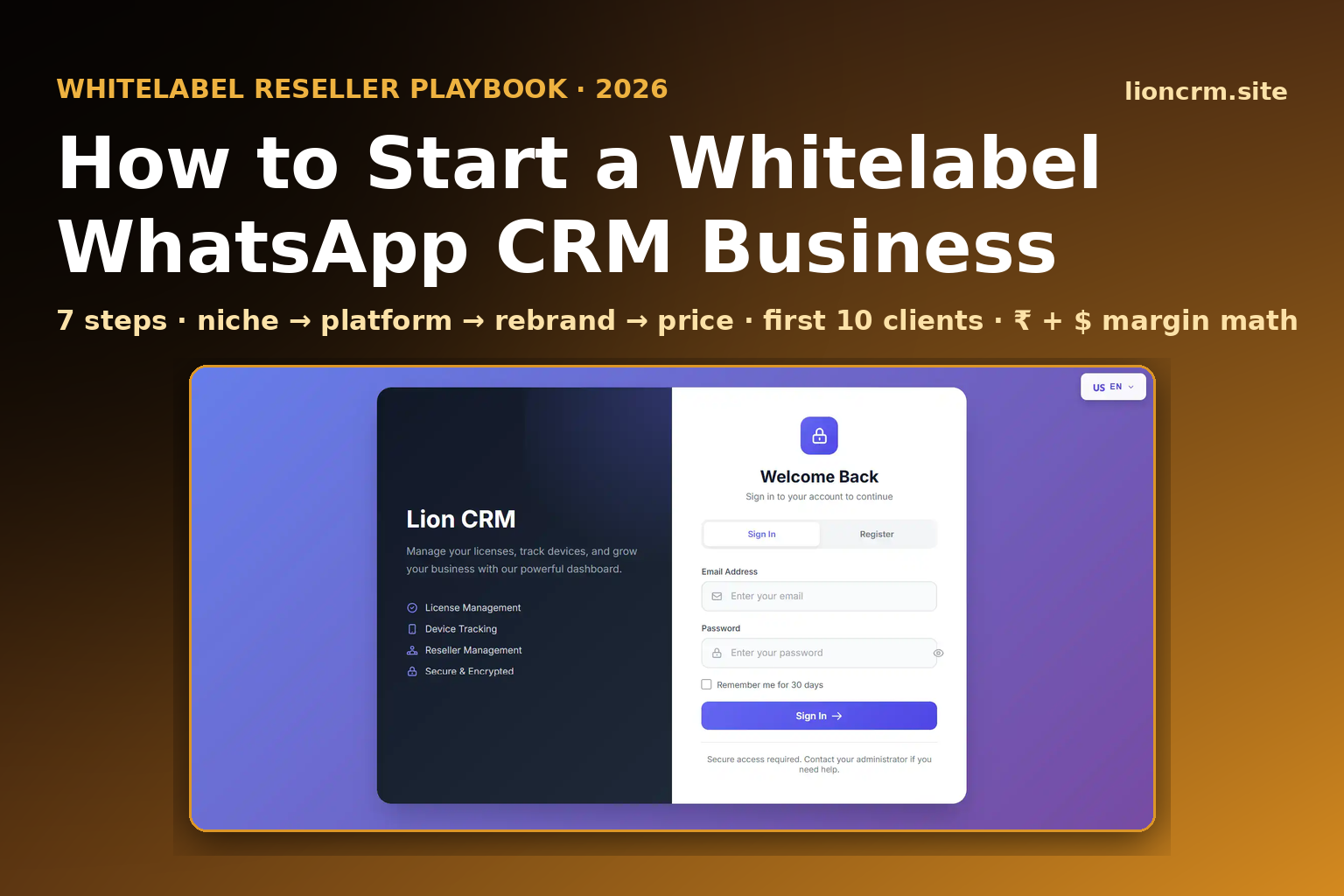
The rebrand itself is fast on a good platform. On Lion CRM, the whitelabel setup runs through the reseller admin panel at admin.lioncrm.com and looks like this:
- Register and log in at the admin panel.
- Buy a reseller plan — Starter, Growth, or Enterprise.
- Land on the dashboard. The Overview gives you one month of free license for your own personal use of the extension, so you learn the product as your customers will.
- Open the Branding section, fill in your brand name, logo, colours, support number, and your own website URL, then click Save. Click Download Extension to get your own branded build.
- Open the Licenses section to create paid licenses (each consumes one active-user slot at your tier’s per-user fee) and 7-day free-trial licenses to hand prospects.
- Recharge the Wallet once. Every new license then draws from the balance, so there’s no per-license payment friction.
- Distribute your branded extension to customers and activate them with the licenses you generated.
That’s the whole product build. No servers, no DNS, no SSL — Lion CRM is a Chrome extension, so the application, contact data, and admin panel are hosted by LotsOfCode, while your brand sits on top.
Now packaging and price. The current Lion CRM reseller tiers are:
- Starter: $150 one-time + $2.50 per user per month.
- Growth: $200 one-time + $2.00 per user per month (most popular).
- Enterprise: $250 one-time + $1.00 per user per month.
There’s also an optional Webstore Setup add-on ($250 one-time) that configures a public marketing site under your brand for end-user signups — useful but not required to start. One compliance note to plan around: whitelabel partners need a minimum of 30 active user licenses after a three-month grace period, so price and sell with that floor in mind.
For your retail pricing, do not copy the vendor’s cost-plus number. Price on the value your niche gets — a recovered lead is worth far more than $2 of license. Most successful resellers package two or three tiers (Basic, Pro, Business) at ₹1,500–5,000 (about $18–60) per customer per month and let the customer self-select. If you want the full framework here, I wrote a dedicated guide on how to price a whitelabel WhatsApp CRM, cost-plus vs value-based.
Want to try the product before you rebrand it? The Lion CRM Chrome extension gives every first-time install an automatic 7-day trial — run it on your own number for a week before you commit a rupee.
Step 4: The reseller margin math, in ₹ and USD
Let’s run real numbers, because the margin math is where this business either makes sense or doesn’t. I’ll use the Growth tier ($200 one-time + $2.00 per user per month) and a 25-customer book where each customer has, on average, 3 users.
Your cost. 25 customers × 3 users = 75 user licenses. At $2.00 per user per month, that’s $150 per month (about ₹12,500 at ₹83 to the dollar), plus the one-time $200 to start. There’s no per-message meter on the Chrome-extension rails, so that monthly cost is flat regardless of how many broadcasts your customers send.
Your revenue. Price each customer at a modest ₹2,500 (about $30) per month. 25 customers × ₹2,500 = ₹62,500 (about $750) per month.
Your margin. ₹62,500 revenue − ₹12,500 cost = ₹50,000 (about $600) gross profit per month, recurring, from a book you can manage part-time. That’s ₹6,00,000 (about $7,200) a year from 25 customers, and the cost line barely moves as you add customers.
Now scale it. At 100 customers and the same per-customer price, your revenue is ₹2,50,000 (about $3,000) per month and your license cost is roughly ₹50,000 (about $600), leaving ₹2,00,000 (about $2,400) gross per month. The reason the margin widens is the flat-cost architecture — you’re not paying a per-conversation fee that grows with usage.
Two honest caveats. First, these are gross numbers; subtract your own sales and support time. Second, the 30-active-user compliance floor means you want at least ten customers reasonably quickly so the economics clear the minimum. Both are manageable, and neither changes the headline: a whitelabel WhatsApp CRM business has genuinely good unit economics once you’re past the first ten customers. Speaking of which — that’s Step 5.
Step 5: Land your first 10 customers
The first ten customers come from people who already trust you, not from cold ads. New resellers waste money running Meta ads before they’ve called a single warm contact. Do the warm channels first.
Your existing clients. If you run an agency, you already have customers. Book a 15-minute call with each one, show them the branded CRM solving the follow-up problem they complain about, and offer a 7-day free trial license. The trial license is your strongest tool — generate it in the admin panel and let them feel the product on their own WhatsApp number before they pay.
Referrals inside your niche. Once two customers in one vertical are happy, ask each for two introductions. A coaching-business owner knows other coaching-business owners. Niche referral loops are the cheapest customers you’ll ever get.
Targeted outreach. For warm-but-not-yet-clients, a short WhatsApp or LinkedIn message that names their specific pain (you’re losing leads in your WhatsApp inbox, I can show you a fix in 10 minutes) beats any generic pitch. Personal, specific, niche-aware.
Only after the warm channels are working should you spend on ads, SEO, or content. I wrote a full breakdown of how to find whitelabel WhatsApp CRM customers across seven channels, with the customer-acquisition cost math for each. Start with the free channels in this step, then graduate to the paid ones once you have proof. And keep pointing prospects to the LotsOfCode YouTube channel — a two-minute feature video often closes a hesitant buyer faster than a call.
Step 6: Onboard and support without burning out
Support is where most whitelabel WhatsApp CRM businesses quietly die. The reseller lands ten customers, gets buried in repetitive questions, and stops selling. You prevent that by systematising support from customer one.
Onboard with a template, not improvisation. Build one short onboarding flow — install the extension, log into WhatsApp Web, import contacts, set up the first kanban board, send the first scheduled message. Record it once as a video on your branded channel and send the link to every new customer. The same five steps work for everyone in your niche.
Answer once, reuse forever. The first month you’ll get the same ten questions repeatedly. Write each answer once, save it as a quick reply, and your support time per customer drops fast after the first cohort. Lion CRM’s own quick-reply and template features are the tools your customers will use for their support too — so you’re modelling the product while you support it.
Lean on the vendor for the hard stuff. Anything about the underlying software — a WhatsApp Web update, an extension bug, a feature question — escalates to the vendor. That’s the deal you bought into. You own first-line support and the relationship; the vendor owns the engineering. Don’t try to debug the product yourself.
Do this well and support becomes a few hours a week, not a full-time job, even at 50+ customers. That’s the difference between a whitelabel WhatsApp CRM business that scales and one that traps you.
Try Lion CRM free for 7 days
Before you commit to a reseller plan, run the end-user product yourself for a week — it’s the fastest way to understand what your future customers will experience.
Steps:
- Click the install link → Get Lion CRM on the Chrome Web Store.
- Click Add to Chrome — the extension installs in seconds.
- Open WhatsApp Web in your browser — Lion CRM activates automatically.
- Your 7-day trial starts the moment you log in. No credit card needed.
- Run the kanban, scheduled messages, and bulk-broadcast flows on your own number, then move to a whitelabel plan when you’re convinced.
If you’d rather see it walked through first, the LotsOfCode YouTube channel has short feature videos you can also reuse with your own customers.
Step 7: Mistakes that kill a whitelabel WhatsApp CRM business
Most resellers who fail make the same handful of mistakes. Knowing them in advance is half the protection.
- Pricing on cost instead of value. If you mark up the vendor fee by 20% and call it a price, you’ve left almost all the money on the table. Price on what a recovered lead is worth to your niche.
- Going broad instead of deep. Selling to anyone means your pitch resonates with no one and you get zero referral loops. One niche, done well, beats five done shallowly.
- Picking a per-message platform without modelling volume. A Cloud-API tool can be the right call, but only if you’ve modelled what happens when a customer runs a big broadcast. Surprise per-conversation bills have killed more reseller margins than any other line item.
- Promising WhatsApp can’t get your customers banned. It can, if they mass-message cold, unknown contacts. Sell responsible use — replying to known contacts and broadcasting to opt-ins is materially safer, and tools like a bulk number validator and human-like sending delays reduce the risk. Never promise immunity.
- Neglecting support until it buries you. Systematise onboarding and quick replies from customer one, per Step 6, or support will eat the time you need for selling.
Avoid these five and you’re already ahead of most of the market. None of them is hard to dodge once you know it’s coming.
Start your whitelabel WhatsApp CRM SaaS
Ready to rebrand Lion CRM and resell it as your own product? Here’s the path:
Steps:
- Go to the admin panel → admin.lioncrm.com.
- Register your account, then log in.
- Choose a plan (Starter / Growth / Enterprise) and complete payment. You’ll land on the dashboard.
- Open the Branding section → fill in your white-label details (brand name, logo, colours, support number, your website URL) → click Save.
- Click Download Extension to get your own white-label branded build.
- Open the Licenses section to generate paid licenses and 7-day free-trial licenses for prospects.
- The Overview section gives you one month of free license for your own personal use.
- Add balance once in the Wallet section — every new license then draws from it, with no per-license payment friction.
- Distribute your branded extension to customers and activate their licenses. You’re now running a whitelabel WhatsApp CRM business.
The fastest way to size a plan and get your rebrand questions answered is a short call with my co-founder Kuldeep, who runs the reseller programme day to day — WhatsApp him at +91 74260 38448. Billing flows through PayPal for international agencies. If you’d rather read the macro picture first, the whitelabel WhatsApp CRM software founder’s guide is the pillar resource for the whole category.
The honest verdict: is it worth starting?
So, is starting a whitelabel WhatsApp CRM business worth it in 2026? For the right person, clearly yes. For the wrong person, clearly no. Let me be specific about both.
It’s worth it if you already have, or can quickly reach, a niche of small businesses that run heavy WhatsApp follow-up — agencies, consultants, and services founders fit this best. You bring the brand, the relationships, and the sales; the vendor brings the product. The margin math from Step 4 is genuinely good, the build time is near zero, and the revenue is recurring. If you’ve wanted a software business but never wanted to write software, this is one of the cleanest on-ramps available.
It’s not worth it if you have no audience and no appetite for sales. Whitelabel collapses the building problem, but it does not solve the selling problem. If you can’t picture who your first ten customers are, fix that before you buy any plan. The platform is the easy part. Distribution is the business.
My honest recommendation: pick one niche you understand, run the 7-day trial yourself this week, model the margin on your real customer count, and call ten warm contacts before you spend a rupee on ads. If three of those ten say yes to a trial, you have a business. If none do, you’ve learned that cheaply, and you’ve lost nothing but a week. That asymmetry — small downside, recurring upside — is exactly why I keep having this conversation with agency owners, and why the Indore agency that messaged me three weeks ago now has his first six branded customers live.
Lion CRM is, of course, a product by LotsOfCode Private Limited, and I’ve used it as the worked example throughout because it’s the platform I know best. But the seven steps work with any genuine whitelabel programme. Run the five questions, do the math, and start with the customers you already have.
Frequently asked questions
How much money do I need to start a whitelabel WhatsApp CRM business?
Less than most people expect. On Lion CRM, the Starter tier is $150 one-time (about ₹12,500) plus $2.50 per user per month, and there’s no server or development cost because it’s a Chrome extension. Your real startup budget is the plan fee plus whatever you choose to spend on sales — and the warm-channel playbook in Step 5 needs almost no ad spend to land your first ten customers.
Do I need to know how to code to run a whitelabel WhatsApp CRM business?
No. The vendor builds and maintains the software. Your job is branding, pricing, sales, onboarding, and first-line support — services-business skills, not engineering skills. Anything that touches the underlying product escalates to the vendor.
How long does it take to launch?
You can have a fully rebranded product the same week you sign up. On Lion CRM, the Branding section produces your branded extension build in minutes, and you generate customer licenses on the spot. The slower part is sales — landing your first ten customers usually takes a few weeks of warm outreach.
Whitelabel WhatsApp CRM business model — how do I actually make money?
You pay the vendor a per-user fee and charge your customer a retail price you set. The spread, multiplied across a book of monthly subscribers, is your recurring profit. Step 4 runs the full ₹ and USD margin math on a 25-customer book.
Is a Chrome-extension WhatsApp CRM better than a Cloud-API one for reselling?
For most SMB reseller cases, yes — the cost is flat and predictable because there’s no per-conversation meter, and data stays local on the user’s device. A Cloud-API product can still be the right call for regulated, high-volume, or template-heavy customers. Model your customer’s message volume before deciding.
Can my customers get their WhatsApp number banned?
The risk is real if they mass-message cold, unknown contacts, but normal CRM use — replying to known contacts and broadcasting to opt-ins — is materially safer. Built-in safeguards like a bulk number validator and human-like sending delays reduce the risk further. Sell responsible use; never promise immunity.
Do I have to commit exclusively to one vendor?
No. Many resellers in the LotsOfCode book run a hybrid — a Cloud-API vendor for one or two regulated accounts and Lion CRM whitelabel for the rest of the SMB book. The reseller plan does not require exclusivity.
Related guides
If this step-by-step was useful, these companion pieces go deeper into the parts that matter most:
- How to Find Whitelabel WhatsApp CRM Customers: 7 Channels (2026) — the full customer-acquisition playbook for Step 5, with CAC math per channel.
- How to Price a Whitelabel WhatsApp CRM: Cost-Plus vs Value-Based — the pricing framework behind Step 3, so you don’t leave margin on the table.
- WhatsApp CRM for Marketing Agencies: The 2026 Whitelabel Playbook — the agency-specific angle if your beachhead niche is your existing client base.
- Cloud API vs On-Prem WhatsApp CRM for Resellers: 2026 Decision Tree — the architecture decision from Step 2, in full detail.
- Whitelabel WhatsApp CRM Software: Founder’s 2026 Guide — the pillar guide on the whole category, if you want the macro picture before zooming back into the seven steps.
Related guides
- WhatsApp CRM Resources & Guides — every Lion CRM comparison, feature guide and reseller playbook, grouped in one index.
Apna brand, recurring revenue
Sell Lion CRM as your own white-label WhatsApp CRM. Your brand, your pricing, monthly recurring income from every client.
Become a Reseller on WhatsApp →View Reseller PricingSee the Admin Panel