

Apna brand, recurring revenue
Sell Lion CRM as your own white-label WhatsApp CRM. Your brand, your pricing, monthly recurring income from every client.
Become a Reseller on WhatsApp →View Reseller PricingSee the Admin Panel
A sales-agency owner in Indore called me in March with a problem I hear a lot. He set up Kommo for a dozen small businesses — real-estate desks, a couple of clinics, a tuition centre — wired their WhatsApp into the pipeline, and the clients loved it. Then he wanted to package the whole thing as his own product, on his own brand and his own pricing, for the next forty leads in his network. He asked Kommo about a whitelabel option and got a no. That gap is why this post exists, and it’s a wall a lot of would-be resellers walk straight into. If you’re hunting for a Kommo whitelabel alternative, you’re in the right place.
I’m Rakshit Soni, co-founder of Lion CRM, a WhatsApp CRM Chrome extension built by LotsOfCode Private Limited for end-users and for whitelabel agency resellers. Kommo is a capable product, so this isn’t a takedown. The point is narrower and more useful — if your goal is to resell a WhatsApp CRM as your own brand and keep recurring margin, Kommo is the wrong tool, and I’ll show you exactly why and what to use instead. (If you’d rather watch than read, the LotsOfCode YouTube channel covers a lot of this in short videos.)
By the end you’ll know who Kommo actually fits, what a real whitelabel alternative has to do, six options worth a look, and the margin math on building a reseller book. Let me start with the product itself, fairly.
Who Kommo is actually built for
Kommo, formerly amoCRM, is a messenger-based sales CRM, and it’s a well-built one. It’s pitched at small sales teams that live in chat — the idea is that your leads come in through WhatsApp, Instagram, Telegram, or Facebook Messenger, and Kommo turns each of those conversations into a card on a sales pipeline you can actually manage.
The feature set is genuinely good, and it’s sales-first by design. Kommo’s strength is the unified inbox plus a visual lead pipeline — every messenger lands in one place, each new chat becomes a lead, and you drag it through stages from first contact to closed deal. On top of that you get Salesbot, its no-code chatbot builder, plus task reminders, broadcast messaging, and a clean activity log on every contact. For a small team that sells through conversations, that’s a credible and well-fitted stack, and the multi-channel pipeline is a real time-saver.
Pricing follows a per-seat SaaS model. Plans run roughly from a Base tier near $15 (about ₹1,250) per user per month, an Advanced tier near $25 (about ₹2,075) per user per month, up to an Enterprise tier near $45 (about ₹3,750) per user per month, billed annually. The WhatsApp connection sits on top of that — you either run Kommo’s built-in WhatsApp integration or connect through Meta’s official WhatsApp Business (Cloud) API, and on the official API you also pay Meta’s own per-message charges, which pass straight through. For a single team running its own sales, that cost is manageable. The trouble starts the moment you try to turn Kommo into a product you sell. Hold that thought, because it’s the whole story.
So the honest summary is this: Kommo is built for the end sales team, not for the reseller. If you’re a small business managing your own pipeline across messengers, it’s a reasonable pick. If you’re an agency trying to build recurring revenue under your own name, keep reading.
Why Kommo doesn’t work as a reseller product
There are three hard reasons a reseller can’t build a real business on Kommo, and each one matters on its own.
The first is the missing whitelabel layer. Kommo is sold as Kommo. There’s no reseller console where you set your own brand name, logo, colours, and support number and hand a client an app that says your company everywhere they look. Kommo runs a partner and affiliate program, which pays you a referral cut, but your client still logs into Kommo-branded software. That makes you a referrer, not the owner of the relationship. The day Kommo changes a price or a feature, your client knows it wasn’t you, and your brand never got built.
The second is the economics. You’re stacking two cost lines that both move on you. There’s Kommo’s per-seat monthly fee, which climbs with every agent your clients add, and there’s the WhatsApp messaging cost on top — and if a client runs on the official Cloud API, Meta moved from per-conversation to per-message billing on 1 January 2026, while India’s WhatsApp marketing-message rates rose too. So part of your cost base is per-seat and part is metered, and neither is yours to rebrand. Selling on a moving cost base is a hard way to promise a client a flat monthly price and still protect your margin.
The third is control of the customer. On a referral or partner-seat model, the vendor owns billing, the brand, and ultimately the customer. If the vendor decides to court your clients directly tomorrow, your book is exposed. A true whitelabel arrangement flips that — you own the brand and the customer, the vendor quietly owns the infrastructure. That ownership is the entire reason to be a reseller in the first place. For the broader version of this argument, my guide on how to start a whitelabel WhatsApp CRM business walks through the full model.
What whitelabel really means for a WhatsApp CRM reseller
It’s worth being precise here, because the word whitelabel gets thrown around loosely and a lot of platforms claim it without delivering it.
A genuine whitelabel WhatsApp CRM lets you do four things. You rebrand the product end to end — name, logo, colours, support details, and your own website URL — so the client never sees the vendor. You set your own prices and bill the client directly, keeping the full spread. You own the customer relationship and the data tied to it. And you lean on the vendor only for the infrastructure underneath, so you carry no servers, no DNS, and no SSL of your own.
Many tools offer a watered-down version. A partner program gives you a discount and a referral cut, but the client still sees the vendor’s brand. A reseller dashboard might let you provision seats, but the login screen still says the vendor’s name. Those are useful, but they aren’t whitelabel, and they don’t build your brand equity over the years.
The test is simple. Can your client tell who actually makes the software? If the answer is yes, it isn’t whitelabel. If the answer is no — if every screen they touch says your brand — then you own something that compounds. That distinction is exactly what Kommo doesn’t offer and what a real alternative has to. My deeper Gallabox alternatives for resellers guide makes the same point against a Cloud API tool, if you want a second example.
The two cost layers that quietly eat reseller margin
This deserves its own section because cost is the single biggest financial trap for a new reseller, and with Kommo it hides in two places at once.
The first layer is Kommo’s per-seat fee. Every agent your clients add bumps your monthly cost on Kommo’s tier — Base, Advanced, or Enterprise. That’s predictable per seat, which is good, but it’s also a fee on software you can’t put your name on, so you’re paying a markup to resell someone else’s brand. The second layer is the WhatsApp messaging cost. If a client runs on Meta’s official Cloud API, you also absorb or pass on per-message charges, and since 1 January 2026 Meta bills per message rather than per 24-hour conversation, with India’s marketing rates rising in the same window. A client who suddenly triples their broadcast volume can turn a profitable account into a break-even one overnight.
Chrome-extension products work differently. A tool like Lion CRM runs on top of WhatsApp Web in the agent’s own browser, using the agent’s own number. There’s no Meta integration in the middle and no per-message meter, so your cost per client is a single flat per-seat line you can model. You know your margin on client one and on client fifty, and a big broadcast doesn’t change it.
For a reseller building a book of small businesses, predictable nearly always beats powerful. The metered model can suit a high-volume sender that genuinely needs verified template broadcasts at scale. But for the long tail of small businesses an agency actually signs, a single flat cost is what keeps the margin intact. I laid out the full version of this trade-off in my Cloud API vs on-prem WhatsApp CRM decision tree for resellers.
What to look for in a Kommo whitelabel alternative
Before you compare logos, get clear on the five things that actually matter when you’re choosing a reseller platform. Score every option against these and the decision gets easy.
- A real rebrand. Full control of brand name, logo, colours, support number, and website URL — not just a partner badge. The client should never see the vendor.
- Predictable cost. A flat per-seat or per-user fee you can model, ideally without a per-message meter that swings with your client’s volume.
- You own billing and the customer. You set the price, you invoice, you keep the relationship. The vendor stays invisible.
- Low operational load. The vendor hosts and maintains the software so you carry no servers, no updates, and no security patching.
- A clean margin structure. Tiered per-user pricing that drops as you scale, plus a trial-license system so you can demo without paying.
Notice that a long feature list isn’t on the list. Features matter for the end user’s experience, but your business as a reseller lives or dies on brand control, predictable cost, and ownership. A tool can have every feature Kommo has and still be useless to you if you can’t put your name on it.
Six whitelabel-ready alternatives to Kommo in 2026
Here’s an honest field guide. I run one of these, so I’ll be upfront about that and fair about the rest. The grouping that matters is architecture, because it sets your cost model — Cloud API and seat-based SaaS tools are metered or per-seat, the Chrome-extension model is flat per seat with no message meter.
- Lion CRM (Chrome extension, full whitelabel). Runs on WhatsApp Web with the agent’s own number, so cost per client is a flat per-seat fee with no per-message meter. The reseller admin panel gives you a true end-to-end rebrand, your own pricing, and client license management. Best fit for an agency building a book of small and mid businesses. This is the one I’ll detail below.
- AiSensy (Cloud API, partner program). A capable broadcast-first API platform with an agency tier. Strong for high-volume template senders, but it’s metered per message and the rebrand is partial. See my AiSensy whitelabel program vs Lion CRM breakdown.
- Wati (Cloud API, reseller tier). Popular and feature-rich, with a reseller route. Same metered-cost caveat applies, and the brand control is limited. I compared the reseller economics in WATI whitelabel program vs Lion CRM.
- Interakt (Cloud API). A solid India-focused API tool, well-suited to a single brand’s own WhatsApp. Reseller branding is minimal, so it fits self-use more than rebranding.
- DoubleTick (Cloud API). A polished, broadcast-and-catalog API tool with strong analytics. Good for a brand’s own use, but it’s sold as DoubleTick with no full reseller rebrand, so it doesn’t build your brand.
- Twilio-based builds (CPaaS, fully custom). If you have developers, you can build a branded CRM on Twilio’s API. Maximum control, maximum effort, and you own the maintenance forever — a real option only for agencies with an engineering team.
If your goal is a low-effort, flat-cost reseller business under your own brand, the Chrome-extension model is the cleanest fit, which is why I’ll spend the rest of this post on it.
Try Lion CRM free for 7 days
Before you resell anything, run the end-user product yourself for a week. It’s the fastest way to understand exactly what your future clients will feel on a demo call, and it costs nothing.
Steps:
- Click the install link → Get Lion CRM on the Chrome Web Store.
- Click Add to Chrome — the extension installs in seconds.
- Open WhatsApp Web in your browser — Lion CRM activates automatically.
- Your 7-day trial starts the moment you log in. No credit card needed.
- Build a mock client pipeline on the kanban board, save a few templates, and schedule a follow-up — that’s the exact demo you’ll run for prospects.
If you’d rather see it walked through first, the LotsOfCode YouTube channel has short feature videos you can reuse with your own clients.
Kommo vs Lion CRM: the reseller comparison
Here’s the side-by-side that matters if you’re choosing a tool to resell, not to use. I’m scoring on reseller fit, not on raw feature count, because that’s the lens that pays your bills.
| What matters to a reseller | Kommo | Lion CRM |
|---|---|---|
| Full whitelabel rebrand | No — sold as Kommo | Yes — name, logo, colours, URL |
| Architecture | Seat-based SaaS + WhatsApp via Cloud API | Chrome extension (WhatsApp Web) |
| Cost model | Per-seat plan fee + per-message meter on API | Flat per-user, no message meter |
| You set client pricing | Limited | Yes, fully |
| You own the customer | Vendor-led | Reseller-owned |
| Servers / hosting on you | N/A (vendor SaaS) | None — vendor hosts |
| Data storage | Vendor cloud | Local on agent’s device |
| Best fit | A small sales team’s own multi-channel pipeline | An agency reselling under its brand |
The pattern is clear. Kommo is excellent at being Kommo for a small sales team, and its multi-channel pipeline and Salesbot are a genuine strength for a business managing its own leads. Lion CRM is built so you can stop being a referrer and start being the brand. One honest caveat I always give: if a client genuinely needs Meta-verified template broadcasts to cold, very large lists, a green tick, or a full multi-channel pipeline spanning Instagram and Telegram, a tool like Kommo is the right call for that client. For the long tail of small businesses an agency actually signs, the extension model wins on cost and control.
What you give up by leaving Kommo — and what you don’t
Switching from a seat-based SaaS CRM to a Chrome-extension model isn’t free of trade-offs, and I’d rather you hear them from me than discover them on a client call. There are three real ones for a Kommo user, and each is narrower than it sounds.
The first is the multi-channel inbox. Kommo pulls WhatsApp, Instagram, Telegram, and Facebook Messenger into one pipeline, so a client working leads across all four sees them in a single view. A WhatsApp-focused extension centres on WhatsApp. For most small businesses that matters far less than people assume — the overwhelming majority of their conversations already happen on WhatsApp, and a clean WhatsApp pipeline beats a cluttered four-channel one they never tend. But if a client genuinely runs heavy Instagram and Telegram lead flow, be honest and weigh that one client separately.
The second is the verified green tick and official-API broadcasts. On Kommo’s Cloud API connection a client can earn the verified business badge and push approved template messages to large lists. A Chrome extension uses the agent’s own number on WhatsApp Web, so there’s no green tick and no mass-template engine. For most small businesses the badge matters less than people think — their customers reply because the number is familiar, not because of a badge. If a client’s whole pitch leans on looking like a verified enterprise or blasting huge cold lists, steer that one client to a Cloud API tool. You can resell both and pick per client.
The third is the deeper sales-automation surface — heavy Salesbot flows, complex pipeline analytics, and a long list of native integrations. This is Kommo’s home turf as a full CRM. The extension model is built for relationship selling and a clean pipeline, not for elaborate automation trees. In practice, the small and mid businesses an agency actually signs rarely use more than a fraction of that surface, so it’s a smaller loss than the feature list suggests.
Now the good news — the long list of things you don’t give up. Your clients keep their own number, their contacts, and their conversation history. They keep a shared team inbox, a kanban pipeline, follow-up flows, templates and quick replies, bulk messaging to opt-in lists with a number validator, and a per-contact profile. The day-to-day experience an agent feels is comparable. What you add is the part Kommo can’t give a reseller: your brand on every screen, a flat cost you can model, and a customer who’s yours. For most agency books, that’s a trade worth making with eyes open.
The reseller margin math: a 25-client book in ₹ and USD
Let’s make this concrete, because the margin is the whole reason to switch from referring Kommo to reselling your own brand.
Say you sign 25 clients in your first few months — a mix of solo operators and small teams. On Lion CRM’s Growth tier, your cost side is $200 (about ₹16,000) one-time plus $2.00 (about ₹165) per user per month. If those 25 clients run 60 agent seats between them, your monthly vendor cost is roughly 60 × $2.00 = $120 (about ₹10,000) a month, plus the one-time license. That’s your entire cost of goods, and it doesn’t move with how many messages anyone sends.
Your revenue side, if you price at a modest ₹2,500 (about $30) per seat per month across those 60 seats, is 60 × ₹2,500 = ₹1,50,000 (about $1,800) a month. Subtract the ₹10,000 vendor cost and you keep roughly ₹1,40,000 (about $1,680) a month in gross margin, recurring, under your own brand. Now picture running that same book on Kommo: a per-seat SaaS fee on every agent, plus a per-message meter on the WhatsApp layer, with Meta’s 2026 switch to per-message billing and India’s marketing-rate rise pushing costs up. One client’s festival broadcast and your cost line jumps unpredictably. The flat-cost model is what makes the margin yours to keep.
Run the same numbers at a smaller scale and the shape holds. Ten clients with 24 seats at the same ₹2,500 price is 24 × ₹2,500 = ₹60,000 (about $720) a month in revenue against roughly 24 × $2.00 = $48 (about ₹4,000) in vendor cost — a clean spread even on a part-time book. Push the seat count to 150 and the per-seat cost drops to $1.00 (about ₹83) on the Enterprise tier, so the margin widens as you grow rather than thinning. That’s the opposite of a stacked per-seat-plus-metered model, where heavy clients cost you more.
One note on the rules: Lion CRM asks whitelabel partners to keep a minimum of 30 active user licenses after a three-month grace period, so this math assumes you’re past the early ramp and actually building. License funding runs through a wallet you top up once, so each new license draws from balance instead of a fresh payment. For the full pricing framework — cost-plus versus value-based — see my guide on how to price a whitelabel WhatsApp CRM.
How to rebrand Lion CRM and sell it as your own
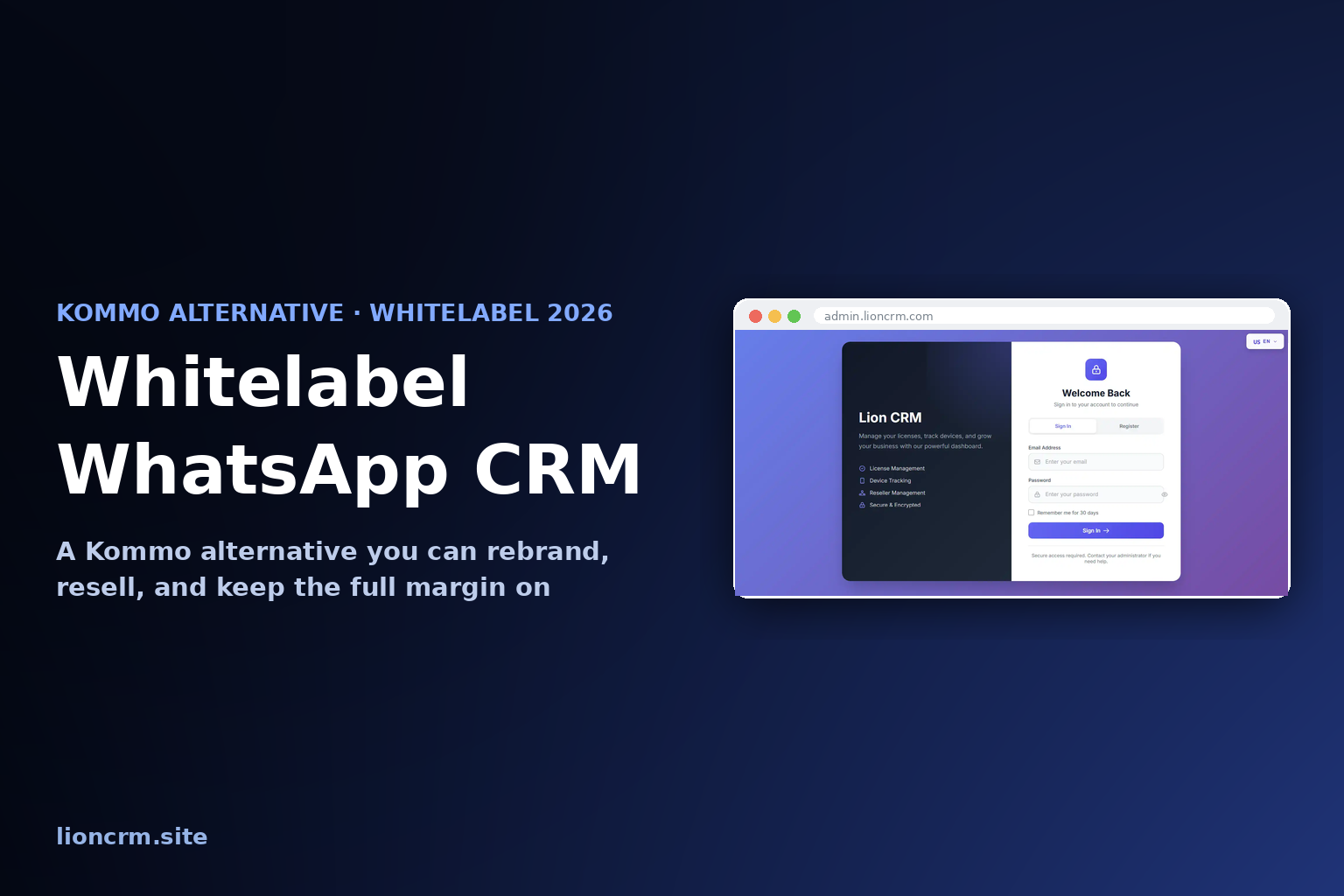
This is the part Kommo can’t do, and on Lion CRM it’s faster than most people expect. The whole rebrand runs through the reseller admin panel at admin.lioncrm.com.
In the Branding section you set your brand name, logo, colours, support number, and your own website URL. Save it, click Download Extension, and you have a branded build that says your company, not Lion CRM, everywhere the agent looks. The application itself — messaging, contact data, admin — is hosted by LotsOfCode, so there’s no server, DNS, or SSL work on your side. You own the brand and the customer; the vendor owns the infrastructure underneath. The customer’s data stays local on the agent’s own device, which is an easy promise to make to a privacy-minded client.
For packaging, I’d sell a single clean product with two or three tiers rather than a raw feature list. Most clients buy outcomes, not feature menus. A Team tier might bundle the kanban pipeline, follow-up flows, and templates; a Business tier adds multi-agent seats and onboarding. Same underlying extension, packaged for how your buyer thinks. If you want end-user buyers to sign up under your own marketing site, the optional Webstore Setup add-on ($250, about ₹20,000, one-time) spins up a public signup site under your brand — useful if you plan to run ads. For more on the dedicated agency angle, see whitelabel WhatsApp CRM for agencies.
Start your whitelabel WhatsApp CRM
Ready to stop referring Kommo and start selling your own branded WhatsApp CRM? Here’s the path:
Steps:
- Go to the admin panel → admin.lioncrm.com.
- Register your account, then log in.
- Choose a plan — Starter ($150 + $2.50/user/mo), Growth ($200 + $2.00/user/mo, most popular), or Enterprise ($250 + $1.00/user/mo) — and complete payment.
- Open the Branding section → add your brand name, logo, colours, support number, and website URL → click Save.
- Click Download Extension to get your white-label branded build.
- In the Licenses section, generate paid licenses and 7-day free-trial licenses for prospects.
- The Overview section gives you one month of free license for your own use.
- Add balance once in the Wallet section — each new license then draws from it, with no per-license payment friction.
- Distribute your branded extension to clients and activate their licenses. You’re now running a WhatsApp CRM business under your own name.
The fastest way to size a plan and get your rebrand questions answered is a short call with my co-founder Kuldeep, who runs the reseller programme day to day — WhatsApp him at +91 74260 38448. International agencies bill through PayPal, so currency isn’t a hurdle. If you’d rather read the macro picture first, the whitelabel WhatsApp CRM software founder’s guide is the pillar resource for the whole category.
How to move a Kommo client to your branded CRM
If you already have clients on Kommo, or you’re about to pitch some, the switch is more about handling than tech. Here’s the path that loses the fewest people.
First, lead with what changes for them and what doesn’t. Their conversations still happen on WhatsApp, with their own number and contacts. What changes is the layer on top — a cleaner WhatsApp pipeline, follow-up flows, and your brand instead of Kommo’s. Frame it as an upgrade to a tool you support directly, not a risky migration. And be honest about the one thing the extension won’t replicate: if a client genuinely runs heavy Instagram and Telegram lead flow, weigh whether they belong on a multi-channel tool and keep your branded CRM for the WhatsApp-led majority.
Second, move the data they care about. Contact lists and templates are the assets. Export their contact list, rebuild their core templates inside the branded extension, and set up a starter kanban pipeline before the handover call so it feels ready, not raw. Most small clients have a handful of templates, not thousands, so this is an afternoon, not a project.
Third, run a short parallel week. Let them keep Kommo live while they try your branded build on a few real chats. When they see their pipeline organised and their follow-ups firing under your brand, the switch makes itself. For the full acquisition and onboarding playbook, read how to find whitelabel WhatsApp CRM customers.
Mistakes that kill a WhatsApp CRM reseller
Most resellers who stall make the same few mistakes. Knowing them in advance is half the protection.
- Reselling a tool you can’t rebrand. If the client sees the vendor’s name, you’re building the vendor’s brand, not yours. Insist on a real whitelabel layer.
- Ignoring the stacked cost base. A per-seat fee plus a per-message meter turns one big client broadcast into a margin shock — and Meta’s 2026 per-message switch plus India’s rate rise make it sharper. Either model that volume carefully or choose flat-cost.
- Pricing on cost, not on value. A recovered lead or a closed deal is worth far more than a monthly fee. Mark up the vendor cost by a little and you throw away the spread.
- Demoing features instead of the outcome. Buyers don’t want a feature list. They want to see their messy inbox become a clean pipeline. Lead with the WhatsApp kanban board view.
- Skipping the onboarding kit. Without a reusable install guide and templates, support eats the time you need for selling. Build it once, on client one.
Dodge these five and you’re already ahead of most of the market. None of them is hard to avoid once you see it coming.
The honest verdict
So, is Kommo the wrong tool for you? It depends entirely on which side of the table you’re on.
If you’re a single small business running your own sales pipeline across WhatsApp, Instagram, and Telegram, and you value a unified inbox, Salesbot automation, and deeper analytics, Kommo is a credible CRM you should weigh on its merits. Nothing here changes that.
But if your goal is to build recurring revenue by reselling a WhatsApp CRM as your own brand, Kommo simply isn’t built for you. There’s no full rebrand, your cost base stacks a per-seat fee on top of a per-message meter in a year when Meta switched to per-message billing and India’s rates rose, and the customer stays the vendor’s. A whitelabel-first, flat-cost tool fixes all three. My honest recommendation: run the 7-day Lion CRM trial this week, rebrand a build in the admin panel so you can see your own name on it, then take that branded demo to three clients you already have. Keep any heavy multi-channel client on a tool like Kommo, resell both, and pick per client. If the rest say yes, you’ve got a business that compounds under your brand instead of someone else’s. That small-downside, recurring-upside shape is exactly why the Indore agency owner who hit Kommo’s whitelabel wall now sells his own branded CRM to most of his network.
Frequently asked questions
Does Kommo offer a whitelabel or reseller program?
Kommo is sold as Kommo, and it runs a partner and affiliate program that pays a referral cut. But there’s no full reseller console to rebrand the product end to end with your own name, logo, and pricing. Your client still logs into Kommo-branded software, so you don’t build your own brand equity or fully own the relationship.
What is the best whitelabel alternative to Kommo for resellers?
For an agency building a book of small and mid businesses, a flat-cost Chrome-extension CRM like Lion CRM is usually the cleanest fit, because it offers a true end-to-end rebrand and no per-message meter. Cloud API tools like AiSensy and Wati have partner tiers but keep metered costs and partial branding.
Why does the cost base matter when reselling Kommo?
Kommo stacks a per-seat plan fee with the WhatsApp messaging cost, and on the official Cloud API Meta moved to per-message billing on 1 January 2026 while India’s marketing rates rose. When you resell at a flat monthly price, a single large broadcast can erase your margin. A flat per-user model keeps your cost predictable on every account.
How much can I earn reselling a whitelabel WhatsApp CRM?
On a 25-client book with around 60 agent seats, priced near ₹2,500 (about $30) per seat per month, gross margin can land around ₹1,40,000 (about $1,680) a month after vendor cost. The spread scales with seats because the per-seat cost is flat, not metered.
Can I move my existing Kommo clients to a branded CRM?
Yes. Their conversations stay on WhatsApp with their own number and contacts. You export their contact list, rebuild their core templates in your branded build, and run a short parallel week before switching fully. For small clients this is usually an afternoon of setup — though a client running heavy Instagram and Telegram flow may be better kept on a multi-channel tool.
Do I need to be technical to resell a whitelabel WhatsApp CRM?
No. The vendor hosts and maintains the software. Your job is branding, packaging, pricing, sales, onboarding, and first-line support — services-business skills, not engineering. Anything touching the underlying product escalates to the vendor.
Is a Chrome-extension WhatsApp CRM safe for my clients to use?
Yes, when used normally. Bans come mainly from mass-messaging cold, unknown contacts. Replying to known buyers and broadcasting to opt-in lists is materially safer, and a bulk number validator plus human-like sending delays reduce the risk further. Sell responsible use to every client and never promise immunity — that’s both the honest pitch and the one that keeps their numbers alive.
Related guides
If this comparison was useful, these companion pieces go deeper into the parts that matter most:
- How to Start a Whitelabel WhatsApp CRM Business in 2026 (7 Steps) — the full start-to-finish business guide behind this comparison.
- Gallabox Alternatives: Whitelabel WhatsApp CRM for Resellers — the same reseller argument against a Cloud API tool.
- AiSensy Whitelabel Program vs Lion CRM (2026) — a like-for-like look at another competitor’s reseller terms.
- WATI Whitelabel Program vs Lion CRM — Reseller Cost Breakdown — the reseller economics of a popular metered platform.
- Cloud API vs On-Prem WhatsApp CRM for Resellers: 2026 Decision Tree — the architecture decision behind the cost-model argument here.
- How to Price a Whitelabel WhatsApp CRM: Cost-Plus vs Value-Based — the pricing framework behind the margin math.
- Whitelabel WhatsApp CRM Software: Founder’s 2026 Guide — the pillar guide on the whole category.
Related guides
- WhatsApp CRM Resources & Guides — every Lion CRM comparison, feature guide and reseller playbook, grouped in one index.
Apna brand, recurring revenue
Sell Lion CRM as your own white-label WhatsApp CRM. Your brand, your pricing, monthly recurring income from every client.
Become a Reseller on WhatsApp →View Reseller PricingSee the Admin Panel