

Every few days someone messages us with the same question. They have seen agencies charging small businesses ₹1,000 or ₹2,000 a month for a WhatsApp tool, and they want to know how to start your own WhatsApp marketing software business without being a developer. It is a fair question, and the honest answer is that it is much easier today than it was three years ago — but only if you skip the mistake almost everybody makes first.
This guide walks through the whole thing: what the business actually is, what it costs, where the money comes from, and the three routes you can take. We run a white label programme ourselves, so we have a side in this. We will be upfront about that, and we will also tell you where our route is the wrong choice.
What this business actually looks like
Strip away the jargon and it is simple. Small businesses in India, Brazil, Indonesia, Nigeria and the Gulf run their entire sales process on WhatsApp. A jewellery shop, a coaching centre, a clinic, a property dealer — all of them are answering customers on WhatsApp Web all day. What they do not have is any structure around it. No follow-up reminders, no way to tag a lead as hot or cold, no way to send the same message to two hundred saved contacts without typing it two hundred times.
You sell them that structure as software, under your own brand name, for a monthly fee. You are not building anything. You are licensing a product, putting your logo on it, and taking the difference between what you pay and what you charge.
That is the entire business. The skill is not technical — it is sales. If you already talk to shop owners, clinics or agencies every week, you are most of the way there.
Three ways to start your own WhatsApp marketing software business
1. Build it yourself
You hire developers, build a product, handle hosting, updates and support forever. Realistic cost in India is ₹8–15 lakh and six to nine months before you have anything sellable. Then WhatsApp changes something and you fix it at your own cost, every time.
This makes sense if software is your long-term company and you want to own the asset. It makes no sense if you want revenue this quarter.
2. Become an affiliate
You promote somebody else’s tool with a link and take 20 to 30 per cent commission. Zero cost, zero risk. Also zero control — the customer belongs to them, the brand is theirs, and the day they cut commissions your income drops.
Affiliate is fine as a side income. It is not a business you can sell later.
3. White label somebody else’s product
You pay a one-time setup fee, get the product under your own brand, and pay a small per-number cost as you add clients. Your customers never see the original company. You set the price, you own the customer, you keep the margin.
This is the route most people should take, and it is the one we will spend the rest of this guide on.
What it really costs to start
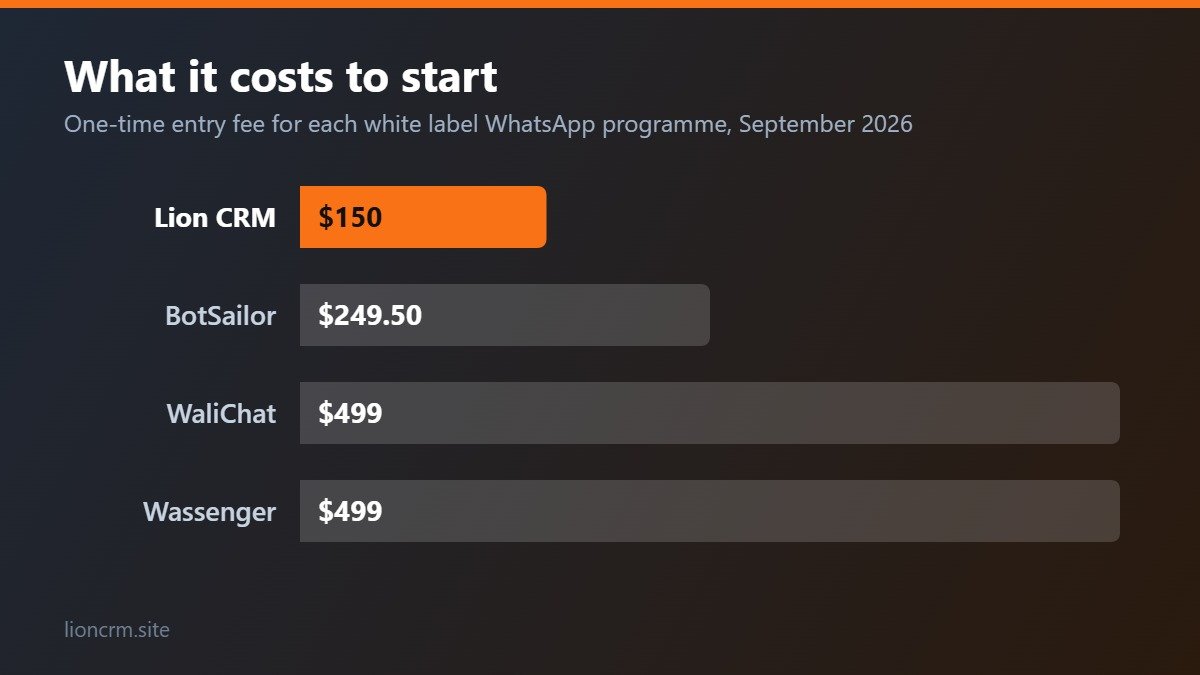
Here is where a lot of guides go soft. Actual published numbers, checked in September 2026, for the main white label WhatsApp programmes:
- Lion CRM — $150 one-time, then $3.25 per user per month
- BotSailor — $249.50 one-time, then $2.25 per active member, minimum 20 billable users
- WaliChat — $499 one-time, nothing per user after that
- Wassenger — $499 one-time, nothing per user after that
Read that carefully, because the cheapest number is not automatically the best deal for you. If you already have three hundred customers waiting, a flat $499 with no per-number cost will work out cheaper over two years. If you are starting from zero, paying $499 before your first sale is money at risk for no reason.
We priced our own white label WhatsApp CRM reseller program at $150 for exactly that reason — the person starting out should not have to gamble half a lakh to find out whether they can sell.
The margin, with real numbers
This is the part worth understanding before you pay anybody anything.
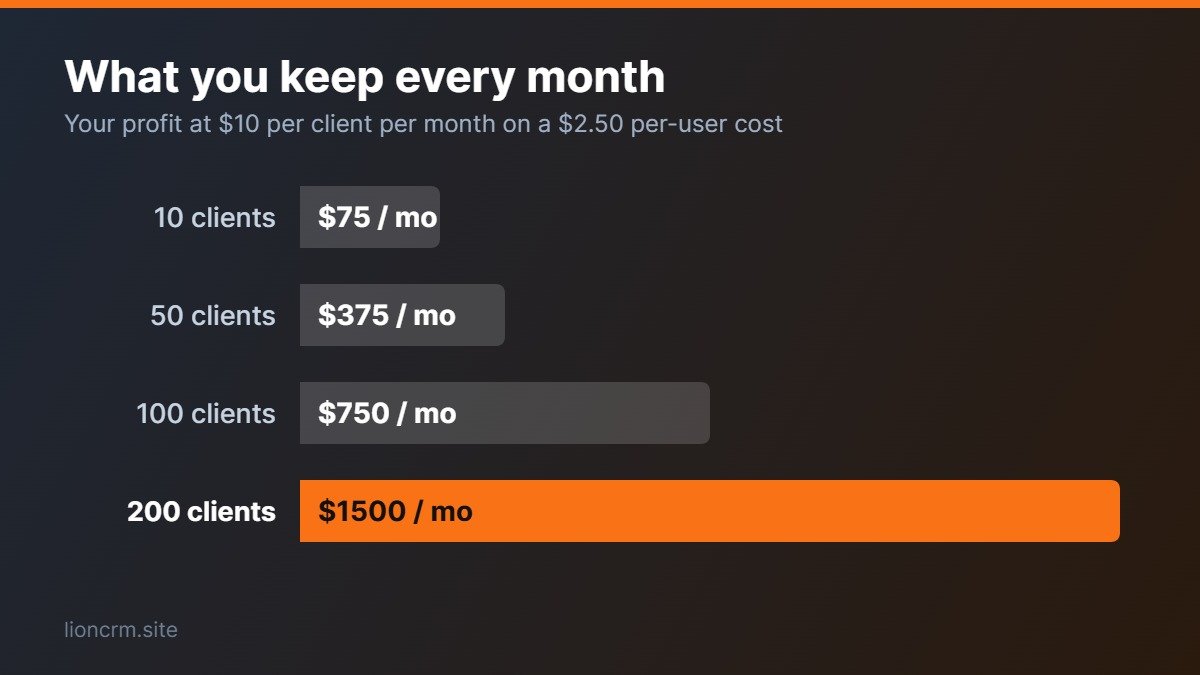
Say you sign ten clients and charge each of them $10 a month, which is roughly ₹1,000 — a price no small business argues with. That is $100 a month coming in. On a $3.25 per-number cost, $25 goes out. You keep $75 a month, every month, for as long as they stay.
Ten clients is a slow month of selling. Fifty clients is $375 a month. Two hundred clients is $1,500 a month, which is a real income in most of the markets this product sells in.
The number that matters is not the first sale, it is retention. Software that a business opens every single day does not get cancelled. That is why a CRM that lives inside WhatsApp Web retains better than a separate app nobody logs into.
We broke this down further in our post on whitelabel WhatsApp CRM profit margins if you want the full maths.
API or Chrome extension? This decision costs people months
Most people who set out to start your own WhatsApp marketing software business assume they need the official WhatsApp Business API. Sometimes you do. Often you do not, and going that route slows you down badly.
With the official API route, every single client needs a Meta Business account, business verification, a WhatsApp Business Account and template approvals. Meta’s own documentation walks through the Cloud API onboarding steps, and it is genuinely involved. For a chartered accountant with forty clients, that is forty verification processes. Many small businesses simply do not have the documents.
With a Chrome extension that works inside WhatsApp Web, there is nothing to approve. The client installs it, enters a licence key, and their existing WhatsApp number becomes a CRM in about two minutes. No Meta account, no verification, no waiting.
The honest trade-off: the API route supports automated template broadcasts at scale and official green tick verification. The extension route is faster, cheaper and covers what the overwhelming majority of small businesses actually want — organised leads, saved replies, follow-ups and controlled bulk sending from their own number.
If you are selling to enterprises, go API. If you are selling to the shop, clinic and coaching-centre market, the extension will close far more deals.
Who to sell to in your first month
Do not start with cold outreach to strangers. Start with the businesses that already know your name.
- Your existing clients, if you run an agency or an IT service. They already pay you and already trust you.
- Coaching centres and institutes — they chase enquiries on WhatsApp constantly and lose most of them to bad follow-up.
- Clinics and diagnostic labs — appointment reminders and report delivery are pure WhatsApp workflows.
- Property dealers and real estate agents — long follow-up cycles, high deal value, they will happily pay.
- Local retail with a delivery business — bakeries, opticians, boutiques, mobile shops.
- Other resellers — once you are running, you can add sub-resellers under your own brand and take a cut of their sales too.
Lead with the problem, not the product. “How many enquiries came on WhatsApp last week that nobody followed up on?” gets you further than any feature list.
Mistakes that kill new software resellers
Pricing too low. Charging ₹300 a month attracts customers who leave in two months and complain constantly. Price at what the value is worth. A business that closes one extra deal a month has already paid for it many times over.
Promising features that do not exist. You did not build the product. Learn exactly what it does and does not do before you sell it, and say no when something is outside its scope.
No onboarding. A licence key emailed with no help is a refund waiting to happen. Fifteen minutes on a call while the client sets up their first labels decides whether they stay a year.
Treating it as a one-time sale. This is a subscription. Your job on day thirty is not to find a new client, it is to make sure the last one is still using it.
A realistic first ninety days
Weeks one and two: get your branded panel set up, learn the product properly, and use it yourself on your own WhatsApp for a few days. You cannot sell software you have not used.
Weeks three to six: go to ten businesses you already know. Show them the tool on your own phone. Give the free trial. Expect two or three to convert.
Weeks seven to twelve: those first clients are your proof. Ask each one for two referrals. Start a simple WhatsApp broadcast to your own contact list. This is usually where it starts compounding.
Most partners cross ten active licences somewhere in month two or three. That is the point where it stops being an experiment.
Is this worth doing at all?
The decision to start your own WhatsApp marketing software business is worth taking if you have, or can build, a way to reach business owners. The product is not the hard part and never was. Somebody with a hundred shopkeepers in their phonebook will out-earn somebody with a better product and no distribution, every time.
If you have no route to customers and no plan to build one, no white label programme will fix that, including ours. Spend three months building a local network first.
If you do have that network, the maths is genuinely good. Low entry cost, recurring revenue, a product people open every day, and a market that is still nowhere near saturated outside the big metros.
Starting with Lion CRM
We run one of these programmes. More than fifty resellers across eight countries are selling our WhatsApp CRM under their own brand right now. Entry is $150 one-time plus $3.25 per user per month, there is a seven-day free trial so you can put it in front of a client before committing, and the only ongoing requirement is ten active licences a month with a three-month grace period while you get going.
You can see the full terms, plan comparison and margin breakdown on the reseller programme page, or check the pricing page including the INR table for India.
And if you are still comparing options, our guide to the best white-label WhatsApp CRM to resell covers the alternatives side by side, including the ones we lose to.