

Apna brand, recurring revenue
Sell Lion CRM as your own white-label WhatsApp CRM. Your brand, your pricing, monthly recurring income from every client.
Become a Reseller on WhatsApp →View Reseller PricingSee the Admin Panel
A reseller in Indore sent me his spreadsheet last month, proud of it. He had 18 client seats live, charged ₹2,500 (about $30) each, and his top line read ₹45,000 a month. That’s my profit, he wrote. It wasn’t. He’d forgotten the one-time license he’d paid, the 30-seat minimum he was still under, the two hours a week he spent answering client questions, and the two clients who’d quietly stopped paying. His real take-home was less than half the number he was celebrating. The gap between revenue and actual profit is what this guide is about.
I’m Rakshit Soni, co-founder of Lion CRM, a WhatsApp CRM Chrome extension built by LotsOfCode Private Limited for end-users and for whitelabel agency resellers. Once you’ve sorted out what a WhatsApp CRM costs to resell and what to charge, the next question is the one that actually pays your rent: what margin do you keep? This guide gives you the real gross and net margin math in rupees and dollars, margin by tier, and the levers that widen it. (If you’d rather watch than read, the LotsOfCode YouTube channel covers a lot of this in short videos.)
By the end you’ll be able to model your own margin at any scale, spot the costs that quietly shrink it, and pick the moves that grow it. Let me start with the word everyone uses loosely — margin.
What profit margin really means for a WhatsApp CRM reseller
Margin is not the same as revenue, and confusing the two is the most expensive mistake a new reseller makes.
There are two margins that matter, and you need both. Gross margin is what’s left after your direct vendor cost — the software fee you pay to run each client’s account. Net margin is what’s left after everything else too: your time, support, churn, payment fees, and the one-time costs spread across the year. Gross margin tells you whether the product is profitable. Net margin tells you whether your business is profitable. The Indore reseller was looking at revenue and calling it gross, while ignoring net entirely.
Here’s why this matters so much in WhatsApp CRM specifically. The gross margin on a flat per-seat tool is genuinely high — often above 90% — because the vendor cost per seat is small. That high number is real, and it’s the reason this is a good business to be in. But it also lulls people into thinking the whole thing prints money, so they never model net. A 92% gross margin can still become a 45% net margin once support and churn are counted, and 45% is still a fine business. The point isn’t to be scared of net costs. The point is to see them, so you price and scale with eyes open.
So every number in this guide comes in two layers: the headline gross margin that proves the model works, and the honest net margin that tells you what actually lands in your account.
The cost stack that decides your margin
Your margin is set by the costs underneath you, so let me lay out the full stack before any math.
On a flat per-seat extension model like Lion CRM, the costs are small and predictable. There’s a one-time whitelabel license fee, somewhere between $150 and $250 (about ₹12,500–₹20,800) depending on tier. Then there’s a per-seat monthly fee of $1.00 to $2.50 (about ₹83–₹208) per active user. There’s a 30-active-user minimum that kicks in after a three-month grace period, so once you’re past the grace window you pay for at least 30 seats. And there are optional one-time add-ons, like the Webstore Setup at $250 (about ₹20,800) if you want a public signup site under your brand. That’s the whole stack — no per-message meter.
On a Cloud-API tool the stack is different and riskier. You still pay a platform fee, but on top sits Meta’s per-message charge, which moves with every campaign your clients send. After Meta switched from per-conversation to per-message billing on 1 January 2026, and India’s marketing rate rose around 10%, that meter got both bigger and harder to predict. A metered cost doesn’t just lower your margin — it makes your margin unknowable until the month is over.
This is the key insight: a flat stack gives you a margin you can calculate in advance, and a metered stack gives you a margin you can only measure in hindsight. For a reseller quoting clients a fixed monthly price, a margin you can calculate beats a margin you discover. Everything below assumes the flat per-seat model, because that’s the one where the math actually holds.
Why the cost model is really a margin decision
People treat per-seat versus per-message as a pricing question. It’s really a margin-stability question, and that’s a bigger deal.
Imagine two resellers, each charging a client a flat ₹2,500 (about $30) a seat. The first runs a flat per-seat tool, so their cost is a fixed ₹166 a seat no matter what. Their margin is locked at about ₹2,300 every single month. The second runs a metered tool, paying per message. In a quiet month their cost might be ₹400 a seat, leaving a fat ₹2,100. But the month that client blasts a festival broadcast to 8,000 contacts, the message bill can swallow most of the spread — and on a bad month, all of it. Same price to the client, wildly different margin.
The flat model doesn’t just give a higher average margin. It gives a margin with no downside tail, and that tail is what kills resellers. You can survive a thin month. You cannot survive a month where one client’s campaign turns your margin negative, because you’ve already promised that client a flat price you can’t claw back. The Cloud API vs on-prem reseller decision tree walks through exactly when each architecture fits, but for margin predictability, flat wins almost every time.
So when you choose your underlying tool, you’re not just choosing a cost. You’re choosing whether your margin is a number you set or a number the market hands you. Pick the one you can set.
Gross margin at three scales: 5, 25 and 100 seats
Let me make this concrete with real numbers. The example below uses the Growth tier — $200 one-time license, then $2.00 (about ₹166) per active user per month — and a reseller price of ₹2,500 (about $30) per seat per month. We’ll set the one-time license aside for now and look at recurring gross margin, then fold the one-time in under net margin.
| Active seats | Monthly revenue | Vendor cost | Gross margin (₹) | Gross margin % |
|---|---|---|---|---|
| 5 | ₹12,500 (~$150) | ₹830 (~$10) | ₹11,670 | 93% |
| 25 | ₹62,500 (~$750) | ₹4,150 (~$50) | ₹58,350 | 93% |
| 60 | ₹1,50,000 (~$1,800) | ₹9,960 (~$120) | ₹1,40,040 | 93% |
| 100 | ₹2,50,000 (~$3,000) | ₹16,600 (~$200) | ₹2,33,400 | 93% |
The headline is that gross margin percentage barely moves with scale, because the cost is flat per seat. What grows is the rupee amount, and that’s the part that matters. Five seats is a side hustle worth about ₹11,670 a month. Sixty seats — roughly 25 small clients — is a real ₹1,40,000-a-month business. A hundred seats clears ₹2,33,400 before your own costs. The model rewards you linearly for selling, with no margin erosion as you grow, which is exactly the shape you want.
There’s a small catch at the bottom of the table, though. At 5 seats you’re under the 30-active-user minimum, so once your three-month grace ends, your real vendor cost is 30 × ₹166 = ₹4,980, not ₹830. That doesn’t change the percentage at scale, but it does mean the smallest resellers carry a fixed floor cost until they grow past 30 seats. Net margin is where that floor shows up, so let’s go there next — right after the one thing you should do before modelling anything.
Try Lion CRM free for 7 days
Before you model a single margin, run the end-user product yourself for a week. It’s the fastest way to feel exactly what your future clients will feel, and it costs nothing.
Steps:
- Click the install link → Get Lion CRM on the Chrome Web Store.
- Click Add to Chrome — the extension installs in seconds.
- Open WhatsApp Web in your browser — Lion CRM activates automatically.
- Your 7-day trial starts the moment you log in. No credit card needed.
- Build a mock client pipeline on the WhatsApp kanban board, save a few templates, schedule a follow-up — that’s the exact demo you’ll run for prospects.
Knowing the product first-hand also makes your support cheaper, which directly protects the net margin we’re about to calculate.
Net margin: the costs that quietly eat your spread
Gross margin proves the product works. Net margin tells you what you actually keep, and it’s always lower — the question is by how much.
Take the 60-seat business with ₹1,40,040 of monthly gross margin. Now subtract the costs gross ignores. The one-time $200 (about ₹16,600) license, spread across a year, is roughly ₹1,400 a month. Support and onboarding — say six hours a week at a modest ₹500 an hour — is about ₹12,000 a month. Payment-gateway fees on your collections run 2–3%, around ₹3,500 on ₹1,50,000. And churn matters: if two of your 60 seats lapse before you replace them, that’s about ₹5,000 of revenue gone. Add those up and you’ve shaved roughly ₹22,000 off the top.
| Line | Amount (monthly) |
|---|---|
| Gross margin (60 seats) | ₹1,40,040 |
| Less: amortised license | −₹1,400 |
| Less: support + onboarding time | −₹12,000 |
| Less: payment fees (~2.5%) | −₹3,500 |
| Less: churn drag (~2 seats) | −₹5,000 |
| Net margin | ₹1,18,140 (~84%) |
That’s still an excellent business — 84% net at this scale. But notice what’s doing the damage: your time is the biggest single line, not the vendor. That’s the clue to scaling profitably. The vendor cost is tiny and fixed; your support time is the thing that grows with clients unless you systematise it. The smaller you are, the worse this looks — at 10 seats, the 30-user minimum floor plus support time can pull net margin under 50%. The encouraging part is the direction: as you add seats, fixed costs spread thinner and net margin climbs toward gross. Scale is the cure.
Margin by tier: Starter vs Growth vs Enterprise
The whitelabel plan you pick changes your per-seat cost, and therefore your margin at scale. Here’s how the three tiers compare on the recurring per-seat fee.
| Tier | One-time license | Per-seat / month | Best for |
|---|---|---|---|
| Starter | $150 (~₹12,500) | $2.50 (~₹208) | Testing the model, first few clients |
| Growth | $200 (~₹16,600) | $2.00 (~₹166) | Most resellers — the popular pick |
| Enterprise | $250 (~₹20,800) | $1.00 (~₹83) | High seat counts, best unit margin |
The pattern is simple: the more you commit up front, the cheaper each seat gets. At 100 seats, the per-seat fee on Growth costs you ₹16,600 a month, while Enterprise halves that to ₹8,300 — an extra ₹8,300 of pure margin every month for the same revenue. The one-time difference between the tiers is trivial against that. So the tier decision is really a forecast: if you’re confident of crossing 50–100 seats, Enterprise pays for itself fast; if you’re still proving the model, Starter or Growth keeps your risk low. You can also see the full plan details and current numbers on the Lion CRM whitelabel pricing page.
One honest note: don’t over-buy the tier to chase a few rupees of unit margin before you have the clients. A cheaper per-seat cost on seats you haven’t sold yet is a worse deal than a slightly higher cost on seats that are actually paying. Match the tier to where you’ll realistically be in six months, not where you hope to be.
Model your margin in the whitelabel admin panel
The cleanest way to stop guessing your margin is to see the real cost mechanics in the admin panel, where the numbers actually live.
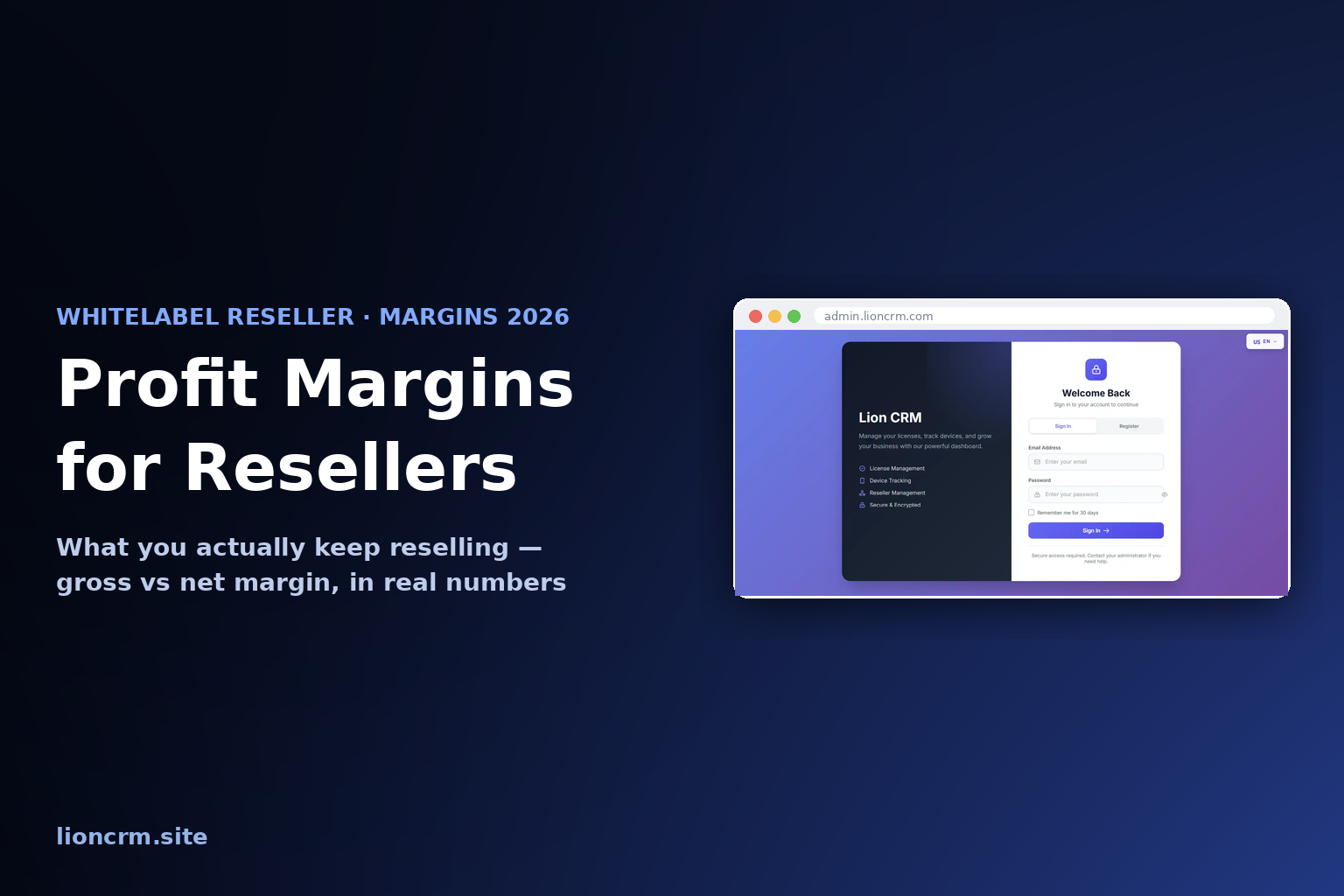
Inside admin.lioncrm.com, the Wallet section shows exactly how much each active license draws, so your per-seat cost stops being an estimate and becomes a figure you can read. The Licenses section lets you issue both paid licenses and 7-day free-trial licenses, so you can see how trials convert to paid seats — which is the real driver of net margin. And the Overview section gives you one month of free license for your own use, so you can run the product on your own brand while you model the spread. Seeing the cost draw against the wallet, next to the price you charge, makes the margin obvious in a way no spreadsheet does.
If you want a second pair of eyes on your numbers before you commit, the fastest route is a short call with my co-founder Kuldeep, who runs the reseller programme day to day — WhatsApp him at +91 74260 38448. He’ll help you size a tier against your client forecast and sanity-check the margin you’re assuming. International agencies pay through PayPal, so currency is never the blocker.
Five levers that widen your reseller margin
Margin isn’t fixed. Once you can see it, you can move it. Here are the five levers that matter most, roughly in order of impact.
First, raise your price with value, not features. The single biggest lever is the number you charge. Moving from ₹2,500 to ₹3,500 a seat on a flat ₹166 cost adds a clean ₹1,000 of margin per seat with no extra cost to you. The way to earn that price is to anchor on outcomes — a recovered lead, a closed deal — which is the whole point of value-based pricing over cost-plus.
Second, cut support time, not support quality. Your time is the biggest net-margin cost, so reusable onboarding videos, a shared FAQ, and template libraries pay back fast. Every hour you remove from per-client support drops straight to net margin.
Third, climb the tier ladder as you scale. Moving to Enterprise once you’re past 50 seats halves your per-seat cost. That’s automatic margin for doing nothing but committing earlier.
Fourth, reduce churn. A retained seat is far cheaper than a won one. Good onboarding and steady check-ins keep seats alive, and since churn is a direct line in the net-margin table, every saved seat is saved margin.
Fifth, sell tiers, not seats. Packaging the same tools into a Team and a Business plan lets buyers self-select into higher value, lifting your average price per seat without a harder sell. The agency reseller guide goes deeper on packaging for service businesses.
Margin mistakes that shrink your spread
Just as important as the levers are the leaks. These are the mistakes I see quietly cost resellers margin every month.
The first is confusing revenue with profit, like the Indore reseller — celebrating the top line while net costs eat half of it. Always model net before you decide you’re rich. The second is pricing on a meter you can’t predict, which turns a knowable margin into a gamble; the flat per-seat model exists precisely to avoid this. The third is ignoring the 30-user minimum, which makes the smallest resellers carry a fixed floor cost they didn’t budget for — model it from day one so the early months don’t surprise you.
The fourth leak is under-pricing out of fear. New resellers often quote low to win the first clients, then get stuck there because raising prices on existing clients is hard. Start a notch higher than feels comfortable; a flat cost means you keep almost all of any increase. The fifth is drowning in unbilled support, where you give away hours that should be productised or priced into a higher tier. If support time is your biggest cost — and the net-margin table says it usually is — then leaving it unmanaged is leaving margin on the table. Fix these five, and your net margin climbs without selling a single extra seat.
Start your whitelabel WhatsApp CRM SaaS
Ready to turn this margin math into a real branded business? Here’s the path from zero to your own WhatsApp CRM.
Steps:
- Go to the admin panel → admin.lioncrm.com.
- Register your account, then log in.
- Choose a plan — Starter ($150 + $2.50/user/mo), Growth ($200 + $2.00/user/mo, most popular), or Enterprise ($250 + $1.00/user/mo) — and complete payment.
- Open the Branding section → add your brand name, logo, colours, support number, and website URL → click Save.
- Click Download Extension to get your white-label branded build.
- In the Licenses section, generate paid licenses and 7-day free-trial licenses for prospects.
- The Overview section gives you one month of free license for your own use.
- Add balance once in the Wallet section — each new license then draws from it, so your per-seat cost is always visible.
- Distribute your branded extension, set your prices, and activate client licenses. You’re now running a WhatsApp CRM business under your own name, on margins you control.
To size a plan against your client forecast, WhatsApp my co-founder Kuldeep at +91 74260 38448; international agencies bill through PayPal. For the macro picture, the whitelabel WhatsApp CRM software founder’s guide is the pillar resource, and how to find whitelabel WhatsApp CRM customers covers filling those seats.
The honest verdict
So what should you actually take away about whitelabel WhatsApp CRM profit margins in 2026?
The gross margin is genuinely high — above 90% on a flat per-seat model — and that’s not marketing, it’s just what a small fixed cost against a healthy price produces. But don’t stop at gross. Your net margin, after your time, churn, fees, and the one-time license, is the number that pays you, and at real scale it still lands in the 75–85% range. That’s a strong business by any standard, as long as you actually model it instead of celebrating revenue.
The two decisions that protect your margin are the cost model and your own price. A flat per-seat cost gives you a margin you can calculate and defend, with no campaign-month downside tail. A value-anchored price keeps the spread wide enough to absorb the support time that scaling brings. Get both right and your margin grows with every seat instead of leaking away.
My honest recommendation: run the 7-day Lion CRM trial this week, open the admin panel and watch the wallet draw against a price you set, then model your own net margin with the tables above before you sign your first client. That’s the difference between the Indore reseller’s imaginary ₹45,000 and a real ₹1,18,000 a month that’s genuinely yours. Know your net, control your cost, price on value — that’s the whole game.
Frequently asked questions
What profit margin can you make reselling a whitelabel WhatsApp CRM?
Gross margin on a flat per-seat tool is usually above 90%, because the vendor cost per seat is small against the price you charge. Net margin — after your time, churn, payment fees, and the one-time license — typically lands around 75–85% at real scale, and lower for very small resellers still under the 30-seat minimum.
What is the difference between gross and net margin for a reseller?
Gross margin is what’s left after your direct vendor cost per seat. Net margin is what’s left after everything else too — support time, churn, payment fees, and one-time costs spread across the year. Gross tells you the product is profitable; net tells you your business is profitable.
How much can I earn reselling a WhatsApp CRM at scale?
On a 60-seat book priced near ₹2,500 (about $30) per seat against a flat $2.00 (about ₹166) vendor cost, gross margin is around ₹1,40,000 (about $1,680) a month, and net margin around ₹1,18,000 (about $1,420) after time, fees, and churn. The rupee amount grows linearly as you add seats, while the percentage stays high.
Does the whitelabel tier I choose change my margin?
Yes. The per-seat fee falls as you commit more up front — $2.50 on Starter, $2.00 on Growth, $1.00 on Enterprise (about ₹208, ₹166 and ₹83). At 100 seats, Enterprise saves roughly ₹8,300 a month over Growth for the same revenue, so high seat counts earn the better unit margin.
Why is the flat per-seat model better for margin than per-message?
A flat cost gives you a margin you can calculate in advance and defend, with no downside in a heavy campaign month. A per-message cost moves with each client’s volume, so your margin is only known in hindsight — and one big broadcast can wipe out the spread on a client you’ve already quoted a flat price.
What hidden costs reduce a reseller’s net margin?
The ones resellers forget are their own support and onboarding time, churn before seats are replaced, payment-gateway fees of 2–3%, the one-time license amortised over the year, and the 30-active-user minimum after the three-month grace period. Support time is usually the largest of these, not the vendor fee.
How do I increase my whitelabel WhatsApp CRM margin?
Raise your price on value rather than features, cut support time with reusable onboarding, climb to a cheaper per-seat tier as you scale, reduce churn with good onboarding, and package tiers so buyers self-select into higher value. Pricing and support time move net margin the most.
Related guides
If this margin breakdown was useful, these companion pieces go deeper into the parts that matter most:
- WhatsApp CRM Pricing for Resellers (2026): What It Costs, What to Charge — the cost and what-to-charge guide that sets up this margin math.
- How to Price a Whitelabel WhatsApp CRM: Cost-Plus vs Value-Based — the pricing-strategy framework behind the widen-your-margin levers.
- How to Start a Whitelabel WhatsApp CRM Business in 2026 (7 Steps) — the start-to-finish business guide around these numbers.
- Cloud API vs On-Prem WhatsApp CRM for Resellers: 2026 Decision Tree — the architecture decision that sets your cost model and margin shape.
- Best Whitelabel WhatsApp CRM Software (2026): 7 Reseller Picks — a scored comparison of the main reseller-ready tools.
- Whitelabel WhatsApp CRM Software: Founder’s 2026 Guide — the pillar guide on the whole category.
Related guides
- WhatsApp CRM Resources & Guides — every Lion CRM comparison, feature guide and reseller playbook, grouped in one index.
Apna brand, recurring revenue
Sell Lion CRM as your own white-label WhatsApp CRM. Your brand, your pricing, monthly recurring income from every client.
Become a Reseller on WhatsApp →View Reseller PricingSee the Admin Panel