

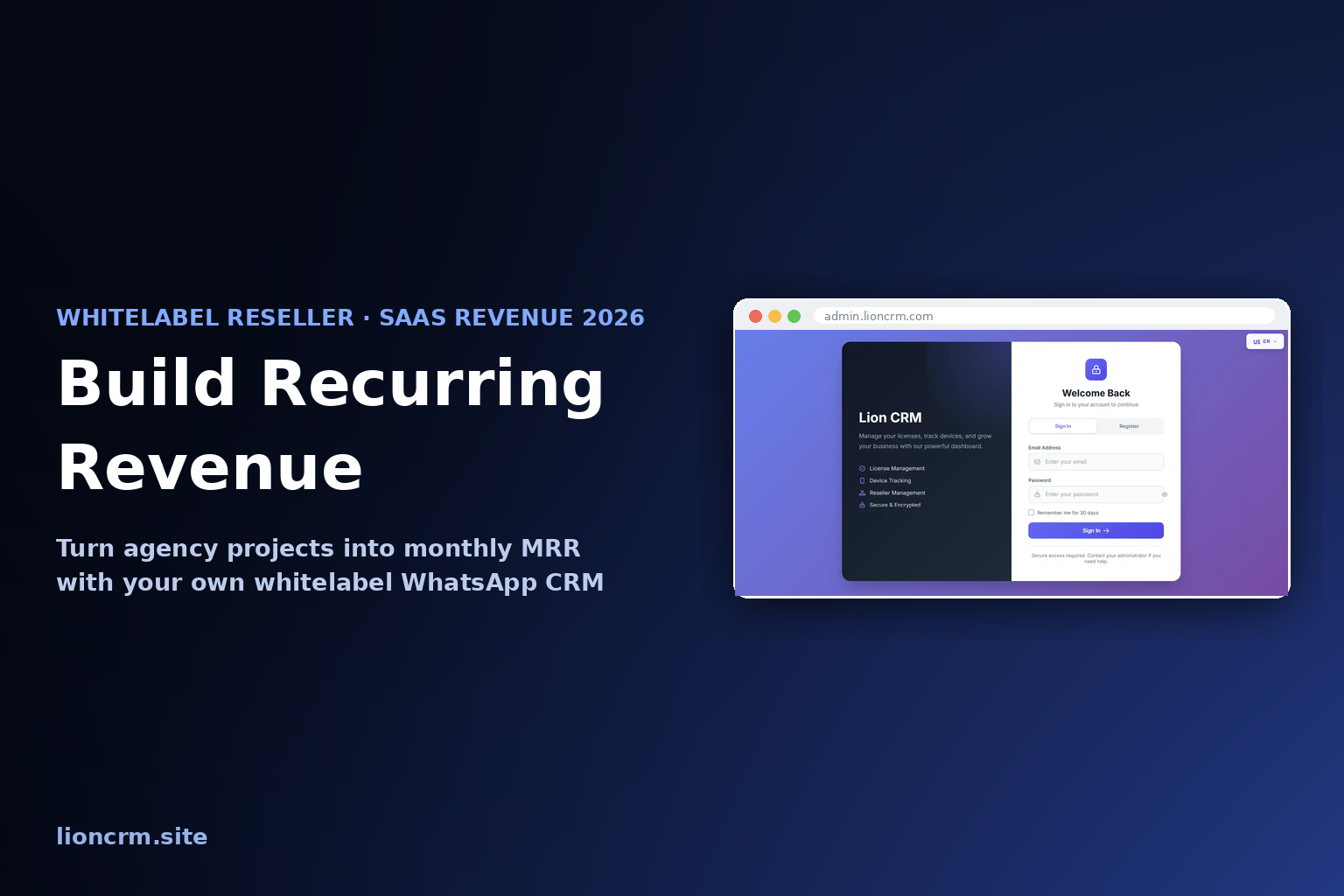
Apna brand, recurring revenue
Sell Lion CRM as your own white-label WhatsApp CRM. Your brand, your pricing, monthly recurring income from every client.
Become a Reseller on WhatsApp →View Reseller PricingSee the Admin Panel
An agency owner in Pune told me something last quarter that I haven’t stopped thinking about. His shop billed ₹14 lakh in a great month and ₹3 lakh in a slow one, and he never knew which kind of month was coming. Every January the counter reset to zero. He’d built a fifteen-person team on income he couldn’t predict past thirty days. I don’t have a business, he said, I have a really stressful freelance job with extra salaries to pay. That sentence is the whole reason this guide exists, because there’s a way out of it, and it doesn’t mean building software for a year.
I’m Rakshit Soni, co-founder of Lion CRM, a WhatsApp CRM Chrome extension from LotsOfCode Private Limited that agencies rebrand and resell as their own subscription product. The fastest route from lumpy project income to steady monthly revenue isn’t a new service line or a retainer you have to keep justifying — it’s owning a product your clients pay for every month whether you do new work or not. A whitelabel WhatsApp CRM is one of the cleanest versions of that move. This guide shows you exactly how the recurring revenue is built, the seat-by-seat math in rupees and dollars, and the moves that grow it. (If you’d rather watch than read, the LotsOfCode YouTube channel covers a lot of this in short videos.)
By the end you’ll see why whitelabel WhatsApp CRM recurring revenue compounds where project work resets, what your own MRR could look like at 10, 50 and 100 seats, and the five levers that actually move it. Let me start with the trap, because you have to feel it before the fix lands.
Why project revenue keeps agencies on a treadmill
Project revenue feels healthy right up until you notice it never accumulates. That’s the trap, and almost every agency owner is in it.
Here’s the mechanic. You sell a website for ₹80,000, deliver it, get paid, and then your revenue for that client is over. To bill ₹80,000 next month you have to find another client and sell another project from scratch. Your income is a series of standing starts, and the team you hired to deliver last month’s work still needs paying this month whether you sold anything or not. The Pune owner wasn’t bad at his craft — his work was excellent. He was just running a machine that throws away its progress every thirty days. Effort in January earned nothing in February.
Retainers help a little, but they’re not the same thing as recurring revenue, and the difference matters more than people think. A retainer is recurring work: the client keeps paying because you keep doing things — posting, designing, reporting. The moment you stop delivering, they stop paying, and renegotiation season comes around every few months. So a retainer is really a subscription to your time, which means it’s capped by how many hours your team has. You can’t scale time without hiring, and hiring eats the margin you just won. That’s a treadmill with a slightly nicer view.
Real recurring revenue is different in one specific way: the client pays for access to a product, not for your hours this month. That decoupling — revenue from labour — is the thing that turns a stressful freelance job into an actual business. And it’s exactly what owning a whitelabel product gives you.
What recurring revenue actually changes for you
When revenue stops resetting and starts stacking, three things change at once, and together they change the kind of company you’re running.
The first is predictability. With ₹2 lakh of monthly recurring revenue, you start February already knowing roughly what February earns, before you’ve sold a thing. That single fact rewrites how you plan — you can hire against a known floor, commit to office rent without flinching, and stop pricing every quote as if your survival depends on it. The Pune owner’s whole stress was variance, not amount. Recurring revenue attacks variance directly.
The second is compounding. This is the part project people underestimate. If you add ₹20,000 of new MRR each month and lose almost none of it, your revenue doesn’t grow in a line — it climbs a staircase that never steps down. Month one you’re at ₹20,000. Month six you’re at ₹1,20,000, not because month six was a heroic sales month but because the first five months are still paying you. Project revenue can’t do this; every month you start from the floor. A subscription business starts from last month’s ceiling.
The third — and this is the one nobody mentions until they sell — is that recurring revenue is worth a multiple. An agency that bills ₹50 lakh a year in projects sells, if it sells at all, for a slice of one year’s profit. A SaaS doing ₹50 lakh of annual recurring revenue is routinely valued at a multiple of that ARR, because the buyer is purchasing a predictable future, not a past. According to widely cited SaaS benchmarks compiled by SaaS Capital, private software companies trade on revenue multiples precisely because that revenue recurs. Same effort, wildly different exit. My honest opinion: most agency owners are sitting on the asset and selling the labour, and they don’t realise a whitelabel product flips that.
How a whitelabel WhatsApp CRM creates recurring revenue
So where does the recurring revenue physically come from? Let me walk the actual flow, because once you see it, the model is obvious.
A whitelabel WhatsApp CRM lets you take a finished product — in Lion CRM’s case, a Chrome extension that turns WhatsApp Web into a sales and support CRM — put your own brand, logo and colours on it, and sell it to your clients as if you built it. You’re not reselling a license like an affiliate; you own the customer relationship, set your own price, and bill them directly every month. Your cost is a small, flat per-seat fee to the vendor underneath you. Your revenue is whatever you charge on top. The spread, every month, is yours. That spread is the recurring revenue.
The reason this works so well for agencies is that you already have the hardest part: customers who trust you. Your existing clients — the ones you built websites and ran ads for — almost all use WhatsApp to talk to their own buyers, and almost none of them have a real system for it. They’re juggling chats, losing leads in unread threads, forgetting follow-ups. You hand them a branded tool that fixes exactly that, charge a monthly fee, and you’ve converted a client you already had into recurring income without finding anyone new. The agency reseller guide goes deeper on which client types convert fastest.
One architecture point matters here, because it’s a genuine selling edge. Lion CRM is not on the WhatsApp Business API and has no Meta partnership — it’s a Chrome extension that layers on top of your client’s own WhatsApp Web session, with all their contact data stored locally on their device, not on a third-party server. That means there’s no per-message meter eating your margin and no infrastructure for you to run. You’re not hosting servers or managing API rate limits; you’re selling a branded extension and collecting a subscription. For a deeper look at how that compares to API-based reselling, the Cloud API vs on-prem reseller decision tree lays out both models side by side.
The whitelabel WhatsApp CRM recurring-revenue math
Numbers make this real, so let me build your MRR from the first seat up. The example uses the Growth tier — $200 (about ₹16,600) one-time, then $2.00 (about ₹166) per active user per month — and a reseller price of ₹2,500 (about $30) per seat per month. Recurring revenue is counted per active seat per month.
| Active seats | Monthly billing (revenue) | Vendor cost | Your recurring margin (MRR) |
|---|---|---|---|
| 10 | ₹25,000 (~$300) | ₹1,660 (~$20) | ₹23,340 |
| 30 | ₹75,000 (~$900) | ₹4,980 (~$60) | ₹70,020 |
| 50 | ₹1,25,000 (~$1,500) | ₹8,300 (~$100) | ₹1,16,700 |
| 100 | ₹2,50,000 (~$3,000) | ₹16,600 (~$200) | ₹2,33,400 |
The shape is the whole point. Each seat adds a fixed, repeating chunk of margin, and because the cost is flat, your margin percentage holds at roughly 93% no matter how many seats you sell. Ten seats — maybe four small clients — is ₹23,000 a month that arrives whether or not you do any new work. Fifty seats is ₹1,16,700 of monthly recurring revenue, which for many agency owners is a larger and far steadier number than their project line. A hundred seats clears ₹2,33,400 a month before your own costs, every month, on autopilot relative to project work.
Now compare that to the project world. To earn ₹1,16,700 from projects you’d sell, scope, deliver and chase payment on roughly ₹1.2 lakh of new work every single month, forever. The 50-seat reseller earns the same number by doing nothing new — the seats renew themselves. That’s not a small efficiency gain; it’s a different category of business. One honest caveat lives in that 30-seat row: there’s a 30-active-user minimum after a three-month grace period, so once grace ends you pay for at least 30 seats even if you’ve sold fewer. That makes the first few months a climb, not a flat start. For the full gross-versus-net breakdown of what actually lands in your account, the reseller profit-margins guide runs every line.
Try Lion CRM free for 7 days
Before you model a rupee of recurring revenue, run the product yourself for a week. It’s the fastest way to understand what your future subscribers are paying for, and it costs nothing.
Steps:
- Click the install link → Get Lion CRM on the Chrome Web Store.
- Click Add to Chrome — the extension installs in seconds.
- Open WhatsApp Web in your browser — Lion CRM activates automatically.
- Your 7-day trial starts the moment you log in. No credit card needed.
- Build a sample client pipeline on the WhatsApp kanban board, save a few templates, schedule a follow-up — that’s the exact demo you’ll show prospects when you sell your branded version.
Living in the product for a week also makes your sales calls honest, because you’ll be recommending a tool you actually use, not a brochure you’re reading.
Why WhatsApp makes a sticky recurring product
Not every product earns recurring revenue. Some get cancelled the second money is tight. WhatsApp CRM is unusually sticky, and stickiness is what keeps recurring revenue recurring instead of leaking.
Think about what a client’s data looks like after three months of use. Their entire customer base is tagged inside the tool. Their deal stages, their saved reply templates, their follow-up reminders, their team’s shared notes — all of it lives in the CRM now. Cancelling doesn’t just stop a subscription; it throws away the system their sales team runs on every day. That switching cost is what protects your revenue. A logo redesign can be cancelled the moment cash gets tight. The tool the whole team uses to not lose deals cannot, because cancelling it costs the client more than it saves.
WhatsApp specifically deepens this in a way other channels don’t. In India and across LATAM, WhatsApp is where business actually happens — it’s the inbox, the storefront and the support desk in one. A client who runs their leads through WhatsApp isn’t using a nice-to-have; they’re using the artery. According to Meta’s own business messaging data, billions of messages flow between people and businesses on WhatsApp every week, and that habit isn’t reversing. When your recurring product sits on the channel your client already can’t live without, churn stays low almost by default. Lion CRM leans into that stickiness with features like the kanban board, custom tabs, message templates and a smart calendar — the more of them a client adopts, the harder it is to leave.
Five moves to build recurring revenue with a whitelabel WhatsApp CRM
Recurring revenue doesn’t build itself evenly — a few moves do most of the work. Here are the five that matter, roughly in order of impact.
First, start with the clients you already have. Your existing roster is the warmest market on earth for this. They trust you, they pay you, and they’re already on WhatsApp. Convert five of them to a branded subscription before you spend a rupee on finding strangers. The guide to finding whitelabel WhatsApp CRM customers covers the outbound side once you’ve mined your own list.
Second, bundle the CRM into what you already sell. Don’t pitch the tool as a separate thing they have to evaluate. Fold it into your existing offer — every website client now gets your branded WhatsApp CRM as part of an ongoing care plan. The subscription rides along with a service they already wanted, so the recurring revenue attaches with almost no extra selling.
Third, price for monthly recurring revenue, not for a one-time win. It’s tempting to charge a big setup fee and a small monthly. Flip it. A modest setup and a healthy monthly is what builds MRR that compounds. A setup-heavy deal pays you once and leaves you back on the treadmill next month. The pricing-strategy guide shows how to anchor the monthly number on the value the client gets.
Fourth, onboard hard so they never leave. Churn is the silent tax on recurring revenue — every seat that cancels is MRR you have to win back just to stand still. The fix is adoption: get the client’s whole team using the kanban board and templates in week one, because a tool that’s fully set up is a tool that’s never cancelled. Good onboarding is the cheapest retention you’ll ever buy.
Fifth, climb the tier ladder as your seats grow. Lion CRM’s per-seat cost drops from $2.50 on Starter to $1.00 on Enterprise. Once you’re past fifty seats, moving to Enterprise widens every seat’s recurring margin without raising a single client’s price. That’s pure MRR margin you earn just by committing earlier. You can see the live tiers on the Lion CRM whitelabel pricing section.
Pricing your recurring plans: monthly vs annual
How you structure the subscription changes how stable your recurring revenue is, so this decision deserves real thought rather than a default.
Monthly billing lowers the barrier to the first yes. A client signs up for ₹2,500 a month without much agonising because the commitment feels small and reversible. The downside is that small reversible commitments are, well, reversible — a monthly plan can be cancelled every thirty days, so your MRR is always one bad month away from a dip. Annual billing flips both: it’s a harder first sell because the client commits to ₹25,000–₹30,000 up front, but once they do, you’ve locked that revenue for a full year and your churn for those seats drops to near zero. Most strong reseller businesses offer both and nudge toward annual with a discount — say two months free for paying yearly — because an annual seat is worth far more than twelve monthly chances to cancel.
There’s a cash-flow angle too that new resellers miss. Annual plans pay you the whole year on day one, which funds your growth without a loan. If you’re trying to scale seats quickly, a base of annual subscribers gives you the cash to do it. My practical recommendation: launch on monthly to get clients in the door fast, then, around renewal, offer your happiest clients an annual upgrade with a discount. You convert your stickiest revenue into your most predictable revenue exactly when trust is highest. For the deeper mechanics of what each seat costs you against what you charge, the pricing-for-resellers guide has the full cost-and-charge tables.
Start your whitelabel WhatsApp CRM SaaS
Ready to turn this into real monthly revenue under your own brand? Here’s the path from zero to your first recurring subscriber.
Steps:
- Go to the admin panel → admin.lioncrm.com.
- Register your account, then log in.
- Choose a plan — Starter ($150 + $2.50/user/mo), Growth ($200 + $2.00/user/mo, most popular), or Enterprise ($250 + $1.00/user/mo) — and complete payment.
- Open the Branding section → add your brand name, logo, colours, support number, and website URL → click Save.
- Click Download Extension to get your white-label branded build.
- In the Licenses section, generate paid licenses for clients and 7-day free-trial licenses for prospects.
- The Overview section gives you one month of free license for your own use.
- Add balance once in the Wallet section — each new license then draws from it, so there’s no per-license payment friction as you scale subscribers.
- Distribute your branded extension, set your monthly price, and activate licenses. Every active seat is now recurring revenue with your name on it.
To size a plan against your client forecast, WhatsApp my co-founder Kuldeep at +91 74260 38448; international agencies bill through PayPal, so currency is never the blocker. For the macro picture, the whitelabel WhatsApp CRM software founder’s guide is the pillar resource, and the 7-step start guide walks the launch end to end. The full Lion CRM feature set is documented on the product pillar page, and there are setup and feature walkthroughs on the LotsOfCode YouTube channel if you’d rather watch your team get onboarded than read it.
Mistakes that quietly kill recurring revenue
Building MRR is half the job. Not leaking it is the other half, and these are the leaks I watch resellers spring most often.
The first is treating the sale as the finish line. You close a subscriber, celebrate, and move on — and three weeks later they cancel because nobody helped them set it up. In recurring revenue the sale is the start of the relationship, not the end. The second is charging a big setup fee and a tiny monthly, which feels like a fast win but rebuilds the treadmill: you’ve front-loaded the money and left almost no recurring base behind. Keep the monthly healthy even if it means a smaller setup.
The third leak is ignoring churn until it’s a flood. A 5% monthly churn sounds harmless until you do the math — it means you lose more than half your customers in a year and have to resell them just to stand still. Track cancellations weekly and fix the reason, don’t just replace the seat. The fourth is under-pricing out of nerves, quoting low to win the first clients and then being stuck there because raising prices on existing subscribers is painful. Start a notch higher than feels comfortable; on a flat per-seat cost you keep almost all of any increase. The fifth is forgetting the 30-seat minimum in your early planning, so the first quarter’s vendor floor catches you off guard. Model it from day one and the early months hold no surprises. Plug these five and your recurring revenue compounds instead of quietly draining.
The honest verdict
So what’s the real takeaway on building whitelabel WhatsApp CRM recurring revenue in 2026?
The opportunity is genuine, and it’s specifically good for agencies, because you already own the asset that’s hardest to get — trusting clients who live on WhatsApp. A whitelabel WhatsApp CRM converts that trust into a product they pay for every month, decoupling your revenue from your hours for the first time. The margin is high and flat, the math compounds instead of resetting, and the product is sticky enough that the revenue stays once it arrives. That combination is rare, and most agency owners walk past it because it looks like more work when it’s actually the opposite.
The honest caveats: the 30-seat minimum makes the first quarter a climb, churn will quietly tax you if you ignore onboarding, and recurring revenue rewards patience — month six is where the staircase becomes obvious, not month one. None of those are dealbreakers, but pretending they don’t exist is how resellers get discouraged early and quit right before it compounds.
My recommendation, the same one I gave the Pune owner: run the 7-day trial this week so you know the product cold, convert five existing clients to a branded monthly subscription before you chase anyone new, and price for the monthly, not the setup. Do that and ninety days from now you’ll start a month already knowing what it earns — which, if you’ve ever run on project income, is the most underrated feeling in business. Own the product, keep the seats, and let the revenue stack.
Frequently asked questions
How does a whitelabel WhatsApp CRM create recurring revenue?
You rebrand a finished product — in Lion CRM’s case a Chrome extension — as your own, sell it to clients on a monthly subscription, and pay only a small flat per-seat fee to the vendor underneath you. The spread between what you charge and that cost repeats every month for every active seat, which is your recurring revenue. You own the customer and set your own price.
How much recurring revenue can an agency make reselling a WhatsApp CRM?
On the Growth tier (about ₹166 per seat cost) at a ₹2,500 per-seat price, 10 seats produce roughly ₹23,000 of monthly recurring margin, 50 seats about ₹1,16,700, and 100 seats about ₹2,33,400. Because the cost is flat, margin holds near 93% as you scale, and the rupee amount grows linearly with every seat you add.
Is recurring revenue different from a retainer?
Yes. A retainer is recurring work — the client pays because you keep delivering hours, so it stops the moment you stop. Recurring revenue from a product means the client pays for ongoing access whether or not you do new work, which decouples your income from your team’s time and lets it compound.
Why is a WhatsApp CRM a sticky recurring product?
After a few months of use, the client’s contacts, deal stages, templates and follow-ups all live inside the tool, so cancelling means throwing away the system their sales team runs on daily. That switching cost keeps churn low. Because WhatsApp is the main business channel in India and LATAM, the tool sits on infrastructure clients already can’t live without.
Should I bill my whitelabel WhatsApp CRM monthly or annually?
Offer both. Monthly billing lowers the barrier to the first yes but can be cancelled every thirty days; annual billing is a harder sell but locks revenue for a year, slashes churn, and pays you the full year up front. A common approach is to launch on monthly, then offer happy clients an annual upgrade with a discount around renewal.
Do I need technical skills or servers to resell a WhatsApp CRM?
No. Lion CRM is a Chrome extension layered on the client’s own WhatsApp Web session, with contact data stored locally on their device — there’s no API to manage, no server to host, and no per-message meter. You handle branding, pricing and client relationships through the admin panel; LotsOfCode runs the application underneath.
How long until the recurring revenue is meaningful?
The compounding is slow at first and obvious later. With a 30-seat minimum, the first quarter is a climb. But if you add even a handful of seats a month and onboard well so almost none churn, the staircase becomes clear around month six, when earlier months are still paying you on top of new ones.
Related guides
If this recurring-revenue breakdown was useful, these companion pieces go deeper into the parts that matter most:
- Whitelabel WhatsApp CRM Profit Margins: A Reseller’s 2026 Math — the gross-vs-net margin detail behind these MRR numbers.
- WhatsApp CRM Pricing for Resellers (2026): What It Costs, What to Charge — the cost-and-charge tables that set your spread.
- How to Price a Whitelabel WhatsApp CRM: Cost-Plus vs Value-Based — the pricing framework for monthly recurring plans.
- How to Start a Whitelabel WhatsApp CRM Business in 2026 (7 Steps) — the end-to-end launch guide.
- Whitelabel WhatsApp CRM for Agencies: A Reseller’s Playbook — converting your existing agency clients into subscribers.
- Whitelabel WhatsApp CRM Software: Founder’s 2026 Guide — the pillar guide on the whole category.
Related guides
- WhatsApp CRM Resources & Guides — every Lion CRM comparison, feature guide and reseller playbook, grouped in one index.
Apna brand, recurring revenue
Sell Lion CRM as your own white-label WhatsApp CRM. Your brand, your pricing, monthly recurring income from every client.
Become a Reseller on WhatsApp →View Reseller PricingSee the Admin Panel