

Almost every guide about reselling software assumes the same thing: that the product is a web app your client logs into. A white label chrome extension is a different animal, and for a lot of resellers it is a much easier one to sell.
We license one ourselves, so we have watched partners sell both kinds side by side. This piece is about what actually changes when the product lives in the browser instead of on a login page — what gets easier, what gets harder, and how to judge whether a programme is worth your money.
What a white label Chrome extension actually is
An extension is a small piece of software that sits inside the browser and adds features to a website the user is already on. It does not replace the site. It layers on top of it.
White labelling one means you license the extension from whoever built it, put your own name, logo and colours on it, and sell it to your customers as your product. Your customer installs it from a link or a file, enters a licence key you generated, and starts using it. They never learn who built it.
The obvious examples are tools that add features to WhatsApp Web, LinkedIn, Gmail or a marketplace dashboard — places where people already spend their working day.
Why it sells more easily than a normal SaaS product
There is no new habit to build
This is the whole thing, really. The reason most small businesses stop paying for software is not price, it is that nobody opens it. A CRM sitting behind a separate login is a place your client has to remember to go. An extension is already on the screen they are staring at.
For you as a reseller, that difference shows up in your churn. Software people see every day does not get cancelled quietly at the end of the quarter.
Setup takes minutes, not weeks
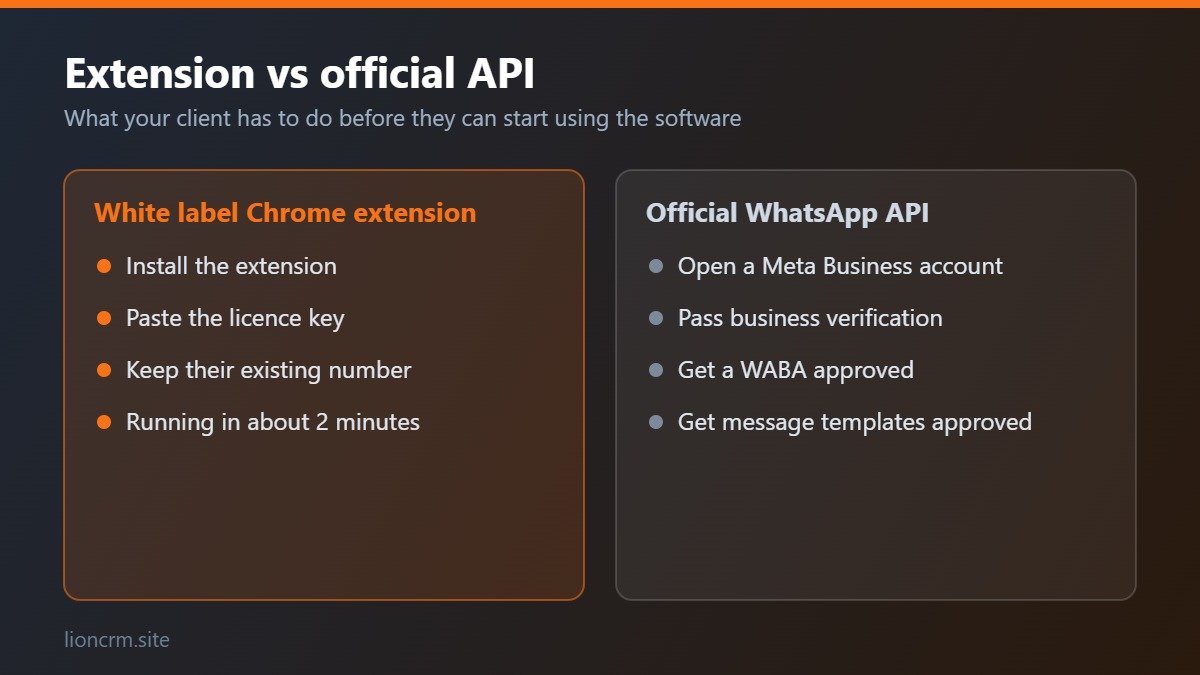
No server to provision. No subdomain. No DNS record. No data migration. The client installs the extension, pastes a licence key, and it works. That matters enormously if you are selling to shopkeepers, clinics and local agencies rather than to IT departments.
Nothing to approve
Products built on official platform APIs — the WhatsApp Business API is the usual case — need the end client to open a Meta Business account, pass business verification and get a WhatsApp Business Account approved. Meta documents the Cloud API onboarding process in full, and it is genuinely involved.
An extension working inside the web client needs none of that. The client keeps the number they already use. You can onboard someone the same afternoon.
Support is lighter
When there is no server in the chain, most of the things that break are not yours. No uptime incidents, no database backups, no migrations. Your support load is mostly “how do I install this” and “where do I put the key”.
The honest disadvantages
Any reseller guide that lists only upsides is selling you something. The real trade-offs:
You are dependent on the host site. If the site the extension sits on changes its layout, the extension breaks until the vendor ships a fix. You cannot fix it yourself. That makes the vendor’s update record the single most important thing you check before signing up — more important than the price.
Chrome Web Store rules apply. Extensions get reviewed, and policies change. A serious vendor will handle this and keep the listing compliant, but it is a dependency you inherit.
It is desktop-first. Extensions do not run on a phone browser. If your client’s team works entirely on mobile, this is the wrong product and you should say so rather than sell it to them.
Volume automation has limits. Anything running in a real browser session on a real account has to behave like a person. If a client wants to send fifty thousand messages an hour, an extension is not the answer and a reseller who pretends otherwise ends up with refunds.
What a white label Chrome extension programme should include
If a vendor cannot give you all of these, the offer is not really white label:
- Your branding throughout — name, logo, colour and support number inside the extension and the panel, with the vendor’s brand nowhere in sight
- Your own admin panel to create, extend and revoke licence keys without asking anyone
- Sub-reseller accounts so you can build a layer under yourself and take a cut of their sales
- A wallet and clear per-number billing so you always know your actual cost this month
- Licence expiry control — a key must stop working when your client stops paying, or you have no leverage
- A written update commitment, because of the dependency described above
- A trial you can put in front of a client before you commit money
What these programmes cost
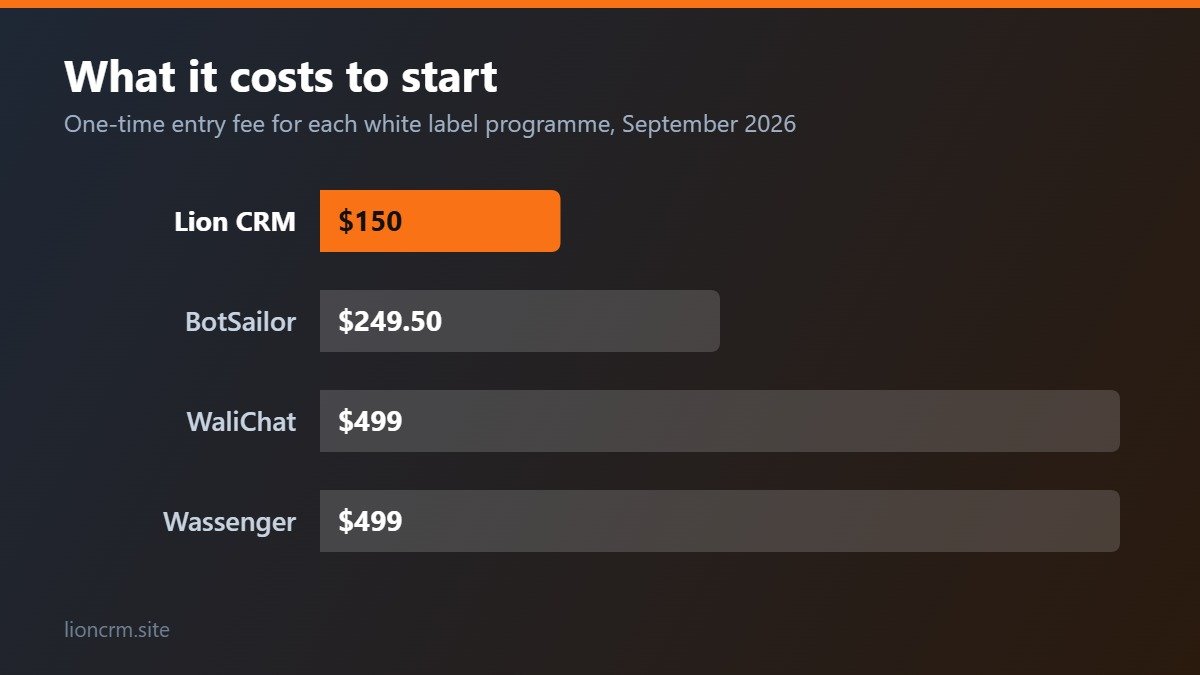
Published figures for the main white-label WhatsApp extension and platform programmes, checked in September 2026:
- Lion CRM — $150 one-time, then $3.25 per user per month
- BotSailor — $249.50 one-time, then $2.25 per active member, minimum 20 billable users
- WaliChat — $499 one-time, nothing per user afterwards
- Wassenger — $499 one-time, nothing per user afterwards
Read those two models against your own situation rather than picking the smallest number. A flat one-time fee with no per-number cost is cheaper over two years if you already have a few hundred clients lined up. A low entry with a per-number cost is cheaper if you are starting from zero and would rather not gamble half a lakh before your first sale.
Working out your margin
The arithmetic is simple enough to do on a phone. You pay a per-number cost, you charge whatever you like, the gap is yours every month.
Say you charge ten clients $10 a month each — around ₹1,000, a price no small business argues about. That is $100 coming in. On a $3.25 per-number cost, $25 goes out. You keep $75 a month, and it repeats.
Fifty clients is $375 a month. Two hundred is $1,500 a month. None of that requires you to hire anyone or build anything.
The number worth watching is not the first sale, it is month three. A client still using the tool in month three usually stays for a year.
Who should sell one
This works if you already talk to small businesses. Agencies with an existing client list, IT consultants, computer and billing-software dealers, WhatsApp marketing sellers, and anyone who has spent years building a local network.
It does not work if you have no route to customers yet. No white label programme fixes distribution, and a vendor who tells you otherwise is taking your setup fee and hoping.
Questions to ask before you pay
We would rather you asked these of us than found out later:
- How often has the extension broken in the last year, and how quickly was it fixed?
- Can I set my own price with no ceiling?
- Does my client ever see your brand — in the extension, in emails, anywhere?
- What is the minimum I must maintain, and what happens if I miss it?
- Can I add sub-resellers, and do you charge extra for that?
- If I stop, do my clients’ licences keep working until they expire?
- Is there a trial I can demo to a client before I pay?
Any vendor who gets vague on question one is the one to walk away from.
Our own programme
Lion CRM is a white label Chrome extension that turns WhatsApp Web into a full CRM — lead board, bulk sending, quick replies, custom tabs and follow-up reminders — on the number the client already uses.
Entry is $150 one-time plus $3.25 per user per month. You get your own branded admin panel, sub-reseller accounts, wallet and expiry control, and an official whitelabel partner certificate. The only ongoing requirement is ten active licences a month, with a three-month grace period while you find your first clients, and there is a seven-day free trial so you can demo to someone before committing. More than fifty resellers across eight countries are selling it under their own brand right now.
Full terms and the margin breakdown are on the white label WhatsApp CRM reseller page, and the pricing page has the INR table for India.
If you are still weighing up options, our guide to starting your own WhatsApp marketing software business covers the build-versus-affiliate-versus-white-label decision, and the best white-label WhatsApp CRM to resell compares the alternatives, including the ones we lose to.