

Apna brand, recurring revenue
Sell Lion CRM as your own white-label WhatsApp CRM. Your brand, your pricing, monthly recurring income from every client.
Become a Reseller on WhatsApp →View Reseller PricingSee the Admin Panel
A reseller in Indore emailed me a spreadsheet last month with a single red cell in it. He’d signed three clients onto a WhatsApp Business API plan he was reselling, marked up the software nicely, and felt clever about it — until Meta’s per-message charges landed and ate most of the spread he thought he’d locked in. I priced the software, he wrote, I forgot I was also reselling a meter. That one line is why this guide exists, because most people who set out to resell the WhatsApp Business API price the part they can see and get surprised by the part they can’t.
I’m Rakshit Soni, co-founder of Lion CRM, a WhatsApp CRM Chrome extension from LotsOfCode Private Limited that agencies and SaaS founders rebrand and resell as their own subscription product. I want to be straight with you up front: Lion CRM is not on the WhatsApp Business API, so this is not a pitch to become our API partner — there’s no such thing. This is the guide I wish that Indore reseller had read first. It walks through how reselling the official WhatsApp Business API actually works in 2026, what the margin really looks like once Meta’s meter is running, and the second reseller model that skips the API entirely. (If you’d rather watch than read, the LotsOfCode YouTube channel covers a lot of this in short videos.)
By the end you’ll understand the three official reseller paths, why the per-message pricing change matters to your margin, and how an extension-based whitelabel route compares on cost, approval friction and speed to first revenue. Let me start with what reselling the API even means, because the word gets used loosely.
What reselling the WhatsApp Business API actually means
When people say they want to resell the WhatsApp Business API, they usually mean one of two different things, and confusing them is the first expensive mistake.
The WhatsApp Business API — Meta now calls it the WhatsApp Business Platform — is not an app. It’s a programmable channel that lets software send and receive WhatsApp messages at scale: bulk template campaigns, automated order updates, chatbot replies, support routing. There’s no inbox you log into. A developer or a platform plugs into it and builds the actual product on top. So when you resell it, you are never selling raw API access to a small business owner — they’d have nothing to click. You’re selling a software layer that sits on the API, plus the metered messaging underneath.
That distinction sets the whole economics. As a reseller you sit between Meta and the client, and your bill has two parts. The first is the software — a dashboard, an inbox, automation, a CRM view — which is yours to price however you like. The second is the messaging, which Meta meters and charges for per message, and which you mostly pass through with a markup. The trap the Indore reseller fell into is pricing the first part beautifully and treating the second as an afterthought, when in high-volume accounts the messaging is the larger and more volatile number. Real WhatsApp Business API reseller economics live in that second line, not the first.
The three ways to resell the WhatsApp Business API
There isn’t one reseller path; there are three, and they differ wildly in cost, control and how long they take to set up. Pick the wrong one and you either over-invest or get stuck depending on someone above you.
Path one: resell on top of a Business Solution Provider. The fastest route is to partner with an existing BSP — a company already approved by Meta that gives you a white-label or sub-account dashboard. You bring the clients, they run the infrastructure, and you mark up both their platform fee and the messaging. You launch in days because you build nothing. The cost is dependence: your margin, your feature set and your branding limits are all set by the BSP above you, and if they raise prices or change terms, you absorb it.
Path two: build on the Cloud API yourself. Meta’s Cloud API is free to access and hosted by Meta, so a technical team can connect directly, build their own dashboard, and resell that as a product. You keep full control and a fatter slice of the software margin. The cost is real engineering — you’re now running a software company, handling phone-number registration, template approvals, webhook reliability and support, on top of finding clients. This is a genuine SaaS build, not a side hustle.
Path three: become an official Tech Provider or Solution Partner. The most formal route is applying to Meta’s partner programs so you can onboard clients under your own approved status. This gives you the most credibility and the broadest feature access, but it’s also the heaviest — Meta vets you, and the bar is built for established platforms, not someone signing their first three clients. The Cloud API vs on-prem reseller decision tree breaks down how the hosting choice underneath these paths changes your obligations.
Notice the pattern: every API path either makes you dependent on a BSP or turns you into a software company overnight. Hold that thought, because the second model later in this guide removes both of those costs.
How WhatsApp Business API pricing works in 2026
You cannot price a reseller plan you don’t understand, so here’s the messaging meter you’ll be marking up, current as of 2026.
Meta charges by message category, and there are four: marketing, utility, authentication and service. They are not priced the same, and the gap between them is the single most important fact for a reseller. Marketing messages — promotions, offers, re-engagement blasts — are the most expensive category by a wide margin. Utility messages — order confirmations, shipping updates, appointment reminders — are much cheaper. Authentication messages — one-time passwords and login codes — are also low-cost. Service messages, the replies a business sends inside a customer’s 24-hour conversation window, are free.
Two changes reshaped this recently, and a reseller has to know both. First, on 1 July 2025 Meta moved from conversation-based pricing to per-message pricing for template messages — you’re now charged each time a template message is delivered, rather than per 24-hour conversation. Second, from April 2025 utility template messages sent inside an open 24-hour service window became free, and Meta added volume-based pricing tiers for utility and authentication, with discounts that climb for high-volume senders. According to Meta’s own pricing documentation, rates also vary by the recipient’s country code, so the same template costs a different amount sent to India versus Brazil versus the United States.
For a reseller, the practical lesson is this: your client’s bill depends heavily on what kind of messages they send. A client running daily marketing blasts is an expensive, volatile account where the meter dominates. A client sending mostly utility and service messages costs little, which means your software margin is most of their bill. My honest advice — price the software clearly and pass messaging through transparently, because clients who later discover a fat hidden markup on Meta’s rates churn the moment a competitor shows them the real numbers.
What it takes to become an official reseller
Before you commit to the API route, walk in with clear eyes about the setup it actually requires, because the friction is front-loaded.
To resell the WhatsApp Business API under your own name, you generally need a verified Meta Business account, a Facebook Business Manager in good standing, and — for the deeper partner tiers — to pass Meta’s business verification, which asks for legal documents proving your company is real. Each client you onboard needs their own verified business, a dedicated phone number that isn’t already on a personal WhatsApp, and a display-name approval that Meta reviews. Message templates also need pre-approval before they can be sent, and that review can bounce a template for wording you’d never expect.
None of this is impossible, but it’s weeks, not minutes, and it’s per-client friction that repeats every time you sign someone. A non-technical small business — the dukandar, the clinic, the local D2C brand — often can’t complete this alone, so onboarding becomes a service you have to deliver before the client sees a single message go out. If you go the BSP route, your partner smooths a lot of this, which is exactly why beginners start there. If you go direct on the Cloud API, all of it is yours to handle. The guide to starting a whitelabel WhatsApp CRM business contrasts this setup load against the lighter model, step by step.
The hidden costs nobody quotes you
The sticker price of API reselling is never the real price. These are the costs that turn a healthy-looking margin into the Indore reseller’s red cell.
The first is the messaging meter itself, which I keep returning to because it’s the one beginners underweight. In a marketing-heavy account, Meta’s per-message charges can dwarf your software fee, and they scale with the client’s volume — so a client who grows their campaigns grows your cost, not just your revenue. The second is support load. API accounts break in ways extensions don’t: a template gets rejected, a number gets flagged, quality rating drops, a webhook stops firing. Every one of those is a support ticket you own, and support time is margin you don’t bill for.
The third hidden cost is platform dependence if you resell through a BSP — their price increase is your price increase, and you can’t easily move clients off them once numbers are registered. The fourth is engineering and uptime if you build direct: you’re now responsible for a service businesses run their sales on, which means on-call, monitoring and a real infrastructure bill. The fifth, quietly, is churn from pricing confusion — clients who can’t predict their WhatsApp bill month to month get nervous, and nervous clients shop around. Add these up and the API model’s true margin is thinner and bumpier than the spreadsheet suggests. That’s not a reason to avoid it; it’s a reason to know it before you quote a price.
The other reseller model: a whitelabel WhatsApp CRM with no API
Here’s the model most resellers never compare against, and it removes the two costs that hurt most: the meter and the approval gate.
A whitelabel WhatsApp CRM Chrome extension takes a different technical road entirely. Instead of plugging into Meta’s API, it layers on top of your client’s own WhatsApp Web session in their browser. Lion CRM works this way — it turns WhatsApp Web into a sales and support CRM with a kanban board, saved templates, follow-up reminders and tags, with the client’s contact data stored locally on their own device, not on a third-party server. Because there’s no API in the loop, there is no per-message charge, no template approval, no business-verification gate, and no display-name review. Your client installs an extension and starts using it; you didn’t wait weeks for Meta to approve anything.
For a reseller, this changes the economics from variable to fixed. You pay the vendor a small, flat per-seat fee and charge your client a flat monthly subscription — the spread is yours, every month, and it doesn’t move when your client sends more messages. There’s no meter eating your margin and no infrastructure for you to run, because you’re reselling a branded extension, not hosting a messaging platform. You take the product, put your own brand, logo and colours on it through the admin panel, and sell it as your own SaaS. The whitelabel WhatsApp CRM software founder’s guide is the pillar resource on how this whole model is built.
The honest trade-off is real and worth stating plainly: an extension that rides WhatsApp Web is built for one-to-one and small-team selling, support and follow-up — it is not the tool for sending a million automated marketing templates a day. If your client’s core need is high-volume outbound broadcasting, the API is the right channel and you should resell that. If your client’s need is to stop losing leads in a messy WhatsApp inbox and run their sales conversations properly, the extension wins on cost, speed and simplicity. Different jobs, different tools — and most small businesses need the second one.
API reseller vs extension reseller, side by side
Put the two reseller models next to each other and the trade-offs stop being abstract.
| Factor | WhatsApp Business API reseller | Whitelabel extension reseller (Lion CRM) |
|---|---|---|
| Setup time per client | Weeks — verification, number, templates | Minutes — install the branded extension |
| Meta approval needed | Yes (business + display name + templates) | No |
| Per-message cost | Yes, metered by Meta, varies by category | None |
| Your cost structure | Variable — scales with client volume | Flat — small per-seat fee |
| Best for | High-volume marketing, OTPs, automation | One-to-one sales, support, follow-up, CRM |
| Infrastructure you run | API uptime, webhooks, or a BSP above you | None — runs in the client’s browser |
| Margin predictability | Bumpy — meter and support eat into it | Steady — fixed spread per seat |
| Speed to first revenue | Slow — onboarding gates | Fast — sell from your existing client list |
Read down the table and the pattern is clear. The API model is the right tool when the client genuinely needs to send messages at industrial scale, and you accept variable cost and approval friction as the price of that power. The extension model is the right tool when the client needs to run sales and support conversations well, and you want fixed margins and a same-day launch. Many of the strongest resellers I know actually offer both — extension for the small-business majority, API for the rare high-volume account — but they make most of their recurring revenue on the simpler, stickier extension side.
Try Lion CRM free for 7 days
Before you model a rupee of reseller revenue on either path, run the extension yourself for a week. It’s the fastest way to feel the difference from the API route, and it costs nothing.
Steps:
- Click the install link → Get Lion CRM on the Chrome Web Store.
- Click Add to Chrome — the extension installs in seconds, with no verification and no number registration.
- Open WhatsApp Web in your browser — Lion CRM activates automatically on your existing session.
- Your 7-day trial starts the moment you log in. No credit card needed.
- Build a sample client pipeline on the WhatsApp kanban board, save a few reply templates, and schedule a follow-up — that’s the exact demo you’ll show prospects when you sell your branded version.
The contrast lands the second you do it. There was no Meta approval, no template review, no waiting — and that absence of friction is the whole reseller advantage of this model.
The reseller economics, in rupees and dollars
Numbers make the choice concrete, so here’s what the flat-fee extension model earns a reseller, with no messaging meter in the math.
The example uses Lion CRM’s Growth tier — $200 (about ₹16,600) one-time, then $2.00 (about ₹166) per active user per month — and a reseller price of ₹2,500 (about $30) per seat per month. Because there’s no per-message charge, every seat’s margin is fixed and repeats monthly.
| Active seats | Monthly billing (revenue) | Vendor cost | Your recurring margin |
|---|---|---|---|
| 10 | ₹25,000 (~$300) | ₹1,660 (~$20) | ₹23,340 |
| 30 | ₹75,000 (~$900) | ₹4,980 (~$60) | ₹70,020 |
| 50 | ₹1,25,000 (~$1,500) | ₹8,300 (~$100) | ₹1,16,700 |
| 100 | ₹2,50,000 (~$3,000) | ₹16,600 (~$200) | ₹2,33,400 |
The shape is the point. Each seat adds a fixed, repeating chunk of margin, and because the cost is flat, your margin holds near 93% no matter how many seats you sell. Now compare that to a marketing-heavy API account, where the client’s messaging bill can swing hundreds of percent month to month and your markup on it is the part competitors undercut first. The flat model trades a smaller theoretical ceiling for far steadier, more predictable revenue — which, when you’re building a business, is usually the better trade. One honest caveat: there’s a 30-active-user minimum after a three-month grace period, so the first quarter is a climb, not a flat start. The reseller profit-margins guide runs every gross-versus-net line, and the pricing-for-resellers guide has the full cost-and-charge tables.
Which model should you actually choose
So with both models on the table, which one should you resell? The honest answer depends on one question about your clients, not about you.
Ask what your clients actually need WhatsApp to do. If most of them want to run their sales and support — talk to leads one to one, stop losing chats, follow up on time, organise a pipeline — the extension model is the better business to be in. It launches same-day, carries no messaging meter, and produces the steady recurring margin in that table above. This is the majority of small businesses, which is why it’s where most reseller revenue actually sits. If, instead, your clients are mid-to-large brands that need to broadcast — daily marketing campaigns, OTP flows, automated notifications to tens of thousands of contacts — then the API is the right channel and you should resell it through a BSP to start, accepting the variable cost.
My practical recommendation for someone starting today: begin with the extension model. It gets you to first recurring revenue this week instead of next quarter, it’s far easier to sell to a non-technical owner, and the margins are predictable while you learn the reseller game. Once you’ve built a client base and you start meeting genuine high-volume accounts, add an API offering through a BSP for those specific clients. You’ll have the cash flow and the credibility to do it well by then. The agency reseller playbook covers which client types convert fastest on the extension side, and the guide to finding whitelabel customers covers outbound once your warm list is mined.
Start your whitelabel WhatsApp CRM SaaS
Ready to resell without an API meter or an approval queue? Here’s the path from zero to your first branded subscriber.
Steps:
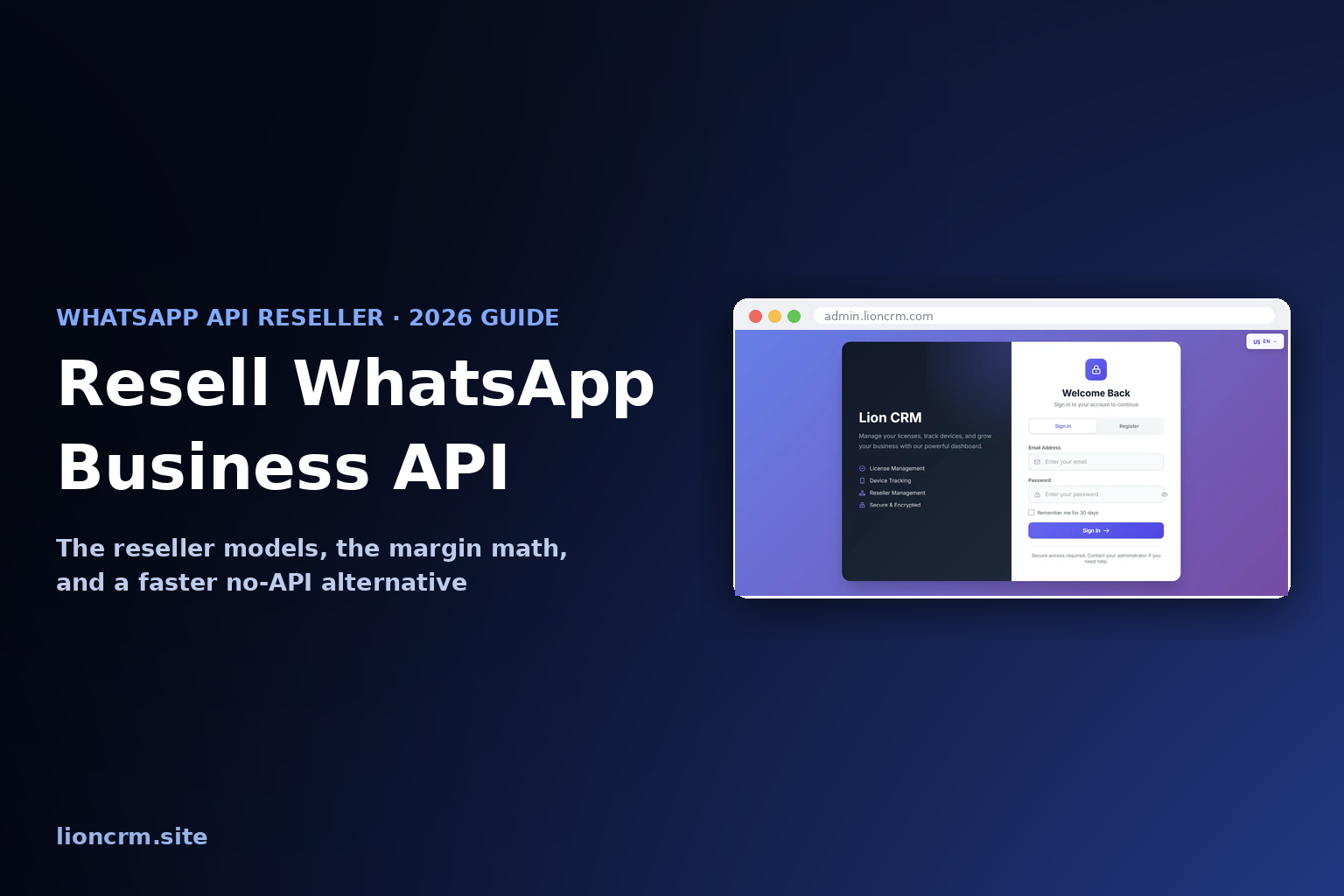
- Go to the admin panel → admin.lioncrm.com.
- Register your account, then log in.
- Choose a plan — Starter ($150 + $2.50/user/mo), Growth ($200 + $2.00/user/mo, most popular), or Enterprise ($250 + $1.00/user/mo) — and complete payment.
- Open the Branding section → add your brand name, logo, colours, support number and website URL → click Save.
- Click Download Extension to get your white-label branded build.
- In the Licenses section, generate paid licenses for clients and 7-day free-trial licenses for prospects.
- The Overview section gives you one month of free license for your own use.
- Add balance once in the Wallet section — each new license then draws from it, so there’s no per-license payment friction as you scale subscribers.
- Distribute your branded extension, set your monthly price, and activate licenses. Every active seat is now recurring revenue under your own brand.
To size a plan against your client forecast, WhatsApp my co-founder Kuldeep at +91 74260 38448; international resellers bill through PayPal, so currency is never the blocker. You can see the live tiers on the Lion CRM whitelabel pricing section, the full feature set on the product pillar page, and walkthroughs on the LotsOfCode YouTube channel if you’d rather watch your team get onboarded than read it.
Mistakes new WhatsApp API resellers make
Most reseller failures aren’t bad luck — they’re the same handful of avoidable mistakes, and I’ve watched all of them happen more than once.
The first is pricing only the software and ignoring the meter. That’s the Indore reseller’s red cell exactly — he quoted a tidy monthly for the dashboard and forgot Meta’s per-message charges would land on top and swing with volume. Always model the messaging cost first, then add your software margin, so a client’s busy month doesn’t quietly turn your profit negative. The second is picking the API path for clients who never needed it. A corner-shop owner who wants to stop losing WhatsApp leads does not need a million-message broadcasting channel — selling him the API saddles you both with verification, templates and a meter for a job a simple extension does better and cheaper.
The third is underestimating onboarding. On the API side, every client needs business verification, a clean number and template approvals, and a non-technical owner usually can’t finish that alone — so you inherit the work, unpaid, before any revenue starts. Budget that time or price it in. The fourth is building direct before you have clients. Plenty of would-be resellers spend three months engineering a Cloud API dashboard, then discover selling is the hard part and they have no customers — start with a BSP or an extension you can sell tomorrow, and only build once demand is proven. The fifth is opaque message markups, hiding a fat margin inside Meta’s rates; the day a competitor shows your client the real per-message price, trust and the account both walk. Price transparently and keep the relationship. Avoid these five and you skip the failure modes that sink most first-year resellers.
The honest verdict
So what’s the real takeaway on becoming a WhatsApp Business API reseller in 2026?
The API reseller business is genuine and large, but it’s heavier and bumpier than the spreadsheet first suggests. You’re reselling a metered channel plus a software layer, which means Meta’s per-message charges, template approvals, business verification and support load all sit between you and your margin. Done through a BSP it’s faster but dependent; done direct it’s controlled but it turns you into a software company. For high-volume marketing and notification accounts, that complexity is worth it, because the API is the only channel that does that job.
But for the majority of small businesses — the ones that just need to run their WhatsApp sales properly — the extension reseller model is the cleaner business. No meter, no approval gate, a same-day launch, and a flat, predictable margin per seat. The Indore reseller’s red cell came from being on the wrong model for his clients, not from being bad at sales. My recommendation, the same one I gave him: start by reselling the extension, get to recurring revenue this week, learn the game on predictable margins, and add an API offering through a BSP only when a real high-volume client appears. Match the model to what your clients actually need, and the margin stops surprising you.
Frequently asked questions
What does it mean to resell the WhatsApp Business API?
It means selling a software product that sits on top of Meta’s WhatsApp Business Platform, plus the metered messaging underneath, to your own clients. You never sell raw API access — clients need a dashboard or inbox to use. Your bill has two parts: the software, which you price freely, and Meta’s per-message messaging, which you mostly pass through with a markup.
How do you become a WhatsApp Business API reseller?
There are three routes: partner with an existing Business Solution Provider and resell their platform under a sub-account, build directly on Meta’s free Cloud API and run your own software, or apply to Meta’s Tech Provider or Solution Partner programs. The BSP route is fastest because you build nothing; the direct and partner routes give more control but require real engineering and Meta verification.
How much does the WhatsApp Business API cost a reseller?
Meta charges per message by category. Marketing messages are the most expensive, utility and authentication messages are much cheaper, and service messages inside a customer’s 24-hour window are free. Since July 2025, pricing is per delivered template message rather than per conversation, and rates vary by the recipient’s country, so a client’s bill depends heavily on what kind of messages they send.
Is reselling the WhatsApp Business API profitable?
It can be, but the margin is bumpier than it looks. The per-message meter scales with your client’s volume, support load is higher, and BSP dependence or infrastructure costs eat in. It’s most profitable on high-volume marketing and notification accounts. For smaller one-to-one sales accounts, a flat-fee extension model usually produces steadier margin.
Can I resell a WhatsApp CRM without the WhatsApp Business API?
Yes. A whitelabel WhatsApp CRM Chrome extension like Lion CRM layers on the client’s own WhatsApp Web session, so there’s no API, no per-message charge and no Meta approval. You rebrand it, set a flat monthly price, and resell it as your own SaaS. It’s built for one-to-one sales, support and follow-up rather than high-volume broadcasting.
Which is better for a beginner: API reselling or extension reselling?
For most beginners, the extension model is the better start. It launches the same day with no approval gate, carries no messaging meter, sells easily to non-technical owners, and produces predictable per-seat margin. The API route is worth adding later, through a BSP, once you meet genuine high-volume clients and have the cash flow to support them.
Do I need technical skills to resell a WhatsApp CRM extension?
No. You handle branding, pricing and client relationships through the admin panel, and clients install a branded extension on their own WhatsApp Web — there’s no API to manage, no server to host, and no per-message meter. LotsOfCode runs the application underneath while you own the customer and the recurring revenue.
Related guides
If this reseller breakdown was useful, these companion pieces go deeper into the parts that matter most:
- WhatsApp Business API: What It Is in 2026 — the buyer-side guide to the same platform — useful for understanding what your clients will be paying for
- WhatsApp Cloud API vs On-Prem: A Reseller’s Decision Tree — how the hosting choice under the API changes your obligations.
- Whitelabel WhatsApp CRM Profit Margins: A Reseller’s 2026 Math — the gross-vs-net margin detail behind the flat-fee model.
- WhatsApp CRM Pricing for Resellers (2026): What It Costs, What to Charge — the cost-and-charge tables that set your spread.
- How to Start a Whitelabel WhatsApp CRM Business in 2026 (7 Steps) — the end-to-end launch guide.
- Whitelabel WhatsApp CRM for Agencies: A Reseller’s Playbook — converting your existing clients into subscribers.
- Whitelabel WhatsApp CRM Software: Founder’s 2026 Guide — the pillar guide on the whole category.
Related guides
- WhatsApp CRM Resources & Guides — every Lion CRM comparison, feature guide and reseller playbook, grouped in one index.
- WhatsApp Business API Pricing 2026 — Meta’s current India rate card, the three cost layers, and what changes on 1 October.
Apna brand, recurring revenue
Sell Lion CRM as your own white-label WhatsApp CRM. Your brand, your pricing, monthly recurring income from every client.
Become a Reseller on WhatsApp →View Reseller PricingSee the Admin Panel